How to Inspire Others
זכרון יעקב | February 13, 2025
Print This Article
View Original PDF

How to Inspire Others

זכרון יעקב | June 27, 2025

RABBI AVRAHAM KOVEL (Aish.com)

How do we stay grounded after achieving spiritual heights? And perhaps the greater challenge: how do we share these transformative experiences in a way that truly inspires others?

These questions, as relevant today as they were thousands of years ago, find their answer in an unexpected moment just after the giving of the Torah.

The Torah tells us that Yisro, Moshe's father-in-law, joined the Jewish nation in the desert after hearing about the miracles G-d performed in Egypt. While this appears at the beginning of this week’s Torah portion, Rashi explains it actually occurred the day after Moshe returned with the second set of tablets. Consider the context: Moshe had just spent three sets of 40 days and nights on Mount Sinai in direct communion with G-d, receiving a divine download of unimaginable proportions. He returned carrying the mission to teach G-d's infinite wisdom to three million Jews. One might expect him to be too overwhelmed for visitors.

Yet instead of brushing him off, Moshe does the exact opposite - he lays out the metaphorical red carpet:

"Moshe went out to meet his father-in-law; he bowed low and kissed him; each asked after the other's welfare, and they went into the tent. Moshe then recounted to his father-in-law everything that Hashem had done to Pharaoh and to the Egyptians for Israel's sake, all the hardships that had befallen them on the way, and how G-d had delivered them." (Exodus 18:7-9)

Moshe's intimate attention to his father-in-law might seem surprising. Shouldn’t he be beyond such mundane interactions?

Nothing could be further from the truth. True spiritual growth doesn't distance us from others—it brings us closer. This wisdom flows from a foundational principle: humanity bears the Divine Image.1 Therefore, the deeper our connection with the Divine, the greater our appreciation must be for His children.

This is why our greatest Torah leaders never retreated to mountaintops. The Rambam exemplified this perfectly: while producing works of eternal wisdom, he served both as leader of the Egyptian Jewish community and as the Sultan's physician, showing how spiritual greatness expresses itself through deeper engagement with both one's own community and the broader world.

The Roadmap of Inspiration

Let's take this conclusion a step further: Given that Moshe just had the most powerful spiritual experience imaginable, his interaction with Yisro must serve as the masterclass in imparting spiritual elevation. When we examine the text closely, we discover that each of Moshe's actions was precisely calculated, forming a seven-step framework for transmitting our highest revelations with genuine connection:

  1. “Moshe went out” - He left his comfort zone and took the initiative
  2. “He bowed low” - He demonstrated respect
  3. “And kissed him” - He gave love and affection
  4. “Each asked after the other’s welfare” - He displayed humanity and empathy
  5. “And they went into the tent” - He provided hospitality and physical nurturing
  6. “Moshe then recounted (וַיְסַפ ֵּ֤ר)...” - Then, and only then, he delivered an inspiring and moving account of the Exodus in order to draw Yisro close to Torah2

One crucial step remains—the seventh step that transforms the previous six into a complete whole, much like Shabbat elevates the six days of the week:

  1. “And Yisro rejoiced over all the kindness that G-d had shown Israel when He delivered them from the Egyptians. And Yisro said ‘Baruch Hashem! (Blessed is G-d!)’” - He steps back and lets Yisro internalize the message on his own.

When we've experienced profound insights or spiritual revelations, our enthusiasm might tempt us to launch straight into sharing these deep truths. But the Torah reveals a crucial principle: the most powerful wisdom can only be conveyed through genuine connection. People don’t care about how much we know until they know how much we care. These seven steps show us exactly how to bridge the gap between having wisdom and making an impact

Making the Extra Effort

A story from recent years brings these seven steps to life: Danny grew up in a religious Jewish family in Brooklyn, but his search for meaning led him far from home – to Montana's Blackfoot Indian Reservation. There, he became a hunter and formed deep bonds with the Native American community. His quest for truth brought him to a renowned Sioux elder who, after two weeks of profound conversation, offered unexpected guidance: 'Seek the truth of your heritage.' Moved by these words, Danny returned to New York, ready to rediscover his Jewish roots.

His search for guidance led him to Rabbi Freifeld, who answered his call on the first ring and, upon hearing of Danny’s interest, invited to his home. When Danny arrived, the Rabbi showed him in, gave him refreshments, and urged him to get comfortable.

“Where do you live, Danny?” he asked gently.

“In Montana.”

“What do you do in Montana?”

Knowing that hunting is primarily against Jewish law, Danny braced for impact, responding, “I hunt.”

The Rabbi's eyes lit up and he leaned forward, his voice filled with wonder. “What do you hunt?”

The Rabbi proceeded to question him enthusiastically about his passion for an hour. At the end of their discussion, the Rabbi invited Danny to come to the Yeshiva the next morning. When Danny arrived, he saw a packed study hall, and the Rabbi sitting in the front holding a baby who was about to receive a circumcision.

Suddenly, Rabbi Freifeld looked up and located Danny at the back of the room. He sent for Danny and gave him a place of honor at his side. Later that day, Danny started in a beginner Talmud class with Rabbi Freifeld as his teacher. Over the next few months, in addition to his studies, Danny spent many hours with Rabbi Freifeld discussing nature, Native American culture, and life in general.

A year later, while meeting with the Rabbi in his office, the Rabbi was called out for an emergency. Danny began perusing the Torah books in the office. A flash of color hidden under the desk drew his attention and curiosity. When he pulled out the book, he stopped and stared in shock. The book, checked out from the library, was a dossier of Native American culture and customs; the information that the loving Rabbi needed to connect with his student to show him just how important he was.

From Sinai to today, this divine wisdom remains unchanged: the path to inspiring others begins not with what we know, but with how deeply we care. As you encounter opportunities to share your wisdom with others, let these seven steps guide your approach. You'll be amazed at how much more receptive people become when you first create genuine connection.
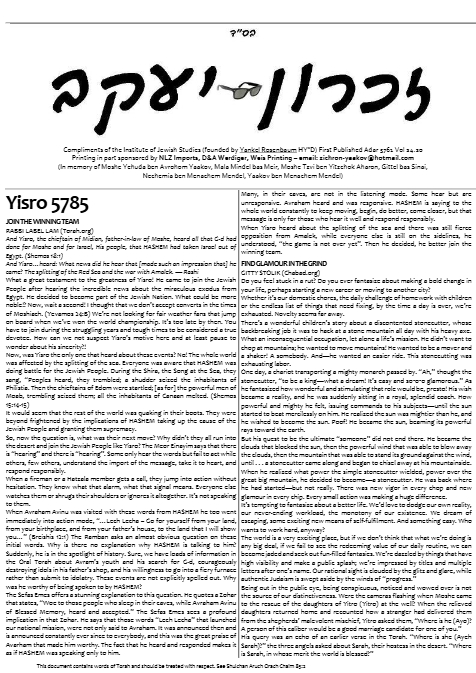

RABBI AVRAHAM KOVEL (Aish.com)

How do we stay grounded after achieving spiritual heights? And perhaps the greater challenge: how do we share these transformative experiences in a way that truly inspires others?

These questions, as relevant today as they were thousands of years ago, find their answer in an unexpected moment just after the giving of the Torah.

The Torah tells us that Yisro, Moshe's father-in-law, joined the Jewish nation in the desert after hearing about the miracles G-d performed in Egypt. While this appears at the beginning of this week’s Torah portion, Rashi explains it actually occurred the day after Moshe returned with the second set of tablets. Consider the context: Moshe had just spent three sets of 40 days and nights on Mount Sinai in direct communion with G-d, receiving a divine download of unimaginable proportions. He returned carrying the mission to teach G-d's infinite wisdom to three million Jews. One might expect him to be too overwhelmed for visitors.

Yet instead of brushing him off, Moshe does the exact opposite - he lays out the metaphorical red carpet:

"Moshe went out to meet his father-in-law; he bowed low and kissed him; each asked after the other's welfare, and they went into the tent. Moshe then recounted to his father-in-law everything that Hashem had done to Pharaoh and to the Egyptians for Israel's sake, all the hardships that had befallen them on the way, and how G-d had delivered them." (Exodus 18:7-9)

Moshe's intimate attention to his father-in-law might seem surprising. Shouldn’t he be beyond such mundane interactions?

Nothing could be further from the truth. True spiritual growth doesn't distance us from others—it brings us closer. This wisdom flows from a foundational principle: humanity bears the Divine Image.1 Therefore, the deeper our connection with the Divine, the greater our appreciation must be for His children.

This is why our greatest Torah leaders never retreated to mountaintops. The Rambam exemplified this perfectly: while producing works of eternal wisdom, he served both as leader of the Egyptian Jewish community and as the Sultan's physician, showing how spiritual greatness expresses itself through deeper engagement with both one's own community and the broader world.

The Roadmap of Inspiration

Let's take this conclusion a step further: Given that Moshe just had the most powerful spiritual experience imaginable, his interaction with Yisro must serve as the masterclass in imparting spiritual elevation. When we examine the text closely, we discover that each of Moshe's actions was precisely calculated, forming a seven-step framework for transmitting our highest revelations with genuine connection:

  1. “Moshe went out” - He left his comfort zone and took the initiative
  2. “He bowed low” - He demonstrated respect
  3. “And kissed him” - He gave love and affection
  4. “Each asked after the other’s welfare” - He displayed humanity and empathy
  5. “And they went into the tent” - He provided hospitality and physical nurturing
  6. “Moshe then recounted (וַיְסַפ ֵּ֤ר)...” - Then, and only then, he delivered an inspiring and moving account of the Exodus in order to draw Yisro close to Torah2

One crucial step remains—the seventh step that transforms the previous six into a complete whole, much like Shabbat elevates the six days of the week:

  1. “And Yisro rejoiced over all the kindness that G-d had shown Israel when He delivered them from the Egyptians. And Yisro said ‘Baruch Hashem! (Blessed is G-d!)’” - He steps back and lets Yisro internalize the message on his own.

When we've experienced profound insights or spiritual revelations, our enthusiasm might tempt us to launch straight into sharing these deep truths. But the Torah reveals a crucial principle: the most powerful wisdom can only be conveyed through genuine connection. People don’t care about how much we know until they know how much we care. These seven steps show us exactly how to bridge the gap between having wisdom and making an impact

Making the Extra Effort

A story from recent years brings these seven steps to life: Danny grew up in a religious Jewish family in Brooklyn, but his search for meaning led him far from home – to Montana's Blackfoot Indian Reservation. There, he became a hunter and formed deep bonds with the Native American community. His quest for truth brought him to a renowned Sioux elder who, after two weeks of profound conversation, offered unexpected guidance: 'Seek the truth of your heritage.' Moved by these words, Danny returned to New York, ready to rediscover his Jewish roots.

His search for guidance led him to Rabbi Freifeld, who answered his call on the first ring and, upon hearing of Danny’s interest, invited to his home. When Danny arrived, the Rabbi showed him in, gave him refreshments, and urged him to get comfortable.

“Where do you live, Danny?” he asked gently.

“In Montana.”

“What do you do in Montana?”

Knowing that hunting is primarily against Jewish law, Danny braced for impact, responding, “I hunt.”

The Rabbi's eyes lit up and he leaned forward, his voice filled with wonder. “What do you hunt?”

The Rabbi proceeded to question him enthusiastically about his passion for an hour. At the end of their discussion, the Rabbi invited Danny to come to the Yeshiva the next morning. When Danny arrived, he saw a packed study hall, and the Rabbi sitting in the front holding a baby who was about to receive a circumcision.

Suddenly, Rabbi Freifeld looked up and located Danny at the back of the room. He sent for Danny and gave him a place of honor at his side. Later that day, Danny started in a beginner Talmud class with Rabbi Freifeld as his teacher. Over the next few months, in addition to his studies, Danny spent many hours with Rabbi Freifeld discussing nature, Native American culture, and life in general.

A year later, while meeting with the Rabbi in his office, the Rabbi was called out for an emergency. Danny began perusing the Torah books in the office. A flash of color hidden under the desk drew his attention and curiosity. When he pulled out the book, he stopped and stared in shock. The book, checked out from the library, was a dossier of Native American culture and customs; the information that the loving Rabbi needed to connect with his student to show him just how important he was.

From Sinai to today, this divine wisdom remains unchanged: the path to inspiring others begins not with what we know, but with how deeply we care. As you encounter opportunities to share your wisdom with others, let these seven steps guide your approach. You'll be amazed at how much more receptive people become when you first create genuine connection.

PDF Preview