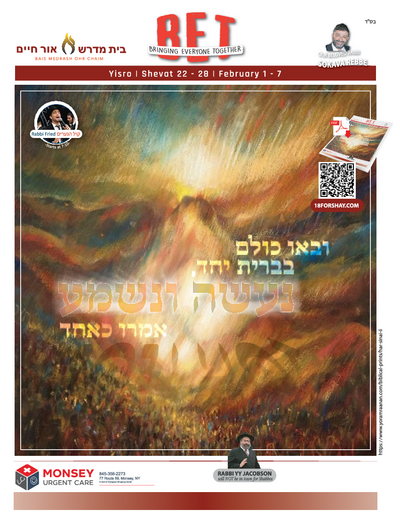
If The Clothing Fits
“ויקח יתרו חתן משה עלה וזבחים לאלקים, ויבא אהרן וכל זקני ישראל 18:12לאכל לחם עם חתן משה לפני האלקים”
“And Yisro, the father-in-law of Moshe, took an olah and a zevachim for Hashem, and Aharon and all of the elders of Klal Yisroel came to eat bread with the father-in-law of Moshe, before Hashem.” Yisro rejoiced for all of the good Hakodosh Boruch Hu bestowed upon Klal Yisroel The end of the posuk tells us that Aharon and the Ziknei Yisroel came to join Yisro “לאכל לחם”, to eat bread with him. What bread is the posuk referring to?
Shabbos 88b – When Moshe Rabbeinu went up to shomayim to receive the Torah, the malachim complained that the Torah should remain in shomayim. Who should get the Torah, Klal Yisroel or the malachim? Moshol - A rich man sent his two sons to a faraway land. One day, a messenger came to the far away land with a precious article of clothing. The clothing had valuable diamonds sewn onto it. There was only one article of clothing. Each brother made his claim in court as to why he believed the clothing was sent for him and not for his brother. The first brother said that he is in the diamond business. He understands and appreciates the value and beauty of the diamonds. Certainly, his father sent it for him and not for his brother who does not appreciate the true value of the diamonds. The second brother came forward to make his claim. He said that it is true he is not familiar with the value of diamonds, however he still wants it. He pointed out that his brother is tall, and he is short. There is a very simple way to ascertain who their father sent it for. Each one should try it on and see who it fits. They both tried it on, and sure enough it fit the short brother.
The malachim claimed that they understand sod while Moshe did not. Moshe responded, “Let’s see who the Torah was ‘tailored’ for.” The mitzvos in the Torah only apply to humans, obviously its purpose is for man and not the malachim. (בן איש חי)
Yisro came to the realization that the Torah is true. He became a ger, and made a firm commitment to perform mitzvos and follow the will of the Ribbono Shel Olam. Aharon and the z’keinim came with “bread”, with Torah, to the Seudah. An integral part of any seudas mitzvah is Torah. Yisro may have thought that while he is eating, he is not necessarily performing Avodas Hashem. Moshe Rabbeinu was at the seudah serving the guests. He learned to do this from Avrohom Avinu. The Midrash tells us that Avrohom served people lots of food. He told them that they would not have to pay for any of the food if they would just thank the Ribbono Shel Olam for the food which He provided. Even the mundane acts of this world can be elevated to be rotzon Hashem. At every seudah, we must recognize and appreciate where the food came from, and thank the Ribbono Shel Olam for it. One who has the opportunity to sit at a seudah with talmidei chachomim, who undoubtedly will be spouting Torah, should make sure to take advantage and enjoy it because it is the true pleasure of this world. We should be zoche to make many simchos, and to have hana’ah from the זיו השכינה.