Seeking Guidance I
The Weekly Farbrengen | February 13, 2025
Print This Article
View Original PDF

Seeking Guidance I

The Weekly Farbrengen | June 27, 2025

During the reign of Yoshiyahu, King of Yehuda, Necho the King of Mitzrayim prepared to pass through Eretz Yisroel on his way northward to wage war against Ashur (Assyria). King Yoshiyahu was aware that HaShem had clearly promised that even a "sword of peace" would not pass through his land, and therefore warned the King of Mitzrayim to keep his troops at a distance. That warning was ignored. Yoshiyahu thereupon confronted them in battle, where he was showered with arrows and died.

Chazal explain that despite the fact that it seemed so clear in the Torah as he understood it, he should have sought the advice of the Navi Yirmiyahu. He would have been taught that his generation was not worthy of this special promise.

(דברי הימים ב' פל"ה כ-כד, תענית כב סע"א)

On one occasion, when King Yannai was celebrating a great victory, an evil man called Elazar ben Po'ira persuaded the king to believe that the hearts of the chachomim were against him. To prove his point, he advised the king to put on the tzitz of the kohen gadol and watch their response.

When Yannai did as he was advised, one elder spoke up: "Your majesty! It is great enough to be king; leave the kehunah for the children of Aharon."

The king, infuriated, expelled all the chachomim from the feast. And Elazar ben Po'ira, seizing the opportunity, incited him to kill them all.

Yannai was hesitant and inquired: "What then will become of the Torah?"

Elazar was quick to reply, "The Torah is written and available to whoever wants to learn it."

Yannai, duly convinced, killed all of the chachomim, leaving the world void of Torah learning – until R. Shimon ben Shetach eventually restored the Torah to its original glory.

Chazal charge Yannai with apikorsus (heresy), for though the Torah shebiksav is written, one must have teachers to guide him to a proper understanding of it, through the oral tradition of the Torah shebe'al peh.

This, according to some, began the development of the karo'im, a group of Yidden who did not follow the chachomim and relied upon their own understanding to explain the Torah.

(קידושין סו ע"א, כוזרי מ"ג סי' ס"ה)

Everyone who says Ashrei knows those words: v'es kol haresha'im yashmid – "and He will destroy all evildoers." Well, there once lived a man who, realizing that he was not particularly righteous, was afraid of cursing himself. He therefore decided to omit the word haresha'im ("evildoers"), so that the verse now read, "and He will destroy all." And in due course, his children all baptized.

(The root of yashmid also denotes apostasy.)

The medieval author of Sefer Chassidim explains that although this man's intentions were good, he was punished for not having consulted the chachomim of his town. They would have explained to him that though Dovid HaMelech himself had a wicked son, Avshalom, he nevertheless did say this posuk, since HaShem will do as He chooses.

(ס' חסידים סי' א'יג)

Following the Elders

Chazal say: One should always heed the counsel of elders. Even if the elders advise one to demolish and the youth advise one to build, one should listen to the elders, for the "demolition" of the elders is ultimately "building," whereas the "building" of the youth will ultimately bring about destruction.

In this context they point to the following story:

After the passing of Shlomo HaMelech, his son Rechavom ascended the kingly throne. A delegation of Yidden soon approached him, asking that he treat them gently and not overburden them with taxes. Rechavom told them, "Return in three days and I will answer you."

He then turned to seek the advice of the elders who had stood before his father. They told him, "If you treat the people gently, they will serve you faithfully throughout all of their days."

Dissatisfied with this approach, the king then consulted some young friends and they told him, "Be firm with the people. Tell them that you will be even more demanding than your father."

At the end of three days the people returned, and the king answered them as his young friends had advised. Infuriated, the people rebelled against him and chose Yerovam as their king.

(מלכים א' יב, לקח טוב שמות ד,כח, מגילה לא ע"ב)

When the Rebbe established Tze'irei Agudas Chabad in order to utilize the energy of the young chassidim in spreading Yiddishkeit, he discreetly requested some of the eltere chassidim to supervise their activities and offer advice.

The Rebbe writes to them in a letter: "If Chazal say that the 'demolition' of elders is ultimately 'building,' how much more so the 'building' of elders. However, your advice should be given in a gentle manner that won't make the young men feel unimportant."

(היכל מנחם ח"א ע' קלו)

Consider

In this day and age, when the Torah shebe'al peh has already been written, does one still need a live teacher to guide him?

Why would the chassidim ask the eltere chassidim to explain to them the Rebbe's words? Hadn't the Rebbe himself spoken directly to them?
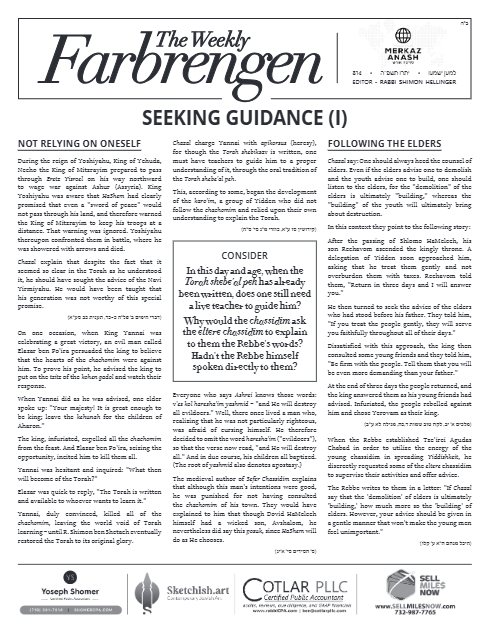

During the reign of Yoshiyahu, King of Yehuda, Necho the King of Mitzrayim prepared to pass through Eretz Yisroel on his way northward to wage war against Ashur (Assyria). King Yoshiyahu was aware that HaShem had clearly promised that even a "sword of peace" would not pass through his land, and therefore warned the King of Mitzrayim to keep his troops at a distance. That warning was ignored. Yoshiyahu thereupon confronted them in battle, where he was showered with arrows and died.

Chazal explain that despite the fact that it seemed so clear in the Torah as he understood it, he should have sought the advice of the Navi Yirmiyahu. He would have been taught that his generation was not worthy of this special promise.

(דברי הימים ב' פל"ה כ-כד, תענית כב סע"א)

On one occasion, when King Yannai was celebrating a great victory, an evil man called Elazar ben Po'ira persuaded the king to believe that the hearts of the chachomim were against him. To prove his point, he advised the king to put on the tzitz of the kohen gadol and watch their response.

When Yannai did as he was advised, one elder spoke up: "Your majesty! It is great enough to be king; leave the kehunah for the children of Aharon."

The king, infuriated, expelled all the chachomim from the feast. And Elazar ben Po'ira, seizing the opportunity, incited him to kill them all.

Yannai was hesitant and inquired: "What then will become of the Torah?"

Elazar was quick to reply, "The Torah is written and available to whoever wants to learn it."

Yannai, duly convinced, killed all of the chachomim, leaving the world void of Torah learning – until R. Shimon ben Shetach eventually restored the Torah to its original glory.

Chazal charge Yannai with apikorsus (heresy), for though the Torah shebiksav is written, one must have teachers to guide him to a proper understanding of it, through the oral tradition of the Torah shebe'al peh.

This, according to some, began the development of the karo'im, a group of Yidden who did not follow the chachomim and relied upon their own understanding to explain the Torah.

(קידושין סו ע"א, כוזרי מ"ג סי' ס"ה)

Everyone who says Ashrei knows those words: v'es kol haresha'im yashmid – "and He will destroy all evildoers." Well, there once lived a man who, realizing that he was not particularly righteous, was afraid of cursing himself. He therefore decided to omit the word haresha'im ("evildoers"), so that the verse now read, "and He will destroy all." And in due course, his children all baptized.

(The root of yashmid also denotes apostasy.)

The medieval author of Sefer Chassidim explains that although this man's intentions were good, he was punished for not having consulted the chachomim of his town. They would have explained to him that though Dovid HaMelech himself had a wicked son, Avshalom, he nevertheless did say this posuk, since HaShem will do as He chooses.

(ס' חסידים סי' א'יג)

Following the Elders

Chazal say: One should always heed the counsel of elders. Even if the elders advise one to demolish and the youth advise one to build, one should listen to the elders, for the "demolition" of the elders is ultimately "building," whereas the "building" of the youth will ultimately bring about destruction.

In this context they point to the following story:

After the passing of Shlomo HaMelech, his son Rechavom ascended the kingly throne. A delegation of Yidden soon approached him, asking that he treat them gently and not overburden them with taxes. Rechavom told them, "Return in three days and I will answer you."

He then turned to seek the advice of the elders who had stood before his father. They told him, "If you treat the people gently, they will serve you faithfully throughout all of their days."

Dissatisfied with this approach, the king then consulted some young friends and they told him, "Be firm with the people. Tell them that you will be even more demanding than your father."

At the end of three days the people returned, and the king answered them as his young friends had advised. Infuriated, the people rebelled against him and chose Yerovam as their king.

(מלכים א' יב, לקח טוב שמות ד,כח, מגילה לא ע"ב)

When the Rebbe established Tze'irei Agudas Chabad in order to utilize the energy of the young chassidim in spreading Yiddishkeit, he discreetly requested some of the eltere chassidim to supervise their activities and offer advice.

The Rebbe writes to them in a letter: "If Chazal say that the 'demolition' of elders is ultimately 'building,' how much more so the 'building' of elders. However, your advice should be given in a gentle manner that won't make the young men feel unimportant."

(היכל מנחם ח"א ע' קלו)

Consider

In this day and age, when the Torah shebe'al peh has already been written, does one still need a live teacher to guide him?

Why would the chassidim ask the eltere chassidim to explain to them the Rebbe's words? Hadn't the Rebbe himself spoken directly to them?

PDF Preview