The Prohibition of Geneivas Daas
Limuday Moshe | January 31, 2024
Print This Article
View Original PDF

The Prohibition of Geneivas Daas

Limuday Moshe | December 10, 2025

The seminal event in this week’s parsha is the giving of the Torah and the Aseres HaDibros [Ten Commandments]. One of the ten commandments is: לא תגנב – “Do not steal”, therefore, for this week I would like to discuss a topic related to theft. I am aware that Rashi explains that we are referring to the prohibition of kidnapping, however, I would like to make a bit of stretch and discuss the topic of geneivas da’as. Geneivas da’as translates literally as theft of the heart, which refers, roughly, to giving a false impression.

As we will see, the prohibition against geneivas da’as is distinct from the concept of sheker [falsehood] and it is important to define the parameters of the injunction. In which circumstances does the prohibition apply, and is a degree of deception sometimes permitted?

Take for instance the following scenario. A tzedokah organization wishes to give a donation to a kallah (and her parents). In order to spare the family the shame of receiving tzedokah, it is suggested that the money be given as a gift by a close family friend, thereby appearing to be a wedding gift rather than tzedokah. Is this permitted? When is it permitted to engage in deception, and does a person’s intent make a difference?

The Prohibition of Deception

As noted, the halachah of deception, geneivas da’as, is distinct from the general concept of falsehood. Rather than stating a falsehood, the concept of geneivas da’as relates to the way in which a person presents himself to somebody else. If Reuven presents himself to Shimon as a friend, whereas in fact this is not the case, he “steals the heart” of Shimon.

The term geneivas da’as (or geneivas lev) is found Sefer Shmuel (II 15:6) in connection with Avshalom’s rebellion against his father: “Avshalom stole the heart of the nation.” It is also mentioned in connection with Lavan, Yaakov Avinu’s notorious father-in-law: After Yaakov abruptly left his house, Lavan reproached him with the words, “And you stole my heart.”

Although the Torah does not present the concept as a formal prohibition, many authorities maintain that geneivas da’as involves a full Torah transgression. According to the Ritva (Chullin 94a), the source of the prohibition is the transgression of theft. Although one might think that theft is limited to stealing money or goods, the Ritva (citing Tosfos) explains that it applies even to theft of the “heart.”

The Smag (Lo Saseh 155) and the Shulchan Aruch HaRav (Hilchos Ona’ah 11) likewise state that the prohibition of deception is a Torah law. The Smak (262), however, writes that the prohibition is rabbinic, and this is also the opinion of the Bach (Choshen Mishpot 228).

Some authorities make a distinction between commerce and other matters, writing that the Torah prohibition applies only to sales and commerce (see Sefer HaKovetz, De’os 2:6; see also Shulchan Aruch HaRav, who makes special mention of deception that results in financial gain). Certainly, if a merchant purposely conceals a flaw in the goods he sells, it will be a full transgression of the prohibition (and be classified as monetary theft as well).

One way or another, the Gemara (Chullin 94b) singles out deception as a prohibition, indicating that its severity goes beyond ordinary falsehood: “It is forbidden to deceive others – even a non-Jew.” Moreover, the Tosefta (Bava Kama 7:3) states that of all types of thievery (in one version seven types are given), geneivas da’as is the most heinous. Ordinary theft relates to the most superficial part of man – his possessions. Geneivas da’as touches his innermost layer: his heart.

Some Halachic Rulings

A better picture of the prohibition can be acquired by observing some of the classic examples of geneivas da’as. The source of these examples is the Gemara itself, and the cases are cited by later authorities such as the Rambam (De’os 2:6) and the Tur (Choshen Mishpot 228).

After introducing the general obligation to synchronize verbal expression with thoughts, the Rambam adds the following:

“It is forbidden to steal the heart of creatures, even the heart of a non-Jew. How is this so? One may not sell non-kosher meat to a non-Jew under the pretense that the meat is kosher; [...] One may not plead insistently with somebody that he should come to eat with him, in the knowledge that he will not do so; [...] one may not open numerous barrels in another’s presence, pretending that this is being done his honor, whereas in fact it is being done for commercial purposes. This, and all matters similar – even a single word of deception – is forbidden. Rather, one’s tongue should be true, one’s spirit sincere and one’s heart pure of all corruption and crookedness.”

The common element of all these examples is that a person gives his fellow a false impression. In one example he causes his friend to think that he wishes to invite him, whereas in actual fact he has no wish to do so. In another he makes someone believe that he is prepared to spend a great deal of effort to serve him, whereas in actual fact this is not so. The prohibition is in creating a false impression.

Even One Word Is A Prohibition

There was a bochur in Yeshiva who was in one of the older shiurim, he went to Reuven and told him “when your son started Yeshiva and was in the first shiur I learnt with him a number of times to help him out”, in reality the older bochur only learnt with this younger bochur once. Based on the aforementioned Rambam which says “even a single word of deception – is forbidden”, this bochur has transgressed on the prohibition of geneivas da’as.

Common Examples of Geneivas Da’as

A common example of geneivas da’as is cheating on tests. Even when there is no direct financial consequence, cheating in exams “steals the heart” of the examiner or any recipient who is interested in the results, since he is lead to believe that the examinee knows the material. Furthermore, if the examinee obtains some form of certificate through his cheating, his offense may have long-term repercussions: whenever he uses his fraudulently attained certificate, he is “stealing the heart” of whoever wishes to know his past results.

If one would do the above and gain a job as a result, then he is doing more than geneivas da’as and he is stealing money off the one who employs him (see Igros Moshe, Choshen Mishpot 2:30, Shu”t Mishneh Halachos 7:275 and Shu”t Shevet HaLevi 10:163 who all frown upon doing the above).

Another frequent application is described by the Ben Ish Chai (Ki Seitzei 9). Arab townswomen used to place large open tubs of yogurt for sale, from which potential buyers could taste a sample. The Ben Ish Chai writes that those who make a tasting circuit without any intention to actually buy yogurt transgress the prohibition of geneivas da’as (since they give a false impression of wishing to purchase the goods). He adds that they also transgress the prohibition of gezel [theft], because permission to taste the yogurt is granted only to potential customers, and not to those whose only wish is to eat free yogurt.

A modern-day equivalent is exploiting money-back policies offered by stores. When stores offer a return option for a particular product, they do so specifically for customers who desire to buy the product (or have a realistic thought of doing so), but wish to reserve the option of returning the product should they find it unsatisfactory. If the customer needs the product for one-off use and knows in advance that he will return it after the event, exploiting the money-back policy may be “stealing the heart” of the store.

The same is true of test-drives. One may not take a fancy car for a short spin, under a false pretext of being interested in purchasing it. However, if it is common practice to do so and the showroom owner is therefore not given a false impression of intention to buy, there will not be a problem. There is a similar issue of onaas devorim: It is prohibited to ask for the price of items in a store if one has no intention of buying right away, since this will cause the owner grief.

A further interesting application is given by the Sefer Chassidim (51), who writes that one may not greet a non-Jew (all the more so a fellow Jew) with an insult, expressing it in such a way that it appears to be a blessing.

Guest of Honor

Although deception involves a severe prohibition, the line between transgression and mitzvah can be thin. The Gemara in Eruvin (100b) writes that that it is proper to appease one’s spouse by declaring one’s intent to buy her an exquisite garment, implying her stature in his eyes as deserving of such. Ultimately, however, the statement is nothing more than a wish, since the husband lacks the means to buy the garment and he makes it clear that he will only buy her the garment if or when he has the means to do so.

We learn from the Gemara that where a person’s intention is to honor somebody the prohibition of geneivas da’as does not apply, regardless of the misrepresentation.

This ruling is stated explicitly by the Gemara (Chullin 94a), where we find that it is forbidden to perform actions that give others a false impression, such as inviting them in the knowledge that they won’t come, or creating the impression that barrels of wine were opened in their honor when they were opened for other purposes. Yet, the Gemara writes that where these actions are carried out to genuinely bring honor to the deceived, no prohibition is transgressed.

In fact, authorities note that it is sometimes important to invite a person even where it is clear that the invitation won’t be accepted, to insure that no offense will be taken from not extending an invitation (Sema 228; Aruch HaShulchan 228:3). This applies when it is common courtesy to do so.

The Question of Intention

By contrast with everyday lies, good intentions alone are not enough to waive the prohibition of geneivas da’as. This halachah is derived from a Mishnah (Demai 4:4), which states that a person should not give terumah to a Kohen or maaser oni to a poor person on Shabbos, but adds that it is permitted to feed them the terumah or maser if it is normal for them to eat with him on Shabbos. The Mishnah adds a condition: He must first inform them that the food is terumah or maaser, as the case may be.

A number of commentaries (Tiferes Yisroel; Shenos Eliyohu; Mishnah Rishonah) explain that the reason the host must declare the food is terumah is on account of the prohibition of geneivas da’as. Thus, we find that in spite of the fact that there is no intention to deceive – the intention is only to fulfill the mitzvah of giving terumah to a Kohen – the prohibition of geneivas da’as remains.

Similarly, intention to give the other person a good feeling is certainly not sufficient to permit the prohibition. The classic cases of geneivas da’as are cases in which a person wishes to make a good impression which will give the other person a good feeling – but where the impression is false, it is forbidden to do so.

It is noteworthy that the Rambam does not give this interpretation to the Mishnah in Demai, and explains rather that if the host does not inform his guests of the food’s status the guests will think that it’s a gift from him and he would wrongfully derive benefit from the terumah.

Due to the fact that the prohibition is potentially a Torah transgression, it is prudent to heed the stringent opinions. Therefore, one should avoid disguising a tzedokah donation as a personal gift (see Shu”t Binyan Av, Vol. 4, no. 77; Titen Emes L’Yaakov 5:2). Some authorities, however, are lenient on this point (see Shu”t Maharam Shick, Yoreh De’ah 230, discussing disguising a donation of ma’aser money as a gift; see also Tzitz Eliezer Vol. 9, 1:4). Certainly, it is permitted to disguise the donation as a gift if the needy recipient will otherwise refuse it (Kesubos 67b).

Attending a Wedding

The prohibition of geneivas da’as applies even where the false impression is not actively created, but is likely and natural under the circumstances. However, if another party receives a false impression of his own accord, where it is not natural that such an impression should be given, there is no obligation to remedy the mistake.

For instance, consider the following case. Reuven, a close friend of Shimon’s, is invited to the wedding of Shimon’s daughter. Arriving at the wedding, Reuven notices that in the adjacent hall Levi, an acquaintance from shul, is marrying off his son. Reuven drops in to Levi’s wedding and Levi, unaware of Reuven’s connection with Shimon, is very impressed that Reuven made the effort to come to his wedding.

Although a false impression has been given, Reuven did not intend it, and took no active measure to create it – he only wanted to drop in to say mazal tov to his acquaintance. Under these circumstances, the question of a violation will depend on the impression conveyed. If Levi could easily imagine that Reuven was there for some other reason and had not come especially for his wedding, it is permitted (based on Tosfos, Chullin 94a; concerning weddings see Titen Emes L’Yaakov 5:125). However, if the normal reaction is to believe that the guest went to great pains to attend the wedding, where in truth he hadn’t, the guest would be required to reveal the true circumstances.

For this reason, Rabbi Shlomah Zalman Auerbach, when dropping in to a wedding in Bnei Brak (he lived in Yerusholayim), was careful to approach the ba’al hasimcha and inform him that he was already in Bnei Brak for another reason, so that he should not think that he came specially.

Fake Sales

I don’t like breaking such news to people, but there are stories every day of stores that advertise that they are having a big sale when in reality there is no sale on. They do this to encourage people to come to the store, and once they are they, hopefully they will buy things. Advertising a false sale is 100% geneivas da’as, even if the stores prices are reasonable.

Similarly, many stores advertise 30% off on all products, and they even change the labels on all the items to say original price $100, sale price $70. However, what they don’t tell you is, that they bumped the prices up the night before and originally the item was worth $70 and the night before the sale they put the price up to $100. Again, besides for the lying involved, the above is geneivas da’as.

Advertising a Sale Without Informing Buyers that the Product is Faulty

Another trick that stores do, is that when products are getting close to the sell by date, they advertise a sale, and advertise things like “buy one get one free”, and they fail to mention that the product is nearly out of date.

Although the buyer is able to check and he will see that the product has nearly expired, it’s still a problem of geneivas da’as, as if the buyer would have known this he wouldn’t have come to the shop.

There was a story once, with a paper ware shop which was selling disposable plates and cups, and they advertised on the packaging 10% off. People came from all over to the shop, however, those who paid proper attention realized that the packets of cups contained 80 cups instead of the regular 100, and the packets of plates contained 20 instead of the regular 25. This meant that not only was it not cheaper than normal, just the opposite, it was more expensive. Although on the packets of cups it was written “contains 80 cups” and on the packets of plates it was written “contains 20 plates”, the sale sign was geneivas da’as as people would never have come if they knew that they were ending up paying more than normal.

Two Buyers Joining Together To Take Advantage of a Sale

Often stores offer incentives such as “buy two get the third item free”. If Reuven goes into such a store and buys one item, and he sees that Shimon also went in to buy one item, is it ok for them to join together and make out that one of them intended to buy two in order that they get the third item free?

It would seem that the above may be geneivas da’as, as the idea behind the sale is to encourage each buyer to buy more items, not simply to offer cheaper prices, and since Reuven only intended to buy one item there may be an issue of geneivas da’as and of stealing. The best thing to do in such a case is to speak to the owner of the store and ask him what exactly the criteria are, and if it’s ok to do the above. (He will properly be caught by surprise by meeting such an honest person, and will be ok with it!)

Raising the Price to Ensure the Buyer Pays the Real Price

Some shop owners know their customers well, and know that they will only buy an item if they feel they have a bargain. Is the seller allowed to raise the price, so that he can let the buyer negotiate and then let him feel he has managed to get a bargain, when really he is paying the price it is worth? I.e. if an item is worth $100, is the seller allowed to pretend it’s worth $120, so that when the buyer negotiates and offers $100 he feels good?

The Pischei Choshen (Onaah 15, he’orah 22) allows doing the above.

Misleading Labels

Some companies sell grape juice and they write on the bottle “100% natural”. The innocent buyer understands this to mean that the grape juice is 100% grape juice, however, really, the item is grape juice and water, however, both are natural, therefore, strictly speaking the label is correct.

Similarly, some companies print on their tins, “contains 1 kg” and in small writing it says “after sifting 500g”. Both of the above cases are likely to be geneivas da’as.

Closing Down Sales

Another trick that some stores do is, they advertise “closing down sale, 30% of all items”, however, they have zero intention of closing down. Doing the above is geneivas da’as as people only come because they feel if they don’t come now they will lose out.

“Cheapest Shop In Town”

Many shops advertise that they are the cheapest shop in town. Since in every town, there are many shops that do the above, everyone knows that the sign is not true. It would therefore seem, that there is no problem of geneivas da’as, however, the above is still forbidden, due to midvar sheker tirchok, one should distance himself from lies.

“Cheapest Frames in Town”

If an optician sells both frames and contact lenses, and the frames they sell are the cheapest in the city, whereas the contacts lenses they sell are the most expensive, it would be ok for them to advertise “cheapest frames in town”, as it’s true, however, doing so is not so yosher, straight, and it would be better not to advertise in such a way.

Pretending to Collect for Hachnosas Kallah When Really One Is Collecting for A Talmid Chocham

If someone is collecting for a talmid chocham, is he allowed to pretend he is collecting for a kallah if he feels he will do better?

In Kovetz Teshuvos (siman 11 in likutim, and in the miluim quoting Shu”t Mishnas Sochir) the Chasam Sofer brings a story that the Gavad of Matasdorf came to Pressburg to collect money for an important cause and he (the Chasam Sofer) spoke the gabboim of the various tzedokah funds and told them all to give generously. When he spoke to the hachonas kallah fund, they said they only give to hachonas kallah causes. The Chasam Sofer discusses what to do in such a case, and he cites a Medrash in Parshas Ki Sisa on the pasuk, ויתן אל משה ככלותו, which says “just like a bride adorns herself with 24 ornaments, similarly, a talmud chocham adorns himself with 24 seforim”. The Medrash continues “A king has the power to break down boundaries, a talmud chocham is like a king and like a bride”.

The Tzitz Eliezer (Vol. 9, siman 1, 5:17) learns out from the above, that if one is collecting for talmiday chachomim or people learning, he is allowed to say he is collecting for hachonas kallah if it will encourage them to give more. However, the Shevet HaLevi (2:119) argues and says we can’t compare every day cases to the case of the Chasam Sofer. The case of the Chasam Sofer was with a well known gadol hador and he has the status of a king, however, who says we can apply this to every talmid chocham. Additionally, there is an issur of geneivas da’as. However, if the money was already collected, it’s ok to keep it.

The Shu”t Mishneh Halachos agrees with the Shevet HaLevi and he explains that our case is different to the case of the Chasam Sofer. In the case of the Chasam Sofer the money was already given, and they were just trying to the get the gabboim of the hachnosas kallah fund to give it to another cause, in such a case it may be allowed. However, for someone to collect money by saying the wrong thing is sheker and geneivas da’as. Even if a talmud chocham may be called a kallah, people don’t look at it like that, and people assume he means hachnosas kallah, therefore, it’s forbidden. However, he offers a solution, which is that the collector should say he is collecting for something important, similar to hachnosas kallah.

Moving the Clock Forward to Ensure that Family Members Get to Shul on Time

The Shu”t Hisorarus Teshuvah (1:36) discusses an interesting shailah. He asks, if one is allowed to move the clock in his house forward to ensure that family members get to shul on time. He cites proof from the Gemara in Shabbos (115a). From Mincha time on Yom Kippur, kenivas hayerek, some type of preparation done to vegetables to ensure they are ready to be eaten on motzei Yom Kippur may be done. People in Rava’s house were doing it from before Mincha, so he told them that he recently received a letter from R’ Yochanan in Eretz Yisroel that says that it’s forbidden, in order to deter them. We see that tricking when it comes to mitzvos is allowed. However, in the end he refutes the proof, as it could be that Rava sent a letter to Eretz Yisroel asking them for a reply saying it’s forbidden, and he did in fact have a letter.

However, the hagoas Ikvei Sofer cites proof that geneivas da’as when it comes to mitzvos is allowed from a Magen Avraham. The Magen Avraham (156) writes, if someone heard a halachah and he feels that it’s correct, he may say that he heard it from an adam gadol [great person], in order that his family accept it (like we find in Eruvin 51a and Pesochim 112a). We see that when it comes to mitzvos, geneivas da’as is allowed.

R’ Yitzchok Zilberstein maintains that when it comes to mitzvos, geneivas da’as is allowed, and one is allowed to move the hands of the clock forward. He explains, that by doing so, he ensures that his family won’t miss out
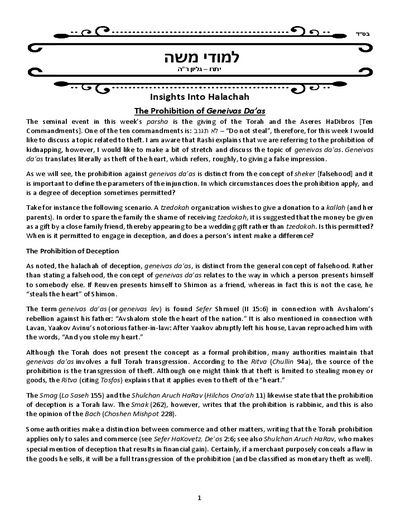

The seminal event in this week’s parsha is the giving of the Torah and the Aseres HaDibros [Ten Commandments]. One of the ten commandments is: לא תגנב – “Do not steal”, therefore, for this week I would like to discuss a topic related to theft. I am aware that Rashi explains that we are referring to the prohibition of kidnapping, however, I would like to make a bit of stretch and discuss the topic of geneivas da’as. Geneivas da’as translates literally as theft of the heart, which refers, roughly, to giving a false impression.

As we will see, the prohibition against geneivas da’as is distinct from the concept of sheker [falsehood] and it is important to define the parameters of the injunction. In which circumstances does the prohibition apply, and is a degree of deception sometimes permitted?

Take for instance the following scenario. A tzedokah organization wishes to give a donation to a kallah (and her parents). In order to spare the family the shame of receiving tzedokah, it is suggested that the money be given as a gift by a close family friend, thereby appearing to be a wedding gift rather than tzedokah. Is this permitted? When is it permitted to engage in deception, and does a person’s intent make a difference?

The Prohibition of Deception

As noted, the halachah of deception, geneivas da’as, is distinct from the general concept of falsehood. Rather than stating a falsehood, the concept of geneivas da’as relates to the way in which a person presents himself to somebody else. If Reuven presents himself to Shimon as a friend, whereas in fact this is not the case, he “steals the heart” of Shimon.

The term geneivas da’as (or geneivas lev) is found Sefer Shmuel (II 15:6) in connection with Avshalom’s rebellion against his father: “Avshalom stole the heart of the nation.” It is also mentioned in connection with Lavan, Yaakov Avinu’s notorious father-in-law: After Yaakov abruptly left his house, Lavan reproached him with the words, “And you stole my heart.”

Although the Torah does not present the concept as a formal prohibition, many authorities maintain that geneivas da’as involves a full Torah transgression. According to the Ritva (Chullin 94a), the source of the prohibition is the transgression of theft. Although one might think that theft is limited to stealing money or goods, the Ritva (citing Tosfos) explains that it applies even to theft of the “heart.”

The Smag (Lo Saseh 155) and the Shulchan Aruch HaRav (Hilchos Ona’ah 11) likewise state that the prohibition of deception is a Torah law. The Smak (262), however, writes that the prohibition is rabbinic, and this is also the opinion of the Bach (Choshen Mishpot 228).

Some authorities make a distinction between commerce and other matters, writing that the Torah prohibition applies only to sales and commerce (see Sefer HaKovetz, De’os 2:6; see also Shulchan Aruch HaRav, who makes special mention of deception that results in financial gain). Certainly, if a merchant purposely conceals a flaw in the goods he sells, it will be a full transgression of the prohibition (and be classified as monetary theft as well).

One way or another, the Gemara (Chullin 94b) singles out deception as a prohibition, indicating that its severity goes beyond ordinary falsehood: “It is forbidden to deceive others – even a non-Jew.” Moreover, the Tosefta (Bava Kama 7:3) states that of all types of thievery (in one version seven types are given), geneivas da’as is the most heinous. Ordinary theft relates to the most superficial part of man – his possessions. Geneivas da’as touches his innermost layer: his heart.

Some Halachic Rulings

A better picture of the prohibition can be acquired by observing some of the classic examples of geneivas da’as. The source of these examples is the Gemara itself, and the cases are cited by later authorities such as the Rambam (De’os 2:6) and the Tur (Choshen Mishpot 228).

After introducing the general obligation to synchronize verbal expression with thoughts, the Rambam adds the following:

“It is forbidden to steal the heart of creatures, even the heart of a non-Jew. How is this so? One may not sell non-kosher meat to a non-Jew under the pretense that the meat is kosher; [...] One may not plead insistently with somebody that he should come to eat with him, in the knowledge that he will not do so; [...] one may not open numerous barrels in another’s presence, pretending that this is being done his honor, whereas in fact it is being done for commercial purposes. This, and all matters similar – even a single word of deception – is forbidden. Rather, one’s tongue should be true, one’s spirit sincere and one’s heart pure of all corruption and crookedness.”

The common element of all these examples is that a person gives his fellow a false impression. In one example he causes his friend to think that he wishes to invite him, whereas in actual fact he has no wish to do so. In another he makes someone believe that he is prepared to spend a great deal of effort to serve him, whereas in actual fact this is not so. The prohibition is in creating a false impression.

Even One Word Is A Prohibition

There was a bochur in Yeshiva who was in one of the older shiurim, he went to Reuven and told him “when your son started Yeshiva and was in the first shiur I learnt with him a number of times to help him out”, in reality the older bochur only learnt with this younger bochur once. Based on the aforementioned Rambam which says “even a single word of deception – is forbidden”, this bochur has transgressed on the prohibition of geneivas da’as.

Common Examples of Geneivas Da’as

A common example of geneivas da’as is cheating on tests. Even when there is no direct financial consequence, cheating in exams “steals the heart” of the examiner or any recipient who is interested in the results, since he is lead to believe that the examinee knows the material. Furthermore, if the examinee obtains some form of certificate through his cheating, his offense may have long-term repercussions: whenever he uses his fraudulently attained certificate, he is “stealing the heart” of whoever wishes to know his past results.

If one would do the above and gain a job as a result, then he is doing more than geneivas da’as and he is stealing money off the one who employs him (see Igros Moshe, Choshen Mishpot 2:30, Shu”t Mishneh Halachos 7:275 and Shu”t Shevet HaLevi 10:163 who all frown upon doing the above).

Another frequent application is described by the Ben Ish Chai (Ki Seitzei 9). Arab townswomen used to place large open tubs of yogurt for sale, from which potential buyers could taste a sample. The Ben Ish Chai writes that those who make a tasting circuit without any intention to actually buy yogurt transgress the prohibition of geneivas da’as (since they give a false impression of wishing to purchase the goods). He adds that they also transgress the prohibition of gezel [theft], because permission to taste the yogurt is granted only to potential customers, and not to those whose only wish is to eat free yogurt.

A modern-day equivalent is exploiting money-back policies offered by stores. When stores offer a return option for a particular product, they do so specifically for customers who desire to buy the product (or have a realistic thought of doing so), but wish to reserve the option of returning the product should they find it unsatisfactory. If the customer needs the product for one-off use and knows in advance that he will return it after the event, exploiting the money-back policy may be “stealing the heart” of the store.

The same is true of test-drives. One may not take a fancy car for a short spin, under a false pretext of being interested in purchasing it. However, if it is common practice to do so and the showroom owner is therefore not given a false impression of intention to buy, there will not be a problem. There is a similar issue of onaas devorim: It is prohibited to ask for the price of items in a store if one has no intention of buying right away, since this will cause the owner grief.

A further interesting application is given by the Sefer Chassidim (51), who writes that one may not greet a non-Jew (all the more so a fellow Jew) with an insult, expressing it in such a way that it appears to be a blessing.

Guest of Honor

Although deception involves a severe prohibition, the line between transgression and mitzvah can be thin. The Gemara in Eruvin (100b) writes that that it is proper to appease one’s spouse by declaring one’s intent to buy her an exquisite garment, implying her stature in his eyes as deserving of such. Ultimately, however, the statement is nothing more than a wish, since the husband lacks the means to buy the garment and he makes it clear that he will only buy her the garment if or when he has the means to do so.

We learn from the Gemara that where a person’s intention is to honor somebody the prohibition of geneivas da’as does not apply, regardless of the misrepresentation.

This ruling is stated explicitly by the Gemara (Chullin 94a), where we find that it is forbidden to perform actions that give others a false impression, such as inviting them in the knowledge that they won’t come, or creating the impression that barrels of wine were opened in their honor when they were opened for other purposes. Yet, the Gemara writes that where these actions are carried out to genuinely bring honor to the deceived, no prohibition is transgressed.

In fact, authorities note that it is sometimes important to invite a person even where it is clear that the invitation won’t be accepted, to insure that no offense will be taken from not extending an invitation (Sema 228; Aruch HaShulchan 228:3). This applies when it is common courtesy to do so.

The Question of Intention

By contrast with everyday lies, good intentions alone are not enough to waive the prohibition of geneivas da’as. This halachah is derived from a Mishnah (Demai 4:4), which states that a person should not give terumah to a Kohen or maaser oni to a poor person on Shabbos, but adds that it is permitted to feed them the terumah or maser if it is normal for them to eat with him on Shabbos. The Mishnah adds a condition: He must first inform them that the food is terumah or maaser, as the case may be.

A number of commentaries (Tiferes Yisroel; Shenos Eliyohu; Mishnah Rishonah) explain that the reason the host must declare the food is terumah is on account of the prohibition of geneivas da’as. Thus, we find that in spite of the fact that there is no intention to deceive – the intention is only to fulfill the mitzvah of giving terumah to a Kohen – the prohibition of geneivas da’as remains.

Similarly, intention to give the other person a good feeling is certainly not sufficient to permit the prohibition. The classic cases of geneivas da’as are cases in which a person wishes to make a good impression which will give the other person a good feeling – but where the impression is false, it is forbidden to do so.

It is noteworthy that the Rambam does not give this interpretation to the Mishnah in Demai, and explains rather that if the host does not inform his guests of the food’s status the guests will think that it’s a gift from him and he would wrongfully derive benefit from the terumah.

Due to the fact that the prohibition is potentially a Torah transgression, it is prudent to heed the stringent opinions. Therefore, one should avoid disguising a tzedokah donation as a personal gift (see Shu”t Binyan Av, Vol. 4, no. 77; Titen Emes L’Yaakov 5:2). Some authorities, however, are lenient on this point (see Shu”t Maharam Shick, Yoreh De’ah 230, discussing disguising a donation of ma’aser money as a gift; see also Tzitz Eliezer Vol. 9, 1:4). Certainly, it is permitted to disguise the donation as a gift if the needy recipient will otherwise refuse it (Kesubos 67b).

Attending a Wedding

The prohibition of geneivas da’as applies even where the false impression is not actively created, but is likely and natural under the circumstances. However, if another party receives a false impression of his own accord, where it is not natural that such an impression should be given, there is no obligation to remedy the mistake.

For instance, consider the following case. Reuven, a close friend of Shimon’s, is invited to the wedding of Shimon’s daughter. Arriving at the wedding, Reuven notices that in the adjacent hall Levi, an acquaintance from shul, is marrying off his son. Reuven drops in to Levi’s wedding and Levi, unaware of Reuven’s connection with Shimon, is very impressed that Reuven made the effort to come to his wedding.

Although a false impression has been given, Reuven did not intend it, and took no active measure to create it – he only wanted to drop in to say mazal tov to his acquaintance. Under these circumstances, the question of a violation will depend on the impression conveyed. If Levi could easily imagine that Reuven was there for some other reason and had not come especially for his wedding, it is permitted (based on Tosfos, Chullin 94a; concerning weddings see Titen Emes L’Yaakov 5:125). However, if the normal reaction is to believe that the guest went to great pains to attend the wedding, where in truth he hadn’t, the guest would be required to reveal the true circumstances.

For this reason, Rabbi Shlomah Zalman Auerbach, when dropping in to a wedding in Bnei Brak (he lived in Yerusholayim), was careful to approach the ba’al hasimcha and inform him that he was already in Bnei Brak for another reason, so that he should not think that he came specially.

Fake Sales

I don’t like breaking such news to people, but there are stories every day of stores that advertise that they are having a big sale when in reality there is no sale on. They do this to encourage people to come to the store, and once they are they, hopefully they will buy things. Advertising a false sale is 100% geneivas da’as, even if the stores prices are reasonable.

Similarly, many stores advertise 30% off on all products, and they even change the labels on all the items to say original price $100, sale price $70. However, what they don’t tell you is, that they bumped the prices up the night before and originally the item was worth $70 and the night before the sale they put the price up to $100. Again, besides for the lying involved, the above is geneivas da’as.

Advertising a Sale Without Informing Buyers that the Product is Faulty

Another trick that stores do, is that when products are getting close to the sell by date, they advertise a sale, and advertise things like “buy one get one free”, and they fail to mention that the product is nearly out of date.

Although the buyer is able to check and he will see that the product has nearly expired, it’s still a problem of geneivas da’as, as if the buyer would have known this he wouldn’t have come to the shop.

There was a story once, with a paper ware shop which was selling disposable plates and cups, and they advertised on the packaging 10% off. People came from all over to the shop, however, those who paid proper attention realized that the packets of cups contained 80 cups instead of the regular 100, and the packets of plates contained 20 instead of the regular 25. This meant that not only was it not cheaper than normal, just the opposite, it was more expensive. Although on the packets of cups it was written “contains 80 cups” and on the packets of plates it was written “contains 20 plates”, the sale sign was geneivas da’as as people would never have come if they knew that they were ending up paying more than normal.

Two Buyers Joining Together To Take Advantage of a Sale

Often stores offer incentives such as “buy two get the third item free”. If Reuven goes into such a store and buys one item, and he sees that Shimon also went in to buy one item, is it ok for them to join together and make out that one of them intended to buy two in order that they get the third item free?

It would seem that the above may be geneivas da’as, as the idea behind the sale is to encourage each buyer to buy more items, not simply to offer cheaper prices, and since Reuven only intended to buy one item there may be an issue of geneivas da’as and of stealing. The best thing to do in such a case is to speak to the owner of the store and ask him what exactly the criteria are, and if it’s ok to do the above. (He will properly be caught by surprise by meeting such an honest person, and will be ok with it!)

Raising the Price to Ensure the Buyer Pays the Real Price

Some shop owners know their customers well, and know that they will only buy an item if they feel they have a bargain. Is the seller allowed to raise the price, so that he can let the buyer negotiate and then let him feel he has managed to get a bargain, when really he is paying the price it is worth? I.e. if an item is worth $100, is the seller allowed to pretend it’s worth $120, so that when the buyer negotiates and offers $100 he feels good?

The Pischei Choshen (Onaah 15, he’orah 22) allows doing the above.

Misleading Labels

Some companies sell grape juice and they write on the bottle “100% natural”. The innocent buyer understands this to mean that the grape juice is 100% grape juice, however, really, the item is grape juice and water, however, both are natural, therefore, strictly speaking the label is correct.

Similarly, some companies print on their tins, “contains 1 kg” and in small writing it says “after sifting 500g”. Both of the above cases are likely to be geneivas da’as.

Closing Down Sales

Another trick that some stores do is, they advertise “closing down sale, 30% of all items”, however, they have zero intention of closing down. Doing the above is geneivas da’as as people only come because they feel if they don’t come now they will lose out.

“Cheapest Shop In Town”

Many shops advertise that they are the cheapest shop in town. Since in every town, there are many shops that do the above, everyone knows that the sign is not true. It would therefore seem, that there is no problem of geneivas da’as, however, the above is still forbidden, due to midvar sheker tirchok, one should distance himself from lies.

“Cheapest Frames in Town”

If an optician sells both frames and contact lenses, and the frames they sell are the cheapest in the city, whereas the contacts lenses they sell are the most expensive, it would be ok for them to advertise “cheapest frames in town”, as it’s true, however, doing so is not so yosher, straight, and it would be better not to advertise in such a way.

Pretending to Collect for Hachnosas Kallah When Really One Is Collecting for A Talmid Chocham

If someone is collecting for a talmid chocham, is he allowed to pretend he is collecting for a kallah if he feels he will do better?

In Kovetz Teshuvos (siman 11 in likutim, and in the miluim quoting Shu”t Mishnas Sochir) the Chasam Sofer brings a story that the Gavad of Matasdorf came to Pressburg to collect money for an important cause and he (the Chasam Sofer) spoke the gabboim of the various tzedokah funds and told them all to give generously. When he spoke to the hachonas kallah fund, they said they only give to hachonas kallah causes. The Chasam Sofer discusses what to do in such a case, and he cites a Medrash in Parshas Ki Sisa on the pasuk, ויתן אל משה ככלותו, which says “just like a bride adorns herself with 24 ornaments, similarly, a talmud chocham adorns himself with 24 seforim”. The Medrash continues “A king has the power to break down boundaries, a talmud chocham is like a king and like a bride”.

The Tzitz Eliezer (Vol. 9, siman 1, 5:17) learns out from the above, that if one is collecting for talmiday chachomim or people learning, he is allowed to say he is collecting for hachonas kallah if it will encourage them to give more. However, the Shevet HaLevi (2:119) argues and says we can’t compare every day cases to the case of the Chasam Sofer. The case of the Chasam Sofer was with a well known gadol hador and he has the status of a king, however, who says we can apply this to every talmid chocham. Additionally, there is an issur of geneivas da’as. However, if the money was already collected, it’s ok to keep it.

The Shu”t Mishneh Halachos agrees with the Shevet HaLevi and he explains that our case is different to the case of the Chasam Sofer. In the case of the Chasam Sofer the money was already given, and they were just trying to the get the gabboim of the hachnosas kallah fund to give it to another cause, in such a case it may be allowed. However, for someone to collect money by saying the wrong thing is sheker and geneivas da’as. Even if a talmud chocham may be called a kallah, people don’t look at it like that, and people assume he means hachnosas kallah, therefore, it’s forbidden. However, he offers a solution, which is that the collector should say he is collecting for something important, similar to hachnosas kallah.

Moving the Clock Forward to Ensure that Family Members Get to Shul on Time

The Shu”t Hisorarus Teshuvah (1:36) discusses an interesting shailah. He asks, if one is allowed to move the clock in his house forward to ensure that family members get to shul on time. He cites proof from the Gemara in Shabbos (115a). From Mincha time on Yom Kippur, kenivas hayerek, some type of preparation done to vegetables to ensure they are ready to be eaten on motzei Yom Kippur may be done. People in Rava’s house were doing it from before Mincha, so he told them that he recently received a letter from R’ Yochanan in Eretz Yisroel that says that it’s forbidden, in order to deter them. We see that tricking when it comes to mitzvos is allowed. However, in the end he refutes the proof, as it could be that Rava sent a letter to Eretz Yisroel asking them for a reply saying it’s forbidden, and he did in fact have a letter.

However, the hagoas Ikvei Sofer cites proof that geneivas da’as when it comes to mitzvos is allowed from a Magen Avraham. The Magen Avraham (156) writes, if someone heard a halachah and he feels that it’s correct, he may say that he heard it from an adam gadol [great person], in order that his family accept it (like we find in Eruvin 51a and Pesochim 112a). We see that when it comes to mitzvos, geneivas da’as is allowed.

R’ Yitzchok Zilberstein maintains that when it comes to mitzvos, geneivas da’as is allowed, and one is allowed to move the hands of the clock forward. He explains, that by doing so, he ensures that his family won’t miss out

PDF Preview