The Wealth We Gave Away
Parsha Jewels | July 15, 2026
Print This Article
View Original PDF

The Wealth We Gave Away

Parsha Jewels | July 12, 2026

There is a mashal told by Rav Kalman Krohn zt”l about a couple poor and uneducated who had two children: a daughter and a son. From a young age, it was clear their son was brilliant, a true child prodigy. By age five he was already more knowledgeable than his teachers, and by ten, no one in the village could teach him anymore.

Left with no choice, the parents sent him away to learn and grow. Over the years, he became a great success. He married into a prestigious family, became a top professor, and eventually rose to one of the highest positions in the country, governor. Wealthy, respected, and admired, he had it all.

After many years, he began to think of his elderly parents. He longed to return home and give back to shower them with gifts, to rebuild their simple lives into one of comfort and dignity. He packed diamonds, gold, and silver and set off.

But he worried. If he simply arrived on their doorstep, so changed and powerful, they might faint from shock. So he decided to disguise himself as a simple, ragged traveler. He would stay the night quietly, and the next day, his sister who still lived in the town would gently reveal who he truly was.

He arrived, knocked on their door, and asked for a place to sleep. As he remembered from his childhood, strangers were sent to sleep in the barn, and that’s where they sent him.

But something about him caught their attention. His baggy coat, bulging pockets… something seemed off. They whispered to one another, “Maybe this man is carrying money. Maybe we can take it.”

They offered him fresh clothing and sent him to bathe. While he was gone, they rifled through his belongings and found riches beyond imagination.

And they decided. “No one knows him here. If he disappears, who will notice?” They gave him meat and wine, waited until he was in a deep sleep… and killed him. They threw his body into the river and returned home, ready to celebrate their new fortune.

The next morning, their daughter arrived. “Was someone here last night?” she asked.

They told her, proudly. “A traveler came. You wouldn’t believe what he had on him…”

She turned pale. “That was your son! That was your son who came home to give you everything!”

They collapsed in horror. They had murdered, with their own hands, the very person who had come to give them the greatest joy of their lives.

At the trial, the father took the stand. “There is no punishment you can give me worse than the one I already live with,” he said. “I destroyed my own blessing. My own child came with arms full of love and gifts, and I threw it all away because of my own greed. Now I live with that forever.”

This tragic story is more than just a mashal. It’s a mirror.

How often do we ignore the blessings Hashem gives us? How often do we focus on what we lack instead of what we have? We have family. We have friends. We have Torah. We have life. And most of all, we have a relationship with Hashem.

But sometimes we throw it all away not physically, like the couple in the story but emotionally. Spiritually. We trade away our joy, our peace, our gratitude, because we get caught up in frustration, jealousy, or negativity. We stop appreciating, and we start complaining.

And that brings us to one of the most moving scenes in the Gemara one that took place right after the Churban.

The Gemara in Makkos 24b tells of a time when Rabban Gamliel, Rabbi Elazar ben Azarya, Rabbi Yehoshua, and Rabbi Akiva were walking near the Har HaBayis. They saw a fox come out of the Kodesh HaKodashim, the holiest place on earth, now in ruins.

The first three Chachamim burst into tears. And rightfully so. the sight was unbearable.

But Rabbi Akiva smiled. They turned to him, stunned. “Akiva, how can you smile at a time like this?” Rabbi Akiva didn’t deny the pain. He wasn’t ignoring the destruction. But he had eyes that saw deeper.

He explained that the very fact that the nevuos of destruction had come true, down to the detail of a fox walking where the Kohen Gadol once stood meant that the nevuos of rebuilding would also come true. If the prophecy of ruin was fulfilled so precisely, then the promise of geulah was equally real.

Rabbi Akiva wasn’t denying the sadness. He was showing the response we must develop if we want the Beis HaMikdash to return. Yes, the Beis HaMikdash was destroyed. Yes, we are still in galus. But why? Because we failed to appreciate what we had. Hashem said, “If you cannot value your time together, if you fight, if you judge each other, if you refuse to see the good in one another then I will scatter you. You will be separated until you learn to cherish your blessings again.”

We were exiled because of sin'as chinam and we will return through ahavas chinam, through seeing the good, appreciating our lives, and thanking Hashem for all He has given us.

That’s why Rabbi Akiva smiled. Because the middah that rebuilds the Beis HaMikdash is the ability to look at a broken world and still say: “There is good here. There is a future. Hashem is with us.”

Maybe this Tisha B’Av, before we ask Hashem for more, we can pause and thank Him for what we already have.

We can stop and look around at our homes, our schools, our communities, our Torah, our families and realize we are the wealthiest people in the world.

And then, from a place of appreciation, we can turn to Hashem and say:

“Ribbono Shel Olam, we see Your blessings. We are grateful. We want more but not because we’re empty, but because we now realize how full we already are.”

That may be the very moment Hashem decides we are ready to return home. That we are ready to be reunited. That we are finally holding our blessings in our hands — and this time, we won't let go.
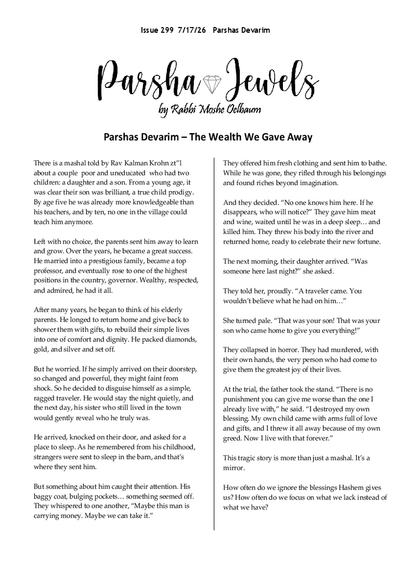
There is a mashal told by Rav Kalman Krohn zt”l about a couple poor and uneducated who had two children: a daughter and a son. From a young age, it was clear their son was brilliant, a true child prodigy. By age five he was already more knowledgeable than his teachers, and by ten, no one in the village could teach him anymore.

Left with no choice, the parents sent him away to learn and grow. Over the years, he became a great success. He married into a prestigious family, became a top professor, and eventually rose to one of the highest positions in the country, governor. Wealthy, respected, and admired, he had it all.

After many years, he began to think of his elderly parents. He longed to return home and give back to shower them with gifts, to rebuild their simple lives into one of comfort and dignity. He packed diamonds, gold, and silver and set off.

But he worried. If he simply arrived on their doorstep, so changed and powerful, they might faint from shock. So he decided to disguise himself as a simple, ragged traveler. He would stay the night quietly, and the next day, his sister who still lived in the town would gently reveal who he truly was.

He arrived, knocked on their door, and asked for a place to sleep. As he remembered from his childhood, strangers were sent to sleep in the barn, and that’s where they sent him.

But something about him caught their attention. His baggy coat, bulging pockets… something seemed off. They whispered to one another, “Maybe this man is carrying money. Maybe we can take it.”

They offered him fresh clothing and sent him to bathe. While he was gone, they rifled through his belongings and found riches beyond imagination.

And they decided. “No one knows him here. If he disappears, who will notice?” They gave him meat and wine, waited until he was in a deep sleep… and killed him. They threw his body into the river and returned home, ready to celebrate their new fortune.

The next morning, their daughter arrived. “Was someone here last night?” she asked.

They told her, proudly. “A traveler came. You wouldn’t believe what he had on him…”

She turned pale. “That was your son! That was your son who came home to give you everything!”

They collapsed in horror. They had murdered, with their own hands, the very person who had come to give them the greatest joy of their lives.

At the trial, the father took the stand. “There is no punishment you can give me worse than the one I already live with,” he said. “I destroyed my own blessing. My own child came with arms full of love and gifts, and I threw it all away because of my own greed. Now I live with that forever.”

This tragic story is more than just a mashal. It’s a mirror.

How often do we ignore the blessings Hashem gives us? How often do we focus on what we lack instead of what we have? We have family. We have friends. We have Torah. We have life. And most of all, we have a relationship with Hashem.

But sometimes we throw it all away not physically, like the couple in the story but emotionally. Spiritually. We trade away our joy, our peace, our gratitude, because we get caught up in frustration, jealousy, or negativity. We stop appreciating, and we start complaining.

And that brings us to one of the most moving scenes in the Gemara one that took place right after the Churban.

The Gemara in Makkos 24b tells of a time when Rabban Gamliel, Rabbi Elazar ben Azarya, Rabbi Yehoshua, and Rabbi Akiva were walking near the Har HaBayis. They saw a fox come out of the Kodesh HaKodashim, the holiest place on earth, now in ruins.

The first three Chachamim burst into tears. And rightfully so. the sight was unbearable.

But Rabbi Akiva smiled. They turned to him, stunned. “Akiva, how can you smile at a time like this?” Rabbi Akiva didn’t deny the pain. He wasn’t ignoring the destruction. But he had eyes that saw deeper.

He explained that the very fact that the nevuos of destruction had come true, down to the detail of a fox walking where the Kohen Gadol once stood meant that the nevuos of rebuilding would also come true. If the prophecy of ruin was fulfilled so precisely, then the promise of geulah was equally real.

Rabbi Akiva wasn’t denying the sadness. He was showing the response we must develop if we want the Beis HaMikdash to return. Yes, the Beis HaMikdash was destroyed. Yes, we are still in galus. But why? Because we failed to appreciate what we had. Hashem said, “If you cannot value your time together, if you fight, if you judge each other, if you refuse to see the good in one another then I will scatter you. You will be separated until you learn to cherish your blessings again.”

We were exiled because of sin'as chinam and we will return through ahavas chinam, through seeing the good, appreciating our lives, and thanking Hashem for all He has given us.

That’s why Rabbi Akiva smiled. Because the middah that rebuilds the Beis HaMikdash is the ability to look at a broken world and still say: “There is good here. There is a future. Hashem is with us.”

Maybe this Tisha B’Av, before we ask Hashem for more, we can pause and thank Him for what we already have.

We can stop and look around at our homes, our schools, our communities, our Torah, our families and realize we are the wealthiest people in the world.

And then, from a place of appreciation, we can turn to Hashem and say:

“Ribbono Shel Olam, we see Your blessings. We are grateful. We want more but not because we’re empty, but because we now realize how full we already are.”

That may be the very moment Hashem decides we are ready to return home. That we are ready to be reunited. That we are finally holding our blessings in our hands — and this time, we won't let go.

PDF Preview