You shall guard your souls greatly
מגדל אור | July 22, 2026
Print This Article
View Original PDF

You shall guard your souls greatly

מגדל אור | August 03, 2025

“ונשמרתם מאד לנפשתיכם כי לא ראיתם כל תמונה ביום דבר ה' אליכם...” (דברים ד:טו)

“You shall guard your souls greatly, for you saw no form on the day Hashem spoke to you at Horev (Sinai) from the midst of the fire.” (Devarim 4:15)

What follows is a warning not to create idols or physical manifestations of G-d, as the nations of the world do. The Jews are warned to guard their souls very much, and not to create any form to represent Hashem. But why is this mitzva so severely worded? We know that Hashem had previously commanded us against worshiping idols. Why now does it seem to be such a life-and-death issue, more so than any other mitzva?

The Bechor Shor suggests that once we were commanded not to forget what transpired at Mount Chorev (Sinai), we might think to create some physical form to remind us of that day. However, that would be our undoing, for that day there was no physical form for us to see. Rather, we must remember in our hearts that day. This is enlightening, but begs the question why a physical form would be so bad. Certainly, we should not worship the physical form, but would a reminder be so bad?

The Haamek Davar’s explanation of this verse speaks to the fact that this verse is often explained to be speaking of maintaining one’s physical health. He says the syntax would have been different were it purely speaking of one’s soul. It would have said, “V’nishmartem es nafshosaichem, and you shall guard your souls.” Instead, it reads, “Vnishmarten l’nafshosaichem, you shall guard “to” your souls.” This means one should guard his body, so that he can thereby protect his soul.

In both cases, we see that what is being protected is the soul, the spiritual piece of godliness which is inside each of us. But it is very easy to forget what we are protecting. The first Mishna in Pirkei Avos urges to “make a fence around the Torah.” Why a fence? Why not a wall, or a fortress, with a moat or barbed wire? Is a small fence really enough?

The answer is that if we build a towering wall around the Torah to protect it, pretty soon the wall will become our focus and we will defend it at all costs, even at the expense of the Torah it was intended to protect. Similarly, there is a concern that if we created a physical representation for the memory of Sinai, or focused on our bodies not merely as a means of protecting our souls, we would soon give the physical existence priority over the spiritual one, and, through that, lead to the destruction of the soul.

By remembering Sinai in our hearts and minds, without a physical item representing that event, we will trigger ourselves to remember that we, too, are spiritual beings, who currently have an additional, physical form. It is part of us, but definitely not “who we are.”
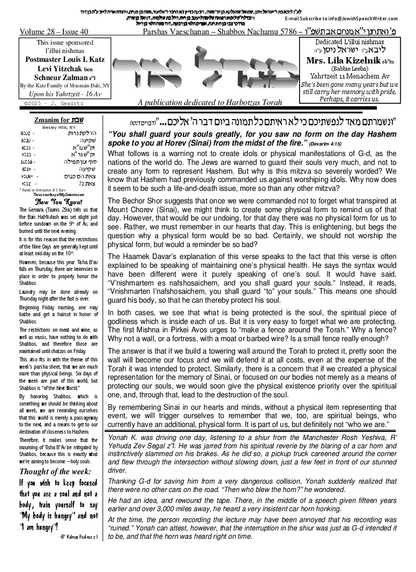
“ונשמרתם מאד לנפשתיכם כי לא ראיתם כל תמונה ביום דבר ה' אליכם...” (דברים ד:טו)

“You shall guard your souls greatly, for you saw no form on the day Hashem spoke to you at Horev (Sinai) from the midst of the fire.” (Devarim 4:15)

What follows is a warning not to create idols or physical manifestations of G-d, as the nations of the world do. The Jews are warned to guard their souls very much, and not to create any form to represent Hashem. But why is this mitzva so severely worded? We know that Hashem had previously commanded us against worshiping idols. Why now does it seem to be such a life-and-death issue, more so than any other mitzva?

The Bechor Shor suggests that once we were commanded not to forget what transpired at Mount Chorev (Sinai), we might think to create some physical form to remind us of that day. However, that would be our undoing, for that day there was no physical form for us to see. Rather, we must remember in our hearts that day. This is enlightening, but begs the question why a physical form would be so bad. Certainly, we should not worship the physical form, but would a reminder be so bad?

The Haamek Davar’s explanation of this verse speaks to the fact that this verse is often explained to be speaking of maintaining one’s physical health. He says the syntax would have been different were it purely speaking of one’s soul. It would have said, “V’nishmartem es nafshosaichem, and you shall guard your souls.” Instead, it reads, “Vnishmarten l’nafshosaichem, you shall guard “to” your souls.” This means one should guard his body, so that he can thereby protect his soul.

In both cases, we see that what is being protected is the soul, the spiritual piece of godliness which is inside each of us. But it is very easy to forget what we are protecting. The first Mishna in Pirkei Avos urges to “make a fence around the Torah.” Why a fence? Why not a wall, or a fortress, with a moat or barbed wire? Is a small fence really enough?

The answer is that if we build a towering wall around the Torah to protect it, pretty soon the wall will become our focus and we will defend it at all costs, even at the expense of the Torah it was intended to protect. Similarly, there is a concern that if we created a physical representation for the memory of Sinai, or focused on our bodies not merely as a means of protecting our souls, we would soon give the physical existence priority over the spiritual one, and, through that, lead to the destruction of the soul.

By remembering Sinai in our hearts and minds, without a physical item representing that event, we will trigger ourselves to remember that we, too, are spiritual beings, who currently have an additional, physical form. It is part of us, but definitely not “who we are.”

PDF Preview