Sidra Acharei Mos
Questions on the Sidra | May 07, 2025
Print This Article
View Original PDF

Sidra Acharei Mos

Questions on the Sidra | June 27, 2025

1. This week’s Sidra begins with the laws concerning the Divine Service in the Mikdash on Yom Kippur. Right at the outset, the warning is intimated that care must be taken to follow the laws exactly as HaShem has commanded them so that there shall not be a repetition of the tragedy that occurred at the Consecration of the Mishkan. On that occasion, Noddov and Avi’hu, the two elder sons of Aharon, died when they presumptuously came near to officiate in a manner not commanded by HaShem.

2. Besides the daily Korban Tommid of the morning and of the evening, and the additional Korban Mussaf of Yom Kippur, the Torah commands other Korbonnos that are to be brought on this holy Day of Atonement. The Kohen Ga’dol is to bring a Korban Chattos on behalf of himself and his household, and another Korban Chattos on behalf of all the Kohannim, too. In addition, there is also a Korban Chattos brought on behalf of the entire Jewish People. As with all Korbonnos Chattos, before the bringing of the Korban, confessions of sins committed must be made to HaShem and forgiveness sought from Him, and this the Kohen Ga’dol does on behalf of the entire Jewish People whose representative he is. Besides these Korbonnos, there are also Korbonnos Olah, for the Kohen Ga’dol and for the People, and a special presentation of incense which is brought, exceptionally, into the Holy of Holies. The incense, which is completely burned up and made to rise in smoke without leaving any residue at all, symbolizes the complete giving-up of oneself to HaShem. It is only through this cloud of smoke, HaShem commands, that the Kohen Ga’dol, representing the Jewish People, can hope to perceive the Glory of HaShem in the Holy of Holies. In this holiest place on earth, on this, one of the holiest days of the year, when all physical pleasures are renounced by us in obedience to the command of HaShem Who has ordered us to abstain from them (the better to feel the spiritual character of this great and holy day) together with our firm resolution to obey the Will of HaShem from now on — in this state of holiness and submission to HaShem can we hope to come close to our Holy G–d Whose Presence manifests Itself so strongly in the Holy of Holies in the Mikdash which is in our midst.

3. The Divine Service of the Kohen Ga’dol on Yom Kippur is onerous and difficult and he must study and rehearse his duties for some days before. For those parts of the Service in the Great Court of the Mishkan or in the Mishkan itself, he is robed in his magnificent garments of splendour. For those parts of the Service done in the Holy of Holies he wears only the four priestly garments of the Kohen Ordinary, but these are made of the finest white linen. Whenever he changes his robes, he immerses himself in the Mikveh, and before and after each part of the Service he laves his hands and feet at the Copper Washstand in the Mikdash.

4. For certain parts of the Service in the Mikdash, the Torah commands that no one is to be in the Mikdash when the Kohen Ga’dol comes in to officiate. We can hardly imagine the purity, the devout concentration and the sublime and holy thoughts of the Kohen Ga’dol, that most righteous and saintly man who is the spiritual leader of his holy People and their representative before HaShem, as he does everything as HaShem has commanded: a man all alone with the Divine Presence in the grand, holy Sanctuary, while the great and silent crowds of the People whose holy trustee he is, wait in sincere repentance and anxious anticipation, outside. On each of the three occasions that the Kohen Ga’dol makes confession before HaShem on behalf of the People, he intones the Great Ineffable Name of HaShem. Upon hearing the Name thus uttered in holiness and purity, the Kohannim and the People who are in the Great Court of the Mikdash fall upon their faces and praise HaShem in pure worship of He Who grants atonement to His repentant People. And when they behold with their own eyes the sign that HaShem has indeed granted atonement (the tongue of crimson wool prominently displayed miraculously changes white) their confidence in HaShem’s forgiveness and mercy is transformed into joy and serene happiness. Blessed indeed is the Holy Nation that experiences such closeness to HaShem: happy is the Jewish People that such is theirs, happy indeed is the People of HaShem.

5. The Korban Chattos of the People on Yom Kippur is unusual in that it consists of two component Korbonnos. The Torah stipulates that two he-goats be taken, for the nature of this animal calls to mind the characteristics of obstinacy, of resistance, and the ability to oppose with firmness any demands made on the individual’s will-power — characteristics with drastically different results. For the one is brought as a Korban Chattos, on the Altar of the Mikdash of HaShem, thus symbolizing a giving-up of oneself to HaShem and His Torah. But the other one, over which all the sins of the People are confessed, is sent away to a rocky, dangerous wilderness, and there, far away from the holy Mikdash of HaShem, it meets its doom and is hurled to death on the crags and rocks. So, too, is it with us: he who is willing to subject himself to the Will of HaShem and adamantly refuses to be deflected from his duty to HaShem, can elevate himself to such a degree that he is admitted even into the holy Mikdash, and even, as it were, upon the Altar. His life is a steady progression of dedication to HaShem. But he who would obstinately refuse to comply with the Will of HaShem, and, stubborn as a goat, will not let himself be guided by the Torah of HaShem, brings upon himself the evils of sin and all kinds of misfortune and calamity, till he meets his end in utter and fearful destruction.

6. The Sidra continues with some other, general, laws of Korbonnos, and stipulates that Korbonnos can be brought only in the Holy Place of HaShem. Indeed, a Korbon brought outside of the Mikdash is a kind of “spiritual murder” and incurs for the transgressor the most severe punishment of “Korais”, for such an act would be the negation of the whole concept of Korbonnos. For one of the principle lessons of Korbonnos is that our whole life and being (represented by the various parts of the Korbonnos which are brought on the Altar) is to be dedicated to HaShem and lived within the bounds of the Torah, guided and sanctified through the holy Mitzvos of HaShem which are central to our very existence, in the same way that the Mikdash is the symbol of the Divine Presence which dwells, not away from us, but in the midst of the Jewish People.

7. Likewise, the Torah forbids (again, with the warning of “Korais”) any of us to eat any blood at all, for blood is symbolic of life itself (for which reason the blood of a Korbon upon the Altar is commanded by HaShem to be a means to achieve atonement). Even the blood of those animals and birds which are not suited for Korbonnos, is forbidden, and indeed the Torah commands that the blood of such animals and birds slaughtered for food must be covered with earth and thus symbolically buried. Thus does the Torah teach us to respect the lifeblood of our food-animals, for all life is sacred.

8. After these laws of the Divine Service of Yom Kippur and the teachings of spiritual elevation inherent in Korbonnos in general, too, the next section of this Sidra warns us to beware of following those degenerate and ignoble practices and customs which stand in such stark contrast to the holiness and purity that HaShem intends for us, His People. The Torah warns us not to learn from the immoral Egyptians amongst whom we lived, nor to imitate the depraved Kenaanites in Eretz Yisroel whom we were about to encounter. Even if their customs might appear attractive, they allow of all kinds of indecency and we are warned not to follow their abominations in any way, nor the immoral practices of any peoples, for to do so will lead to our spiritual and physical annihilation, as indeed the ways of those degenerate peoples inevitably led them to theirs. On the contrary, the holy Torah of HaShem is our only safeguard against moral and physical ruin, and it is only by observing the Mitzvos and doing them that we can live: “Follow My laws and take care to keep My decrees, for I am HaShem your Lord. Guard My decrees and My laws — it is only by observing them properly that a person can truly live — I am HaShem.”

9. There follows a list of forbidden marriages and relationships, and further warnings against idolatry and other abominable practices of the heathen nations. The Torah warns us that the Holy Land does not tolerate its inhabitants if they indulge in any such immoral practices, but spews out such people that would defile themselves and the Holy Land of HaShem. For one cannot compare he who would offend against the King’s laws in a distant province of his realm with one who transgresses those laws in the very palace of the King.

10. The Sidra ends with HaShem’s exhortation to us to “guard that which I have given over to you to guard (that is, the laws of the Torah) in order that nothing of these abominable customs which were done before you shall be done; this way you will not become defiled through them — I am HaShem your Lord.” This is a clear instruction to erect safeguards round the laws of the Torah, to keep away from anything that could lead to an infringement in our duty of observing the Laws of HaShem. Thus, our Chachommim, of blessed memory, made various decrees that protect the laws of the Torah from violation, and through their deep, inspired insight into human nature, protect us from unwittingly transgressing the Laws of HaShem. It is only because of these Rabbinical Decrees enacted by our Torah leaders (and which can have application to any sphere of activity) that the Torah — with its People — has been preserved so faithfully through the ages to this day.

For the explanation of the Haftorah of Sidra מות אחרי please go to HAFTORAHS.
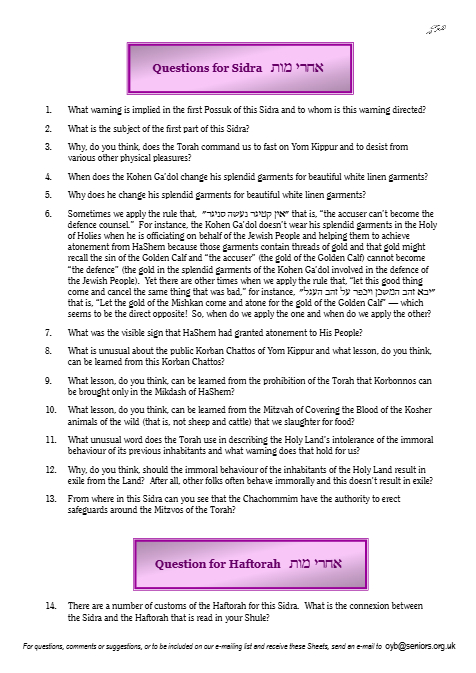
1. This week’s Sidra begins with the laws concerning the Divine Service in the Mikdash on Yom Kippur. Right at the outset, the warning is intimated that care must be taken to follow the laws exactly as HaShem has commanded them so that there shall not be a repetition of the tragedy that occurred at the Consecration of the Mishkan. On that occasion, Noddov and Avi’hu, the two elder sons of Aharon, died when they presumptuously came near to officiate in a manner not commanded by HaShem.

2. Besides the daily Korban Tommid of the morning and of the evening, and the additional Korban Mussaf of Yom Kippur, the Torah commands other Korbonnos that are to be brought on this holy Day of Atonement. The Kohen Ga’dol is to bring a Korban Chattos on behalf of himself and his household, and another Korban Chattos on behalf of all the Kohannim, too. In addition, there is also a Korban Chattos brought on behalf of the entire Jewish People. As with all Korbonnos Chattos, before the bringing of the Korban, confessions of sins committed must be made to HaShem and forgiveness sought from Him, and this the Kohen Ga’dol does on behalf of the entire Jewish People whose representative he is. Besides these Korbonnos, there are also Korbonnos Olah, for the Kohen Ga’dol and for the People, and a special presentation of incense which is brought, exceptionally, into the Holy of Holies. The incense, which is completely burned up and made to rise in smoke without leaving any residue at all, symbolizes the complete giving-up of oneself to HaShem. It is only through this cloud of smoke, HaShem commands, that the Kohen Ga’dol, representing the Jewish People, can hope to perceive the Glory of HaShem in the Holy of Holies. In this holiest place on earth, on this, one of the holiest days of the year, when all physical pleasures are renounced by us in obedience to the command of HaShem Who has ordered us to abstain from them (the better to feel the spiritual character of this great and holy day) together with our firm resolution to obey the Will of HaShem from now on — in this state of holiness and submission to HaShem can we hope to come close to our Holy G–d Whose Presence manifests Itself so strongly in the Holy of Holies in the Mikdash which is in our midst.

3. The Divine Service of the Kohen Ga’dol on Yom Kippur is onerous and difficult and he must study and rehearse his duties for some days before. For those parts of the Service in the Great Court of the Mishkan or in the Mishkan itself, he is robed in his magnificent garments of splendour. For those parts of the Service done in the Holy of Holies he wears only the four priestly garments of the Kohen Ordinary, but these are made of the finest white linen. Whenever he changes his robes, he immerses himself in the Mikveh, and before and after each part of the Service he laves his hands and feet at the Copper Washstand in the Mikdash.

4. For certain parts of the Service in the Mikdash, the Torah commands that no one is to be in the Mikdash when the Kohen Ga’dol comes in to officiate. We can hardly imagine the purity, the devout concentration and the sublime and holy thoughts of the Kohen Ga’dol, that most righteous and saintly man who is the spiritual leader of his holy People and their representative before HaShem, as he does everything as HaShem has commanded: a man all alone with the Divine Presence in the grand, holy Sanctuary, while the great and silent crowds of the People whose holy trustee he is, wait in sincere repentance and anxious anticipation, outside. On each of the three occasions that the Kohen Ga’dol makes confession before HaShem on behalf of the People, he intones the Great Ineffable Name of HaShem. Upon hearing the Name thus uttered in holiness and purity, the Kohannim and the People who are in the Great Court of the Mikdash fall upon their faces and praise HaShem in pure worship of He Who grants atonement to His repentant People. And when they behold with their own eyes the sign that HaShem has indeed granted atonement (the tongue of crimson wool prominently displayed miraculously changes white) their confidence in HaShem’s forgiveness and mercy is transformed into joy and serene happiness. Blessed indeed is the Holy Nation that experiences such closeness to HaShem: happy is the Jewish People that such is theirs, happy indeed is the People of HaShem.

5. The Korban Chattos of the People on Yom Kippur is unusual in that it consists of two component Korbonnos. The Torah stipulates that two he-goats be taken, for the nature of this animal calls to mind the characteristics of obstinacy, of resistance, and the ability to oppose with firmness any demands made on the individual’s will-power — characteristics with drastically different results. For the one is brought as a Korban Chattos, on the Altar of the Mikdash of HaShem, thus symbolizing a giving-up of oneself to HaShem and His Torah. But the other one, over which all the sins of the People are confessed, is sent away to a rocky, dangerous wilderness, and there, far away from the holy Mikdash of HaShem, it meets its doom and is hurled to death on the crags and rocks. So, too, is it with us: he who is willing to subject himself to the Will of HaShem and adamantly refuses to be deflected from his duty to HaShem, can elevate himself to such a degree that he is admitted even into the holy Mikdash, and even, as it were, upon the Altar. His life is a steady progression of dedication to HaShem. But he who would obstinately refuse to comply with the Will of HaShem, and, stubborn as a goat, will not let himself be guided by the Torah of HaShem, brings upon himself the evils of sin and all kinds of misfortune and calamity, till he meets his end in utter and fearful destruction.

6. The Sidra continues with some other, general, laws of Korbonnos, and stipulates that Korbonnos can be brought only in the Holy Place of HaShem. Indeed, a Korbon brought outside of the Mikdash is a kind of “spiritual murder” and incurs for the transgressor the most severe punishment of “Korais”, for such an act would be the negation of the whole concept of Korbonnos. For one of the principle lessons of Korbonnos is that our whole life and being (represented by the various parts of the Korbonnos which are brought on the Altar) is to be dedicated to HaShem and lived within the bounds of the Torah, guided and sanctified through the holy Mitzvos of HaShem which are central to our very existence, in the same way that the Mikdash is the symbol of the Divine Presence which dwells, not away from us, but in the midst of the Jewish People.

7. Likewise, the Torah forbids (again, with the warning of “Korais”) any of us to eat any blood at all, for blood is symbolic of life itself (for which reason the blood of a Korbon upon the Altar is commanded by HaShem to be a means to achieve atonement). Even the blood of those animals and birds which are not suited for Korbonnos, is forbidden, and indeed the Torah commands that the blood of such animals and birds slaughtered for food must be covered with earth and thus symbolically buried. Thus does the Torah teach us to respect the lifeblood of our food-animals, for all life is sacred.

8. After these laws of the Divine Service of Yom Kippur and the teachings of spiritual elevation inherent in Korbonnos in general, too, the next section of this Sidra warns us to beware of following those degenerate and ignoble practices and customs which stand in such stark contrast to the holiness and purity that HaShem intends for us, His People. The Torah warns us not to learn from the immoral Egyptians amongst whom we lived, nor to imitate the depraved Kenaanites in Eretz Yisroel whom we were about to encounter. Even if their customs might appear attractive, they allow of all kinds of indecency and we are warned not to follow their abominations in any way, nor the immoral practices of any peoples, for to do so will lead to our spiritual and physical annihilation, as indeed the ways of those degenerate peoples inevitably led them to theirs. On the contrary, the holy Torah of HaShem is our only safeguard against moral and physical ruin, and it is only by observing the Mitzvos and doing them that we can live: “Follow My laws and take care to keep My decrees, for I am HaShem your Lord. Guard My decrees and My laws — it is only by observing them properly that a person can truly live — I am HaShem.”

9. There follows a list of forbidden marriages and relationships, and further warnings against idolatry and other abominable practices of the heathen nations. The Torah warns us that the Holy Land does not tolerate its inhabitants if they indulge in any such immoral practices, but spews out such people that would defile themselves and the Holy Land of HaShem. For one cannot compare he who would offend against the King’s laws in a distant province of his realm with one who transgresses those laws in the very palace of the King.

10. The Sidra ends with HaShem’s exhortation to us to “guard that which I have given over to you to guard (that is, the laws of the Torah) in order that nothing of these abominable customs which were done before you shall be done; this way you will not become defiled through them — I am HaShem your Lord.” This is a clear instruction to erect safeguards round the laws of the Torah, to keep away from anything that could lead to an infringement in our duty of observing the Laws of HaShem. Thus, our Chachommim, of blessed memory, made various decrees that protect the laws of the Torah from violation, and through their deep, inspired insight into human nature, protect us from unwittingly transgressing the Laws of HaShem. It is only because of these Rabbinical Decrees enacted by our Torah leaders (and which can have application to any sphere of activity) that the Torah — with its People — has been preserved so faithfully through the ages to this day.

For the explanation of the Haftorah of Sidra מות אחרי please go to HAFTORAHS.

PDF Preview