Parshat Acharei Mot
The Jewish Weekly | April 27, 2024
Print This Article
View Original PDF

Parshat Acharei Mot

The Jewish Weekly | June 27, 2025

Are any of the Mitzvot of the Torah given to us to make us suffer?

You might think that’s the case in Parshat Acharei Mot, where the Torah gives us the laws of Yom Kippur: we are told ‘תענו את נפשותיכם - you must afflict your souls’.

I heard from Rabbi Mirvis, the Chief Rabbi of Great Britain and the Commonwealth that the Rambam, in his Mishneh Torah, gives us his explanation. He quotes this verse and explains it by saying, ‘והיא לשבות לו מאכילה ושתיה - you must ‘rest’ on this day from eating and drinking’. It’s the soft tone of ‘resting’ from something in order to provide an uplifting experience. So this ‘affliction’ is not there to make us suffer – rather it is providing us with the rules of a wonderful game without which we wouldn’t be able to play.

It’s for this reason, that this whole section of law is called ‘שביתת עשור - the ‘resting’ that we do on this day. It’s a positive statement rather than a punitive one.

The same can be applied to all other areas of Jewish law which might seem to be unfairly restrictive. Let’s take Kashrut – the laws relating to kosher food or Taharat Hamishpacha – laws relating to family purity. They actually serve to enhance our lives, to give us meaning and added happiness and joy.

Perhaps the finest example of this is Shabbat. In the Ten Commandments presented in the Book of Devarim, the term used there by Hashem is ‘שמור’ – ‘guard the Sabbath day’ meaning that we must separate ourselves from certain things that we do during the week. But in the Book of Shemot, the term used by Hashem is, ‘זכור’ – ‘Remember the Sabbath day’ through positive action. And in the Lecha Dodi prayer that we recite on Friday night, we declare, “שמור וזכור בדיבור אחד” – Hashem issued these two statements in one single utterance – indicating that the ‘שמור’ is there for the sake of the ‘זכור’. We relate to Shabbat not as being an unfair day of restriction, but rather, as a most beautiful experience through which our lives can be shaped and enhanced immeasurably.

So, are there mitzvot of the Torah which are intended to cause us suffering? Absolutely not! Quite the contrary! It’s thanks to all the mitzvot of the Torah that we can live a life of meaning, of spirituality and of deep happiness.

So let’s pray for the recovery of all the sick, for the release of the hostages, as well as praying for our soldiers and healthcare professionals, and Chevra Kadisha members worldwide, and for those who need healing, shidduchim, children and parnassah and may we be blessed to have the most awesome, gorgeous, beautiful, peaceful, healthy, amazing, relaxed, spiritual, sweet, and happy Shabbat.

NUMBER OF MITZVOT: 28

MITZVOT ASEH: 2
MITZVOT LO TAASEH: 26

NUMBER OF PESUKIM: 80

NUMBER OF WORDS: 1170
NUMBER OF LETTERS: 4294

HAFTORA:

Ashkenazim & Chabad: Amos 9:7 - 15
Sephardim: Yechezkel 20:2 - 20

Shabbat Mevarchim Chodesh Iyar which falls on Wednesday and Thursday, May 8, and 9.

We do not say Kail Maleh, however, we do say Av Harachamim that was composed for the martyrs of the Crusade period most of whom were slain during the period of Sefirat Haomer.

This Shabbat afternoon we begin the weekly study of a Chapter of Pirkei Avot every Shabbat until Rosh Hashana. This week we study Chapter 1.
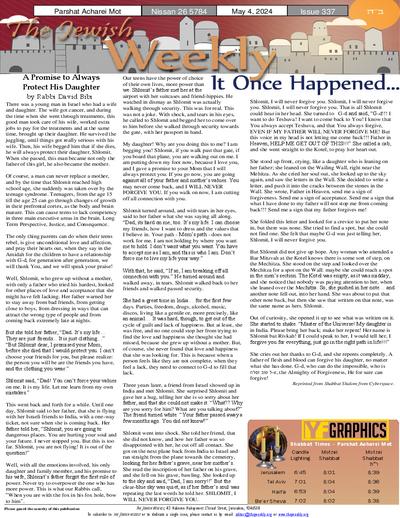
Are any of the Mitzvot of the Torah given to us to make us suffer?

You might think that’s the case in Parshat Acharei Mot, where the Torah gives us the laws of Yom Kippur: we are told ‘תענו את נפשותיכם - you must afflict your souls’.

I heard from Rabbi Mirvis, the Chief Rabbi of Great Britain and the Commonwealth that the Rambam, in his Mishneh Torah, gives us his explanation. He quotes this verse and explains it by saying, ‘והיא לשבות לו מאכילה ושתיה - you must ‘rest’ on this day from eating and drinking’. It’s the soft tone of ‘resting’ from something in order to provide an uplifting experience. So this ‘affliction’ is not there to make us suffer – rather it is providing us with the rules of a wonderful game without which we wouldn’t be able to play.

It’s for this reason, that this whole section of law is called ‘שביתת עשור - the ‘resting’ that we do on this day. It’s a positive statement rather than a punitive one.

The same can be applied to all other areas of Jewish law which might seem to be unfairly restrictive. Let’s take Kashrut – the laws relating to kosher food or Taharat Hamishpacha – laws relating to family purity. They actually serve to enhance our lives, to give us meaning and added happiness and joy.

Perhaps the finest example of this is Shabbat. In the Ten Commandments presented in the Book of Devarim, the term used there by Hashem is ‘שמור’ – ‘guard the Sabbath day’ meaning that we must separate ourselves from certain things that we do during the week. But in the Book of Shemot, the term used by Hashem is, ‘זכור’ – ‘Remember the Sabbath day’ through positive action. And in the Lecha Dodi prayer that we recite on Friday night, we declare, “שמור וזכור בדיבור אחד” – Hashem issued these two statements in one single utterance – indicating that the ‘שמור’ is there for the sake of the ‘זכור’. We relate to Shabbat not as being an unfair day of restriction, but rather, as a most beautiful experience through which our lives can be shaped and enhanced immeasurably.

So, are there mitzvot of the Torah which are intended to cause us suffering? Absolutely not! Quite the contrary! It’s thanks to all the mitzvot of the Torah that we can live a life of meaning, of spirituality and of deep happiness.

So let’s pray for the recovery of all the sick, for the release of the hostages, as well as praying for our soldiers and healthcare professionals, and Chevra Kadisha members worldwide, and for those who need healing, shidduchim, children and parnassah and may we be blessed to have the most awesome, gorgeous, beautiful, peaceful, healthy, amazing, relaxed, spiritual, sweet, and happy Shabbat.

NUMBER OF MITZVOT: 28

MITZVOT ASEH: 2
MITZVOT LO TAASEH: 26

NUMBER OF PESUKIM: 80

NUMBER OF WORDS: 1170
NUMBER OF LETTERS: 4294

HAFTORA:

Ashkenazim & Chabad: Amos 9:7 - 15
Sephardim: Yechezkel 20:2 - 20

Shabbat Mevarchim Chodesh Iyar which falls on Wednesday and Thursday, May 8, and 9.

We do not say Kail Maleh, however, we do say Av Harachamim that was composed for the martyrs of the Crusade period most of whom were slain during the period of Sefirat Haomer.

This Shabbat afternoon we begin the weekly study of a Chapter of Pirkei Avot every Shabbat until Rosh Hashana. This week we study Chapter 1.

PDF Preview