ABSTRACT Likutei Sichos
Ben Chamesh L'Mikra | July 08, 2025
Print This Article
View Original PDF

ABSTRACT Likutei Sichos

Ben Chamesh L'Mikra | December 10, 2025

Torah gives the soul the strength to rise above the exile

First fear, then love of HaShem, precludes the effect of Bilaam & Amalek

“Crouching lion” is a metaphor for the might of the Jews lying dormant during the exile

כי מראש צרים אראנו ומגבעות אשורנו כג, ט ד

"I gaze and see the [Jewish] people from the top of rocks” from the distance of Chochmah, referring to the level of nullification of the Patriarchs
“I behold them from the hills” from the nearness of Binah, referring to the “lesser” degree of world-view, but involvement with the particulars of the Matriarchs
G-d's ultimate intent is that the physical world be transformed into a dwelling for Him; this is not accomplished by transcending and wholly nullifying the world -- the level of the Patriarchs, but specifically by transforming the existing world into a vessel for G-dliness -- the level of the Matriarchs

Moshe, a true leader

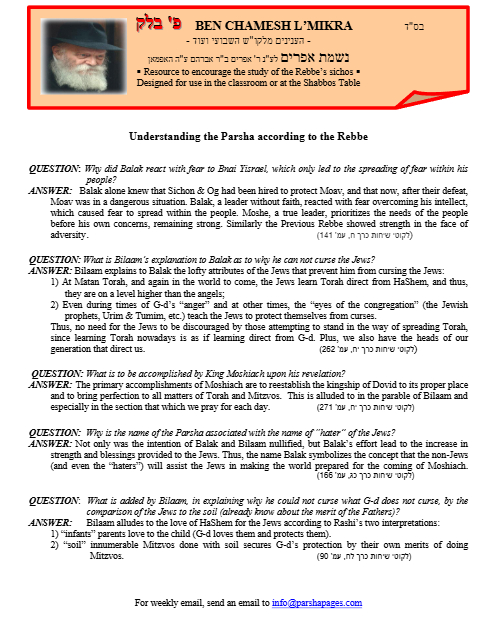
Moshe, a true leader, prioritizes the needs of the people before his own concerns, remaining strong; similarly, the Previous Rebbe showed strength in the face of adversity
Balak alone knew that Sichon & Og had been hired to protect Moav, and that now, after their defeat, Moav was in a dangerous situation; Balak, a leader without faith, reacted with fear overcoming his intellect, which causes fear to spread within the people

הבועל ארמית קנאים פוגעין בו

The sin of cohabiting with a non-Jewish woman violates intrinsic boundaries
Pinchas, who performed an act beyond rules, was rewarded a privilege that defied the usual boundaries, the privilege of Kehuna to someone not born a priest

Be careful in the large matters of Tznius

Two explanations of what was good: individual tent openings didn’t line up opposite each other and that the tribes stayed separate; together they express the great tznius within the Jews

In this last prophecy Bilaam speaks about the end of days (verses 17-20)

Rashi explains entire first section (17-18) of the prophecy was about Dovid HaMelech
Rambam explains each portion of the verses as alternating: initial allusion to the initial Moshiach (Dovid) that saved the Jews from their enemies; the ending allusion to the later Moshiach (from the children of Dovid) that saves the Jews in the end of days

No need to be discouraged by those attempting to stand in the way of spreading Torah

Bilaam explains to Balak the lofty attributes of the Jews that prevent him from cursing the Jews:
1) at Matan Torah, and again in the future world, the Jews learn Torah direct from HaShem, and thus, they are on a level higher than the angels;
2) even during times of G-d’s “anger” and at other times, the “eyes of the congregation” (the Jewish prophets, Urim & Tumim, etc.) teach the Jews to protect themselves from curses
Torah gives the soul the strength to rise above the exile

First fear, then love of HaShem, precludes the effect of Bilaam & Amalek

“Crouching lion” is a metaphor for the might of the Jews lying dormant during the exile

כי מראש צרים אראנו ומגבעות אשורנו כג, ט ד

"I gaze and see the [Jewish] people from the top of rocks” from the distance of Chochmah, referring to the level of nullification of the Patriarchs
“I behold them from the hills” from the nearness of Binah, referring to the “lesser” degree of world-view, but involvement with the particulars of the Matriarchs
G-d's ultimate intent is that the physical world be transformed into a dwelling for Him; this is not accomplished by transcending and wholly nullifying the world -- the level of the Patriarchs, but specifically by transforming the existing world into a vessel for G-dliness -- the level of the Matriarchs

Moshe, a true leader

Moshe, a true leader, prioritizes the needs of the people before his own concerns, remaining strong; similarly, the Previous Rebbe showed strength in the face of adversity
Balak alone knew that Sichon & Og had been hired to protect Moav, and that now, after their defeat, Moav was in a dangerous situation; Balak, a leader without faith, reacted with fear overcoming his intellect, which causes fear to spread within the people

הבועל ארמית קנאים פוגעין בו

The sin of cohabiting with a non-Jewish woman violates intrinsic boundaries
Pinchas, who performed an act beyond rules, was rewarded a privilege that defied the usual boundaries, the privilege of Kehuna to someone not born a priest

Be careful in the large matters of Tznius

Two explanations of what was good: individual tent openings didn’t line up opposite each other and that the tribes stayed separate; together they express the great tznius within the Jews

In this last prophecy Bilaam speaks about the end of days (verses 17-20)

Rashi explains entire first section (17-18) of the prophecy was about Dovid HaMelech
Rambam explains each portion of the verses as alternating: initial allusion to the initial Moshiach (Dovid) that saved the Jews from their enemies; the ending allusion to the later Moshiach (from the children of Dovid) that saves the Jews in the end of days

No need to be discouraged by those attempting to stand in the way of spreading Torah

Bilaam explains to Balak the lofty attributes of the Jews that prevent him from cursing the Jews:
1) at Matan Torah, and again in the future world, the Jews learn Torah direct from HaShem, and thus, they are on a level higher than the angels;
2) even during times of G-d’s “anger” and at other times, the “eyes of the congregation” (the Jewish prophets, Urim & Tumim, etc.) teach the Jews to protect themselves from curses

PDF Preview