ABSTRACT Likutei Sichos - The Role of Nations and Avrohom's Standard
Ben Chamesh L'Mikra | July 08, 2025
Print This Article
View Original PDF

ABSTRACT Likutei Sichos - The Role of Nations and Avrohom's Standard

Ben Chamesh L'Mikra | December 10, 2025

In the “end of days” the non-Jews will assist in making the world reveal G-dliness. One nullifies the name of an idol either upon its disgrace, or by adding to its worthlessness; even more so by Balak as he becomes a conduit for the Jews’ blessings (name of the Parsha)

According to Rambam and Chassidus the nations of the world have an independent role to play in the times of Moshiach, transforming their tendencies into revealing G-d in the world

Avrohom established a new standard for the Jews to love HaShem without limits, further revealed when curses of Bilaam were overturned. HaShem turns the curses into blessings. Bilaam’s saddling his donkey (hate), was preceded by Avrohom’s saddling (love); both changed the standard, but from different sides

The power of mesiras nefesh received from the Fathers and the Mothers does not change with the times. The true power of the Jews comes from the spiritual, mainly the power of mesiras nefesh, referred to as the “peak of flintrocks”

Grabbing indicates a desire above reason and logic, the service of mesiras nefesh (like the Previous Rebbe). The first parable speaks of the inability to curse the Jews since they were beloved by HaShem; the second parable praises the Jews; they are like a young lion; they wake from their sleep to grasp Mitzvos (Tzitzis, Krias Shema and Tefillin)

Jews profit from irrational hatred since G-d reverses the curse to a blessing with the same intensity. Balak requested cursing the Jews as a means to removing them only from his land; Bilaam wanted to remove them from the world

“Soil” alludes to humility and plainness (simple), these qualities are needed to serve G-d, that brings G-d to an inherent love to His “infants”. Bilaam alludes to the love of HaShem for the Jews according to Rashi’s two interpretations: “infants” parents love to the child (G-d loves them); “soil” innumerable Mitzvos done with soil secures G-d’s protection by their own merits

One needs to be concerned with watering the world (refinement and purification). וירד מים עד ים ומנהר עד אפסי ארץ refers to Moshiach. The days of Moshiach (אפסי ארץ) are connected to our deeds and service (נהר) in the times of Galus

Previous Rebbe
30 Years of Leadership 1920-1950
Mesiras Nefesh in Spreading Torah and Chassidus

  • 1st Era Russia - סכנת נפשות בפועל ממש
  • 2nd Era Lithuania & Poland - ויקנאו בו אחיו
  • 3rd Era United States - אמעריקא איז ניט אנדערש
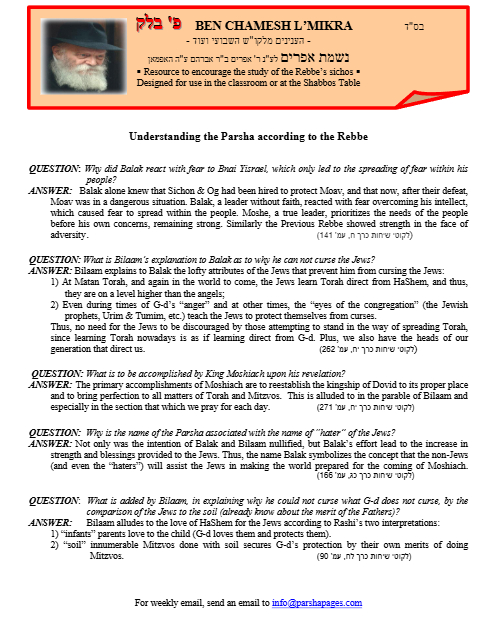
In the “end of days” the non-Jews will assist in making the world reveal G-dliness. One nullifies the name of an idol either upon its disgrace, or by adding to its worthlessness; even more so by Balak as he becomes a conduit for the Jews’ blessings (name of the Parsha)

According to Rambam and Chassidus the nations of the world have an independent role to play in the times of Moshiach, transforming their tendencies into revealing G-d in the world

Avrohom established a new standard for the Jews to love HaShem without limits, further revealed when curses of Bilaam were overturned. HaShem turns the curses into blessings. Bilaam’s saddling his donkey (hate), was preceded by Avrohom’s saddling (love); both changed the standard, but from different sides

The power of mesiras nefesh received from the Fathers and the Mothers does not change with the times. The true power of the Jews comes from the spiritual, mainly the power of mesiras nefesh, referred to as the “peak of flintrocks”

Grabbing indicates a desire above reason and logic, the service of mesiras nefesh (like the Previous Rebbe). The first parable speaks of the inability to curse the Jews since they were beloved by HaShem; the second parable praises the Jews; they are like a young lion; they wake from their sleep to grasp Mitzvos (Tzitzis, Krias Shema and Tefillin)

Jews profit from irrational hatred since G-d reverses the curse to a blessing with the same intensity. Balak requested cursing the Jews as a means to removing them only from his land; Bilaam wanted to remove them from the world

“Soil” alludes to humility and plainness (simple), these qualities are needed to serve G-d, that brings G-d to an inherent love to His “infants”. Bilaam alludes to the love of HaShem for the Jews according to Rashi’s two interpretations: “infants” parents love to the child (G-d loves them); “soil” innumerable Mitzvos done with soil secures G-d’s protection by their own merits

One needs to be concerned with watering the world (refinement and purification). וירד מים עד ים ומנהר עד אפסי ארץ refers to Moshiach. The days of Moshiach (אפסי ארץ) are connected to our deeds and service (נהר) in the times of Galus

Previous Rebbe
30 Years of Leadership 1920-1950
Mesiras Nefesh in Spreading Torah and Chassidus

  • 1st Era Russia - סכנת נפשות בפועל ממש
  • 2nd Era Lithuania & Poland - ויקנאו בו אחיו
  • 3rd Era United States - אמעריקא איז ניט אנדערש
PDF Preview