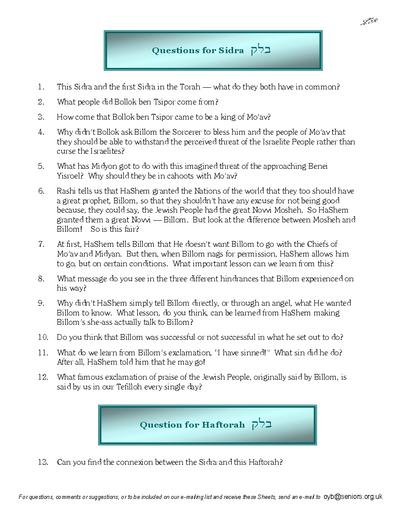
Sidra of the Week Balak
1. All the events described in the Torah concerning the Jewish People were either experienced by them or were witnessed by them. Even those events which occurred before the Jewish Nation came into physical existence were witnessed by the ancestors of the Jewish Nation and through them and their descendants the record of those events were passed down to us to this day. Thus, all the happenings reported in the Torah could have come down to us today, quite independently of the Written Torah, through those who experienced or witnessed them and through the generations which followed them. (Of course, there would be some risk that the reports would have become distorted with continuous retelling. Only the Torah, with its correctness safeguarded by the Halochoh which governs its faithful transmission from generation to generation, is absolutely free from the blemishes common to all traditions handed down through time. But we would have some knowledge of those events of long ago, even if the Torah would not have recorded them for us.)
But there are two exceptions. The first concerns all of Mankind and that is: the Creation of the world. No human was there to witness it. If HaShem had not included the account of Creation in the Torah, there could be no certainty about the events of Creation. But HaShem desired that everyone should know how the world came into existence, the better to appreciate that HaShem is the Creator of All and the Father and King of all Mankind.
The second exception concerns the Jewish People and is the episode of Billom and Bollok of this Sidra. For if HaShem would not have informed us in His Torah of this episode, no-one of the Jewish People would have known with any certainty of these happenings. This episode happened completely behind the scenes: the Jewish People were not at all aware of the frantic, malevolent efforts of Billom and Bollok. Even though, sadly, we did experience the plague which is reported at the end of the Sidra, we would never have known with any certainty that this was a result of Billom’s evil counsel, and we would never have known of Billom’s wicked efforts to curse the Jewish People — efforts which were so wonderfully frustrated by HaShem. The events in this Sidra are recorded in the Torah so that everyone — but especially we ourselves — should be aware not only of HaShem’s recognizable and visible protection of us, but also of His protection of us at all times — many times quite hidden from us.
2. At the end of the previous Sidra, the Torah tells how the Emorites and their king Si’chon, and then Og, the king of the Boshon region, had challenged us to battle and how HaShem had helped us to vanquish these two belligerent peoples and we had taken possession of their lands. It was after these conquests that Bollok, who had recently been made king of the people of Mo’av, and the people of Midyon, took fright at the unnatural victories of the Jewish People. Midyon and Mo’av had relied upon Si’chon and Og to protect them from any attack, and now that these two fearsome warriors and their fighting-men had been thoroughly defeated in battle, Mo’av and Midyon were sick with fear: What would happen to them now that their mighty protectors had been vanquished? Somehow, they felt, they must halt the advance of the Jewish People. (Really, they had nothing to fear, for the Jewish People were not allowed by HaShem to take any territory from Ammon or Mo’av, and the people of Midyon were not at all threatened. Mo’av’s anxiety was rooted more in their jealousy of the superiority of the Jewish People.)
3. Bollok realized that the power of the Jewish People was not a natural power. He imagined that their strength came from their leader, and he knew that the leader of the Jewish People — Mosheh our Teacher — had grown up in the land of Midyon. Fearing the Jewish People, Mo’av and Midyon hastily made peace between themselves (they were really old enemies but they felt that they now faced a common enemy) and in reply to Bollok’s query about Mosheh, the Midyanites informed him that the power of Mosheh lies in his mouth: he prays to the Almighty G-d, HaShem, and HaShem does as Mosheh asks. So Bollok sent for Billom the son of Be’or, whom he knew from his own experiences to likewise have power in his mouth, for what he spoke came true. Bollok asked that Billom, with his supernatural powers, should come to Bollok’s assistance. After all, they were fellow-countrymen. Let Billom pronounce a curse upon the Jewish People so that they could be vanquished by Mo’av. Bollok would pay him well.
4. Billom, a heathen from the land of Arram on the River Euphrates, was granted the gift of prophecy by HaShem so that the Nations of the world could not later claim that had they been granted prophets like the Jewish People had been granted, they too would have been deserving of HaShem’s favour. HaShem therefore granted the Nations of the world someone with many extraordinary gifts, including even the gift of prophecy. His advice was indeed sought by rulers and kings from far and wide, and Billom became a very powerful man, but evil and loathsome. For instead of using his powers for the good, Billom, with the encouragement of the heathen peoples, allied to this G-d-given gift of prophecy the arts of sorcery and witchcraft and with their willing consent and compliance, Billom used his powers to bring some of the Nations of the world down to an unprecedented low level of immorality.
5. When the messengers arrive with their request, Billom tells them to stay the night so that he should obtain the permission of HaShem to go with them. (He knew full well from Whom his power came, but his ideas of HaShem were weird indeed, as were those of most people at that time.) That night, HaShem tells Billom that he is not to go with these messengers, and neither is he to curse the Jewish People. Indeed, they do not need his blessing either, for they are already blessed by HaShem.
6. When Bollok received the news that Billom refused to come, he sent messengers of higher rank, with promises of greater riches and honour, if he would come.
Our Chachommim, of blessed memory, point out for us that in a number of places the Torah shows that, "A person is led along the path that he himself wants to follow." Billom himself wanted to harm the Jewish People. Although HaShem had told him that he should not go, when Billom audaciously persisted in asking to be allowed to go, HaShem granted His permission. For if this is the path that he has chosen, then this is the path along which he shall be led — and he shall suffer the consequences of his own choice. So HaShem tells Billom that he may go, but at the same time HaShem warns him that he will be able to proclaim only those words that HaShem shall put into his mouth.
7. Billom eagerly sets out together with the princes of Mo’av, and HaShem signals His displeasure at Billom’s choice by sending an angel to repeatedly hinder his path — and to warn him again. First, Billom’s she-ass turns off the path into a field so as to avoid the angel. Then, going through a vineyard with a stone wall on either side of the path, the she-ass squeezes past the angel, crushing Billom’s foot against an ancient mound of stones that formed part of the wall. On both occasions, Billom, ignorant of the reason for his she-ass’s uncommonly erratic behaviour, strikes the beast. On the third occasion, the she-ass simply crouches down in front of the angel, as the path there is so narrow that there is no room to go round. When Billom strikes his she-ass a third time, the she-ass turns its head round to Billom, and HaShem opens its mouth. Within the hearing of Billom’s entourage of princes and officers, the she-ass asks Billom the reason for his cruel treatment. What else could it do to avoid the angel with the drawn sword? Billom has no answer to the rebuke of his she-ass.
8. HaShem then opens the eyes of Billom so that he sees the angel and he realizes the cause of his she-ass’s behaviour. He apologizes for his actions and impudently says that although HaShem Himself has given permission for his journey, if it is displeasing to the angel, he will return home. But the angel warns him again that HaShem has given His permission that he can go but that he can proclaim only those words that HaShem will put into his mouth. Billom continues on his way.
9. When he arrives, Bollok takes him to a vantage point from where he can see the Jewish People encamped, and after building altars and bringing sacrifices, Billom opens his mouth. But instead of vile curses, he utters blessings and beautiful praises of the People of Israel. This happens three times — and each time Bollok is beside himself with anger and despair, until in the end Bollok sends Billom back to his country in shame and disgrace. (See separate section.)
10. Before he goes, however, Billom gives his wicked advice to Bollok. “The G–d of the Hebrews hates all kinds of immoral behaviour. If you can entice them away from their holy Torah and ensnare them in immoral conduct, then G–d’s anger will be turned against them and you will be able to overcome them.” Acting on this evil counsel, the Mo’avites and Midyanites, under the pretence of friendship, indeed ensnare the Jewish People. Immediately, HaShem sends a plague which sweeps through the People and there is great confusion in the Camp: nobody knows what to do. Then Pinchos ben Elozzor ben Aharon HaKohen rises up from among the people. Zealous for the honour of HaShem, he makes a gory example of one of the Princes of the Tribes who was consorting with a Midyanite princess — and instantly the plague stops. But twenty-four thousand of the Jewish People had died in the plague.
For the explanation of the Haftorah of Sidra בלק please go to HAFTORAHS.