Ligging In Learning Is Supposed to Bring You Close to Hashem
Bitachon Weekly | May 29, 2024
Print This Article
View Original PDF

Ligging In Learning Is Supposed to Bring You Close to Hashem

Bitachon Weekly | June 27, 2025

Our Parsha begins: If you will “walk” in My commandments, I will give you all types of goodness. What does it mean to “walk” in My commandments? Rashi explains this means being Amel toiling B'torah. Later in the Parsha, this word is repeated constantly throughout the Tochacha, like: יִרֶק יִמִּﬠ וּכְלֵתּ םִאְוכו כא יִרֶק יִמִּﬠ םֶתְּכַלֲהַוכו כג םֶתְּכַלֲהַו יִרֶקְבּ יִמִּﬠ זכ וכ you will “walk” with Me unresponsively, which means that the Yidden will deny Hashem’s Hashgacha Pratis and regard their unfortunate circumstances as mere “coincidence”. We need to constantly be aware that Hashem is behind every tiny thing that happens to you.

So the Torah uses the same word [“walking”] in regards to being Amel B'torah and the concept of Hashgacha Pratis. This implies that there is a connection between them.

Being Amel B'torah means becoming close with Hashem. Like the Rambam [in Hilchos De’os and Hilchos Shemita] refers to learning Torah as “knowing Hashem”, and R' Boruch Ber called Bnei Torah: “M'vakshei Hashem”. A true Ben-Torah is full of Bitachon, and he lives with Hashgacha Pratis. [Indeed, how can we manage to learn in Kollel without Bitachon?]. Not living with Hashgacha Pratis and Bitachon is a sign of deficiency of the true Ameilus B'torah. And sure enough, Rashi says that if you are not Amel B'Torah, you will end up being Kofer B’ikar.

Dovid HaMelech said: I ask for one thing: 'ה תֵאֵמ יִתְּלַאָשׁ תַחַא תיֵבְבּ יִתְּבִשׁ שֵׁקַּבֲא הָּתוֹא 'ה ד זכ םילהת To sit in the “Bais Hashem” my entire life [i.e. to learn Torah]. Dovid calls the Bais HaMedrash “Bais Hashem”. We see that when Dovid learned Torah, he wanted to come close to Hashem. That’s what Talmud Torah is all about; to bring Hashem into your life.

What If Your Learning Is Not Bringing You Close to Hashem?

Limud HaTorah has to bring you closer to Hashem. But what if you are learning plenty of Torah, yet you are loaded with all kinds of worries [plus Kin’ah, Ta’ava and Kavod]? And despite your Hasmada, you are still nervous and angry or jealous! It is a sign that perhaps you need to change your M'halech in learning. You need more Shaar HaBitachon [or to read Bitachon Weekly!] since the main purpose of learning Torah is missing in your present form of Talmud Torah. R’ Dovid Bleicher said that each person must learn the Mussar he needs, as it says: םָמוֹי הֶגְּהֶי וֹת ָרוֹתְבוּ הָלְיָלָו ב א םילהת He toils in “his” [personal] Torah day and night.

In last week’s Parsha we read about the Mitzva of Shemita. Shemita means to stop working. Does this mean to stop working and do nothing?? Chas V'shalom! Shemita is called Shabbos La’Hashem”; i.e. the point is that we should learn Torah! We are given a year of Shemita to learn Torah and have Bitachon; thereby coming close to Hashem.

You Have the Ability and Power to Generate Blessing and Goodness in Your Life

It’s not easy to have Bitachon, because the Tevah says the opposite. If we keep remembering the Nissim of the past, it becomes easier to have Bitachon. Our world enjoys talking about Tzaros. The more we talk about Tzaros, the more we invite Tzaros, Chas V'shalom. The more we talk about Chasdei Hashem, the more we invite more and more goodness into our lives.

Sometimes, we can really have everything we want if we only have Bitachon. Hashem can really do anything, and He is just waiting for our Chizuk in Bitachon.
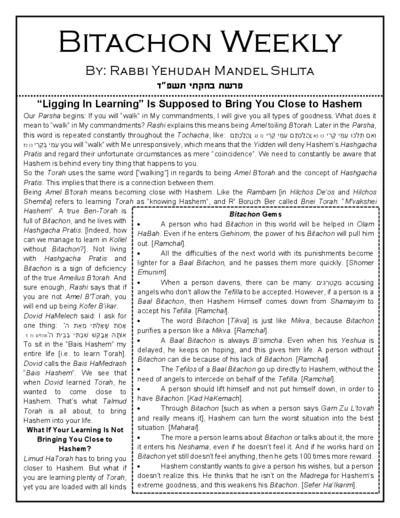

Our Parsha begins: If you will “walk” in My commandments, I will give you all types of goodness. What does it mean to “walk” in My commandments? Rashi explains this means being Amel toiling B'torah. Later in the Parsha, this word is repeated constantly throughout the Tochacha, like: יִרֶק יִמִּﬠ וּכְלֵתּ םִאְוכו כא יִרֶק יִמִּﬠ םֶתְּכַלֲהַוכו כג םֶתְּכַלֲהַו יִרֶקְבּ יִמִּﬠ זכ וכ you will “walk” with Me unresponsively, which means that the Yidden will deny Hashem’s Hashgacha Pratis and regard their unfortunate circumstances as mere “coincidence”. We need to constantly be aware that Hashem is behind every tiny thing that happens to you.

So the Torah uses the same word [“walking”] in regards to being Amel B'torah and the concept of Hashgacha Pratis. This implies that there is a connection between them.

Being Amel B'torah means becoming close with Hashem. Like the Rambam [in Hilchos De’os and Hilchos Shemita] refers to learning Torah as “knowing Hashem”, and R' Boruch Ber called Bnei Torah: “M'vakshei Hashem”. A true Ben-Torah is full of Bitachon, and he lives with Hashgacha Pratis. [Indeed, how can we manage to learn in Kollel without Bitachon?]. Not living with Hashgacha Pratis and Bitachon is a sign of deficiency of the true Ameilus B'torah. And sure enough, Rashi says that if you are not Amel B'Torah, you will end up being Kofer B’ikar.

Dovid HaMelech said: I ask for one thing: 'ה תֵאֵמ יִתְּלַאָשׁ תַחַא תיֵבְבּ יִתְּבִשׁ שֵׁקַּבֲא הָּתוֹא 'ה ד זכ םילהת To sit in the “Bais Hashem” my entire life [i.e. to learn Torah]. Dovid calls the Bais HaMedrash “Bais Hashem”. We see that when Dovid learned Torah, he wanted to come close to Hashem. That’s what Talmud Torah is all about; to bring Hashem into your life.

What If Your Learning Is Not Bringing You Close to Hashem?

Limud HaTorah has to bring you closer to Hashem. But what if you are learning plenty of Torah, yet you are loaded with all kinds of worries [plus Kin’ah, Ta’ava and Kavod]? And despite your Hasmada, you are still nervous and angry or jealous! It is a sign that perhaps you need to change your M'halech in learning. You need more Shaar HaBitachon [or to read Bitachon Weekly!] since the main purpose of learning Torah is missing in your present form of Talmud Torah. R’ Dovid Bleicher said that each person must learn the Mussar he needs, as it says: םָמוֹי הֶגְּהֶי וֹת ָרוֹתְבוּ הָלְיָלָו ב א םילהת He toils in “his” [personal] Torah day and night.

In last week’s Parsha we read about the Mitzva of Shemita. Shemita means to stop working. Does this mean to stop working and do nothing?? Chas V'shalom! Shemita is called Shabbos La’Hashem”; i.e. the point is that we should learn Torah! We are given a year of Shemita to learn Torah and have Bitachon; thereby coming close to Hashem.

You Have the Ability and Power to Generate Blessing and Goodness in Your Life

It’s not easy to have Bitachon, because the Tevah says the opposite. If we keep remembering the Nissim of the past, it becomes easier to have Bitachon. Our world enjoys talking about Tzaros. The more we talk about Tzaros, the more we invite Tzaros, Chas V'shalom. The more we talk about Chasdei Hashem, the more we invite more and more goodness into our lives.

Sometimes, we can really have everything we want if we only have Bitachon. Hashem can really do anything, and He is just waiting for our Chizuk in Bitachon.

PDF Preview