The Follower and the Leader
זכרון יעקב | June 21, 2024
Print This Article
View Original PDF

The Follower and the Leader

זכרון יעקב | June 27, 2025

We see a curious interaction between Moshe and Yehoshua towards the end of this week’s parsha.

In order to appoint seventy elders to represent the tribes, Moshe requested each tribe offer six candidates but two should only offer five. No tribe wished to back down so lots were drawn and two of the nominees were stood down.

When the other elders were activated, the two nominees also began to prophesy about the future when the Jewish people would enter the land of Israel.

“Yehoshua ... said ‘Moshe, my master, imprison them!’ Moshe said to him, ‘Are you zealous for my sake? If only all the Lord's people were prophets, that the Lord would bestow His spirit upon them!’ (11:28-9)

What was Yehoshua’s objection and Moshe’s response?

Yehoshua was the devoted student and servant. Anyone and anything that could disturb the rule of his master was an anathema and disruptive. Such disturbances needed to be removed.

As the responsible leader however, Moshe understood that he could not do everything by himself but had the responsibility for everything working smoothly. Earlier he said as much to Hashem.

‘Why have I not found favour in Your eyes that You place the burden of this entire people upon me? Did I conceive this entire people? Did I give birth to them...? Where can I get meat to give all these people? .. Alone I cannot carry this entire people for it is too hard for me.’ (11:14)

Despite his direct hot line to G-d, on a day-to-day basis Moshe was responsible for the material and spiritual needs of the community of several million ex-slaves living in a desert. Ultimately all complex issues fell on his plate to resolve and they needed to be resolved. So, any reasonable help was gratefully accepted, even if that help was not directly sanctioned.

But from the perspective of the follower, any confusion in the line of management is a problem. People get confused which instructions are to be followed and what direction the organisation should take.

But the responsible leader needs a management group to provide solutions. Otherwise, the leader is always under pressure to personally solve every single problem.
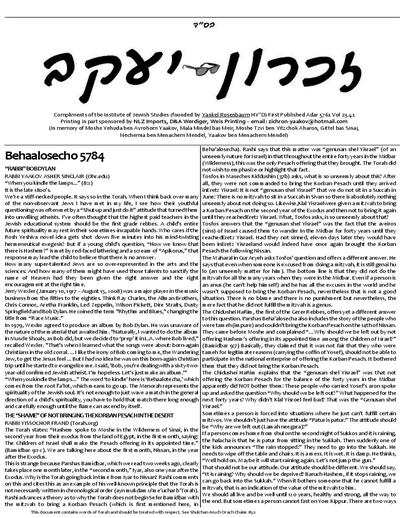

We see a curious interaction between Moshe and Yehoshua towards the end of this week’s parsha.

In order to appoint seventy elders to represent the tribes, Moshe requested each tribe offer six candidates but two should only offer five. No tribe wished to back down so lots were drawn and two of the nominees were stood down.

When the other elders were activated, the two nominees also began to prophesy about the future when the Jewish people would enter the land of Israel.

“Yehoshua ... said ‘Moshe, my master, imprison them!’ Moshe said to him, ‘Are you zealous for my sake? If only all the Lord's people were prophets, that the Lord would bestow His spirit upon them!’ (11:28-9)

What was Yehoshua’s objection and Moshe’s response?

Yehoshua was the devoted student and servant. Anyone and anything that could disturb the rule of his master was an anathema and disruptive. Such disturbances needed to be removed.

As the responsible leader however, Moshe understood that he could not do everything by himself but had the responsibility for everything working smoothly. Earlier he said as much to Hashem.

‘Why have I not found favour in Your eyes that You place the burden of this entire people upon me? Did I conceive this entire people? Did I give birth to them...? Where can I get meat to give all these people? .. Alone I cannot carry this entire people for it is too hard for me.’ (11:14)

Despite his direct hot line to G-d, on a day-to-day basis Moshe was responsible for the material and spiritual needs of the community of several million ex-slaves living in a desert. Ultimately all complex issues fell on his plate to resolve and they needed to be resolved. So, any reasonable help was gratefully accepted, even if that help was not directly sanctioned.

But from the perspective of the follower, any confusion in the line of management is a problem. People get confused which instructions are to be followed and what direction the organisation should take.

But the responsible leader needs a management group to provide solutions. Otherwise, the leader is always under pressure to personally solve every single problem.

PDF Preview


