Bechukosai From Above to Below to Above
Print This Article
View Original PDF

Bechukosai From Above to Below to Above

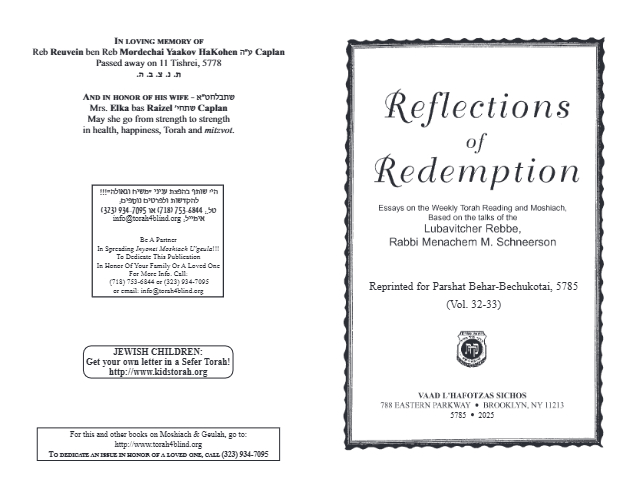
Reflections of Redemption | June 27, 2025

The last Torah portion of Vayikra, like the first, speaks of sacrifices. Here, the discussion centers on the first-born animal, which represents an arousal from Above, and the tithing of the tenth animal, which represents an arousal from below. Both are a necessary part of the process of transforming the world, preparing it for the times of Moshiach.

The inner connection between sections of the Torah can teach us much about our own connection with Redemption. This is logical, since the ultimate purpose and fulfillment of Torah is Moshiach. The Jewish people alone were given the Torah and it is our Divine mission to bring Moshiach, the era of Redemption when the whole world will be filled with knowledge of G-dliness. Indeed, the very question this raises, why our mitzvos are necessary to bring Moshiach, is addressed in the structure of Vayikra.

There is a well-known principle that the “end is linked to the beginning, and the beginning is attached to the end.” The portion of Bechukosai is the last portion of Vayikra, or Leviticus as it’s called in English. Thus, we should find a special connection between the end and the beginning both of the portion and of the book of Vayikra as a whole. As with every aspect of Torah, this connection reveals an important lesson in our Divine service of preparing the world for Moshiach.

There is an obvious connection between the beginning of Vayikra as a whole and its conclusion in the portion of Bechukosai. Both speak of sacrifices. Of course, there’s an immediate, superficial connection, since with the coming of Moshiach and the rebuilding of the Temple, of holiness – such as the birth of a first-born animal – forces us to recognize the presence of holiness and thus be elevated. Both our awareness and our daily activities become more spiritually oriented, more attuned to the G-dliness innate to the world. This is an obvious prelude to the times of Moshiach, when such awareness will be fully manifest.

The second type of spiritual service, that of tithing the animals, represents man’s own efforts to elevate himself, an arousal from below. In this way we take the initiative to refine our natures, to transform the animal within us into a vehicle for holiness. Through our mitzvos, we make the world a dwelling place for G-d.

The beginning of the Torah portion reflects this dichotomy. It begins as follows: “If in My statutes you will walk, and My commandments you will keep.” Statutes (Chukim) are Divinely ordained mitzvos, without an apparent reason. Walking indicates continual motion – an unlimited movement. Such a Divine service has infinite potential. Being motivated to fulfill the Torah’s commands from Above arouses a desire to be elevated. Nevertheless, this “walking,” this unlimited arousal, is missing something.

Whatever elevation occurs as a result has no permanence. Even the greatest self-sacrifice, aroused from Above, does not permanently transform the individual. For the rest of the soul-powers to be affected, the person must act. The Divine soul comes into the body so that man here below, with his animal soul, becomes a vehicle for G-dliness. Thus, there must be as well an arousal from below, the service of “My commandments you will keep.” By using one’s own soul-powers – the tenth, the animal, to perform the mitzvos, one becomes a vessel for keeping and maintaining the unlimited revelation of G-dliness. This revelation until now has been apparent only occasionally and temporarily. Yet the ideal is for this arousal from Above – the first-born, Chochmah, “If in My statutes you will walk” – to be visible openly to one and all.

That state arrives with Moshiach, brought on by the arousal from below – the tithing of animals, the ten soul-powers, “and My commandments you will keep.” It is our actions, performing the mitzvos in response to a recognition of G-dliness, that transforms the world, gives G-dliness itself a permanent home here in the physical realm.

This explains why the coming of Moshiach depends on each and every one of us, our personal activity and Divine service.

(Based on Likkutei Sichos 17:332-339)
The last Torah portion of Vayikra, like the first, speaks of sacrifices. Here, the discussion centers on the first-born animal, which represents an arousal from Above, and the tithing of the tenth animal, which represents an arousal from below. Both are a necessary part of the process of transforming the world, preparing it for the times of Moshiach.

The inner connection between sections of the Torah can teach us much about our own connection with Redemption. This is logical, since the ultimate purpose and fulfillment of Torah is Moshiach. The Jewish people alone were given the Torah and it is our Divine mission to bring Moshiach, the era of Redemption when the whole world will be filled with knowledge of G-dliness. Indeed, the very question this raises, why our mitzvos are necessary to bring Moshiach, is addressed in the structure of Vayikra.

There is a well-known principle that the “end is linked to the beginning, and the beginning is attached to the end.” The portion of Bechukosai is the last portion of Vayikra, or Leviticus as it’s called in English. Thus, we should find a special connection between the end and the beginning both of the portion and of the book of Vayikra as a whole. As with every aspect of Torah, this connection reveals an important lesson in our Divine service of preparing the world for Moshiach.

There is an obvious connection between the beginning of Vayikra as a whole and its conclusion in the portion of Bechukosai. Both speak of sacrifices. Of course, there’s an immediate, superficial connection, since with the coming of Moshiach and the rebuilding of the Temple, of holiness – such as the birth of a first-born animal – forces us to recognize the presence of holiness and thus be elevated. Both our awareness and our daily activities become more spiritually oriented, more attuned to the G-dliness innate to the world. This is an obvious prelude to the times of Moshiach, when such awareness will be fully manifest.

The second type of spiritual service, that of tithing the animals, represents man’s own efforts to elevate himself, an arousal from below. In this way we take the initiative to refine our natures, to transform the animal within us into a vehicle for holiness. Through our mitzvos, we make the world a dwelling place for G-d.

The beginning of the Torah portion reflects this dichotomy. It begins as follows: “If in My statutes you will walk, and My commandments you will keep.” Statutes (Chukim) are Divinely ordained mitzvos, without an apparent reason. Walking indicates continual motion – an unlimited movement. Such a Divine service has infinite potential. Being motivated to fulfill the Torah’s commands from Above arouses a desire to be elevated. Nevertheless, this “walking,” this unlimited arousal, is missing something.

Whatever elevation occurs as a result has no permanence. Even the greatest self-sacrifice, aroused from Above, does not permanently transform the individual. For the rest of the soul-powers to be affected, the person must act. The Divine soul comes into the body so that man here below, with his animal soul, becomes a vehicle for G-dliness. Thus, there must be as well an arousal from below, the service of “My commandments you will keep.” By using one’s own soul-powers – the tenth, the animal, to perform the mitzvos, one becomes a vessel for keeping and maintaining the unlimited revelation of G-dliness. This revelation until now has been apparent only occasionally and temporarily. Yet the ideal is for this arousal from Above – the first-born, Chochmah, “If in My statutes you will walk” – to be visible openly to one and all.

That state arrives with Moshiach, brought on by the arousal from below – the tithing of animals, the ten soul-powers, “and My commandments you will keep.” It is our actions, performing the mitzvos in response to a recognition of G-dliness, that transforms the world, gives G-dliness itself a permanent home here in the physical realm.

This explains why the coming of Moshiach depends on each and every one of us, our personal activity and Divine service.

(Based on Likkutei Sichos 17:332-339)

PDF Preview