The Unity of Torah—Rabbi Shimon
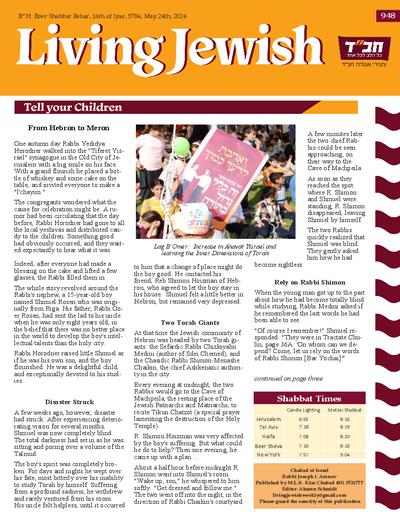
Lag B’Omer commemorates the passing of Rabbi Shimon Bar Yochai, one of the foremost sages of the Talmud and author of the Zohar. Rabbi Shimon’s knowledge extended from the legal realm of the Torah, to its deepest mystical secrets. He was able to perceive these two areas of knowledge not as distinct, self-contained disciplines, but as one composite unit, the legal aspect being the body and the mystical the soul of one integrated Torah.
This unity within the Torah which Rabbi Shimon recognized enabled him to perceive the Divine unity within our material world, and moreover, to have this unity expressed in actual fact as well as in the abstract. Thus the Zohar relates that Eretz Yisrael once suffered a severe drought. When the Jews appealed to Rabbi Shimon for help, he expounded the verse, “how good and how pleasant it is for brothers to dwell together” — and it began to rain.
In the same vein, the Midrash relates that one of Rabbi Shimon’s students returned to Eretz Yisrael after acquiring wealth in foreign lands. Seeing that some of his other students grew envious, Rabbi Shimon led them to a valley and called out, “valley, valley, fill up with gold coins,” and it did. “Anyone who wants may take,” declared Rabbi Shimon, “but he should know that he is taking from his portion in the World to Come.” Rabbi Shimon was able to make the spiritual wealth of the World to Come manifest as material wealth in this world.
There is a Talmudic debate on the verse, “this Torah scroll shall not depart from your mouth.” Rabbi Yishmael maintains that as much time as possible should be devoted to Torah study, but part of one’s time should be devoted to earning a livelihood. Rabbi Shimon argues the verse should be taken at face value. A person should devote all of his time and effort to Torah study, leaving it to G‑d to ensure that his material needs will be met.
Rabbi Shimon was true to his own teachings. The Talmud says of him, Torato umanuto — “His profession was Torah.” He devoted himself solely to Torah study. Yet, although Rabbi Shimon himself was able to function at this exalted level, it appears to be beyond the grasp of most people. In fact, our Rabbis state that the concept of Torato umanuto as exemplified by Rabbi Shimon no longer exists.
The Alter Rebbe explains that fulfilling a mitzvah establishes an eternal union with the Divine. Thus, studying Torah even briefly with the undivided attentiveness of “those who ate manna,” (their material needs were provided, and they could concentrate on spiritual growth) affirms us in a timeless bond with G‑d at the level of Rabbi Shimon Bar Yochai. Even after such study, when a person turns to material concerns, this inner connection is maintained. Thus, during our Torah study, we can approach the level of “those who ate manna,” and emulate Rabbi Shimon’s state of Torato umanuto.
Adapted from Timeless Patterns in Time, from the talks of the Rebbe, reprinted with perm. from Sichos in English
Related Articles