Understanding the Parsha according to the Rebbe
Ben Chamesh L'Mikra | July 23, 2023
Print This Article
View Original PDF

Understanding the Parsha according to the Rebbe

Ben Chamesh L'Mikra | December 31, 2025

QUESTION: Moshe separated 6 cities of refuge. However, we have not had these cities for many years. What is the spiritual concept that remains relevant to us today?

ANSWER: Chaza”l tells us that the words of Torah are a refuge for us. The spiritual understanding of the city of refuge for a person who “accidentally” kills, speaks about a person that takes a life from its true life source, Torah and Mitzvos. One that sins is cut off from the flow of life-force to the soul. The Torah then tells us that one should not give up hope, for one can always seek refuge within Torah and be saved. And those that go in the ways of Torah must be signposts for others to be saved within Torah. (363, עמ' בלקוטי שיחות כרך)

QUESTION: What is the hidden lesson in the recounting that at the time of the Giving of the Torah, HaShem used a “Great Voice” which did not fade?

ANSWER: All portions of Torah are continuously revealed in each generation, which is a continuation of the initial Giving from Har Sinai. All the laws, customs, decrees etc. from the subsequent generations was already included in HaShem’s Giving of the Torah at Har Sinai. The Great Voice, that included all the Torah throughout the generations, does not fade but continues to be absorbed in each of us. This concept includes all the Torah learning that is translated into the 70 languages. (1092, עמ' דלקוטי שיחות כרך)

QUESTION: Why does the Torah establish the mitzvah of saying Shema (a constant matter) in two parts, morning and night, while learning of Torah (differences in times) is set as one mitzvah with no distinctions?

ANSWER: The reasoning is understood in the inner essence of each mitzvah and its spiritual effects. The saying of Shema seeks to bring forth HaShem’s kingship on the world (per the word אחד, א – the number one of the world to be recognized as king ח – in the eight levels of heaven and earth and ד – and the four directions). Thus, the mitzvah is separated into the two main time frames of the world, day and night in which to accomplish this spiritual effect. Whereas, the mitzvah of learning Torah mainly functioning above the world, and thus, a constant mitzvah above the distinctions of the word. Nevertheless, these two Mitzvos are in the same verse, since a person needs the power of Torah in order to achieve the effects in this world where the true revelation of HaShem is lacking. (21 , עמ'יד לקוטי שיחות כרך)

QUESTION: ה' הוא האלקים בשמים ממעל ועל הארץ מתחת אין עוד What is the special emphasis that we should know that G-d is in the Heavens and on the earth?

ANSWER: Chassidus explains that this verse doesn’t just negate the possibility of another god. Rather, this verse clarifies that no existence is possible except for HaShem. HaShem is unique and the singular Existence which establishes the Heavens and the earth. (26, עמ' כט לקוטי שיחות כרך)

QUESTION: Rambam includes the concept of love and fear of HaShem (seemingly opposite feelings) together. How is this possible?

ANSWER: Love is a movement of closeness; Fear is a movement of distance and nullification. Yet, the ultimate is a love which is related to awe together in one heart, which is achieved through contemplation about HaShem. (32 , עמ'דל לקוטי שיחות כרך)
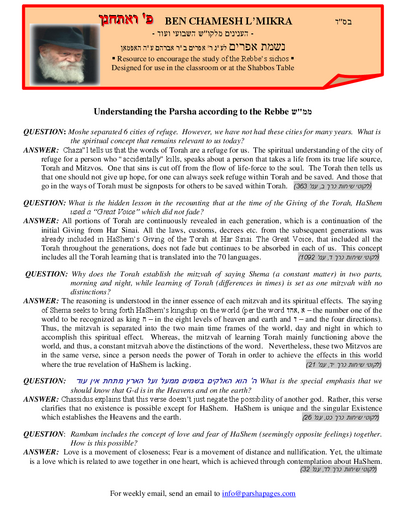
QUESTION: Moshe separated 6 cities of refuge. However, we have not had these cities for many years. What is the spiritual concept that remains relevant to us today?

ANSWER: Chaza”l tells us that the words of Torah are a refuge for us. The spiritual understanding of the city of refuge for a person who “accidentally” kills, speaks about a person that takes a life from its true life source, Torah and Mitzvos. One that sins is cut off from the flow of life-force to the soul. The Torah then tells us that one should not give up hope, for one can always seek refuge within Torah and be saved. And those that go in the ways of Torah must be signposts for others to be saved within Torah. (363, עמ' בלקוטי שיחות כרך)

QUESTION: What is the hidden lesson in the recounting that at the time of the Giving of the Torah, HaShem used a “Great Voice” which did not fade?

ANSWER: All portions of Torah are continuously revealed in each generation, which is a continuation of the initial Giving from Har Sinai. All the laws, customs, decrees etc. from the subsequent generations was already included in HaShem’s Giving of the Torah at Har Sinai. The Great Voice, that included all the Torah throughout the generations, does not fade but continues to be absorbed in each of us. This concept includes all the Torah learning that is translated into the 70 languages. (1092, עמ' דלקוטי שיחות כרך)

QUESTION: Why does the Torah establish the mitzvah of saying Shema (a constant matter) in two parts, morning and night, while learning of Torah (differences in times) is set as one mitzvah with no distinctions?

ANSWER: The reasoning is understood in the inner essence of each mitzvah and its spiritual effects. The saying of Shema seeks to bring forth HaShem’s kingship on the world (per the word אחד, א – the number one of the world to be recognized as king ח – in the eight levels of heaven and earth and ד – and the four directions). Thus, the mitzvah is separated into the two main time frames of the world, day and night in which to accomplish this spiritual effect. Whereas, the mitzvah of learning Torah mainly functioning above the world, and thus, a constant mitzvah above the distinctions of the word. Nevertheless, these two Mitzvos are in the same verse, since a person needs the power of Torah in order to achieve the effects in this world where the true revelation of HaShem is lacking. (21 , עמ'יד לקוטי שיחות כרך)

QUESTION: ה' הוא האלקים בשמים ממעל ועל הארץ מתחת אין עוד What is the special emphasis that we should know that G-d is in the Heavens and on the earth?

ANSWER: Chassidus explains that this verse doesn’t just negate the possibility of another god. Rather, this verse clarifies that no existence is possible except for HaShem. HaShem is unique and the singular Existence which establishes the Heavens and the earth. (26, עמ' כט לקוטי שיחות כרך)

QUESTION: Rambam includes the concept of love and fear of HaShem (seemingly opposite feelings) together. How is this possible?

ANSWER: Love is a movement of closeness; Fear is a movement of distance and nullification. Yet, the ultimate is a love which is related to awe together in one heart, which is achieved through contemplation about HaShem. (32 , עמ'דל לקוטי שיחות כרך)

PDF Preview