G d Called the Light Day and the Darkness Was Called Night
מגדל אור | October 11, 2023
Print This Article
View Original PDF

G d Called the Light Day and the Darkness Was Called Night

מגדל אור | December 31, 2025

“G-d called the light, ‘day,’ and the darkness was called, ‘night...’” (Beraishis 1:5)

At the beginning of the creation of this world, Hashem brought light into being. It was so good that it ended up being hidden for the righteous in the future, but a spark of it enlightened the sun and the moon later in Creation, and the light they give is based off that original light. Hashem also did not want it to be mixed with darkness, so He created a distinction between them. They would each have their time of existence and primacy.

The question is, why did Hashem have to name these creations? There was no one else in the world. He knew what they were, so why did they need a designation?

The Chizkuni says there were six things named by Hashem, Himself. These were the light, the darkness, Heaven, Earth, oceans, and Man. Hashem had to name them, he says, because there was no Man to name them. This can be contrasted to the animals of the world, which Adam was invited to name, and the Torah tells us he did so.

The question remains, however, why Hashem needed to name the light, dark, sky, etc., before Man was created. Why not let Adam name them when he experienced them, as he did with the animals? Why did they need a name beforehand?

Perhaps we can suggest that when the Chizkuni says, “there was no man to name them,” it wasn’t merely a practical issue, that Man hadn’t been created yet. Rather, Man is incapable of fathoming certain things, and Hashem wanted us to understand that there are things in the world which are beyond our understanding, yet He created them for a purpose.

Were Man to name these things, the name would fall short of their true essence. Furthermore, these things represent our limited vision vis-à-vis Hashem’s omniscience. Mankind, for all its efforts, has not been able to cross the expanse of space, nor plumb the depths of the sea. We don’t experience all that lies beneath the earth, and certainly, we don’t know the true potential of humankind. People are at once medical marvels, wonders of engineering, and metaphysical bearers of tremendous power.

That is why Hashem, Himself, had to name these things, so we would remain humble and strive for continual growth in our knowledge of Hashem and His ways. When we recognize that there are things we cannot comprehend, we will not question Hashem, and will instead seek to understand the world around us as HE sees it, not as we do.

One day, R’ Yehonoson Eibshitz was walking to Shul when the powerful ruler of the region, with whom he had often conversed, met him in the street. The ruler asked him where he was going. R' Yehonasan replied that he didn't know. Assuming he didn't hear the simple question, the ruler asked again. Once again, R’ Yehonasan answered that he didn't know. The ruler, thinking he was being mocked, got very angry and threatened to throw him in jail if he continued to play games with him. R’ Yehonasan apologized, but told the ruler that he didn't know. Incensed, the ruler called his guards and had R’ Yehonasan taken to jail.

The next morning, the ruler came and asked, “I don't understand you. You are an intelligent, upstanding, person and I am certain you were not doing anything wrong. Why make a laughing stock out of me and have yourself sent to jail, rather than tell me where you were going??”

R' Yehonasan replied “My presence in jail is precisely why I couldn't tell you where I was going. I set out for the local synagogue, but, ended up here. I can only tell you where I am intending to go but as to where I am really going, only Hashem knows, and apparently, He had other plans for me.”

©2023 – J. Gewirtz
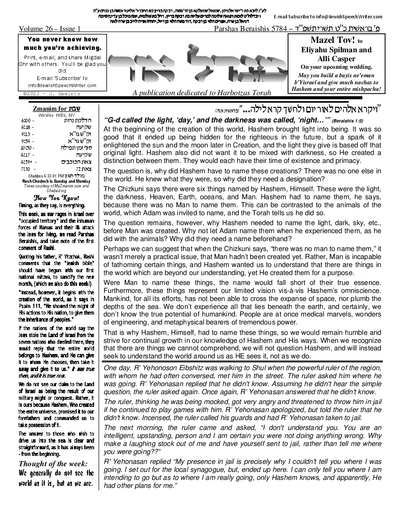
“G-d called the light, ‘day,’ and the darkness was called, ‘night...’” (Beraishis 1:5)

At the beginning of the creation of this world, Hashem brought light into being. It was so good that it ended up being hidden for the righteous in the future, but a spark of it enlightened the sun and the moon later in Creation, and the light they give is based off that original light. Hashem also did not want it to be mixed with darkness, so He created a distinction between them. They would each have their time of existence and primacy.

The question is, why did Hashem have to name these creations? There was no one else in the world. He knew what they were, so why did they need a designation?

The Chizkuni says there were six things named by Hashem, Himself. These were the light, the darkness, Heaven, Earth, oceans, and Man. Hashem had to name them, he says, because there was no Man to name them. This can be contrasted to the animals of the world, which Adam was invited to name, and the Torah tells us he did so.

The question remains, however, why Hashem needed to name the light, dark, sky, etc., before Man was created. Why not let Adam name them when he experienced them, as he did with the animals? Why did they need a name beforehand?

Perhaps we can suggest that when the Chizkuni says, “there was no man to name them,” it wasn’t merely a practical issue, that Man hadn’t been created yet. Rather, Man is incapable of fathoming certain things, and Hashem wanted us to understand that there are things in the world which are beyond our understanding, yet He created them for a purpose.

Were Man to name these things, the name would fall short of their true essence. Furthermore, these things represent our limited vision vis-à-vis Hashem’s omniscience. Mankind, for all its efforts, has not been able to cross the expanse of space, nor plumb the depths of the sea. We don’t experience all that lies beneath the earth, and certainly, we don’t know the true potential of humankind. People are at once medical marvels, wonders of engineering, and metaphysical bearers of tremendous power.

That is why Hashem, Himself, had to name these things, so we would remain humble and strive for continual growth in our knowledge of Hashem and His ways. When we recognize that there are things we cannot comprehend, we will not question Hashem, and will instead seek to understand the world around us as HE sees it, not as we do.

One day, R’ Yehonoson Eibshitz was walking to Shul when the powerful ruler of the region, with whom he had often conversed, met him in the street. The ruler asked him where he was going. R' Yehonasan replied that he didn't know. Assuming he didn't hear the simple question, the ruler asked again. Once again, R’ Yehonasan answered that he didn't know. The ruler, thinking he was being mocked, got very angry and threatened to throw him in jail if he continued to play games with him. R’ Yehonasan apologized, but told the ruler that he didn't know. Incensed, the ruler called his guards and had R’ Yehonasan taken to jail.

The next morning, the ruler came and asked, “I don't understand you. You are an intelligent, upstanding, person and I am certain you were not doing anything wrong. Why make a laughing stock out of me and have yourself sent to jail, rather than tell me where you were going??”

R' Yehonasan replied “My presence in jail is precisely why I couldn't tell you where I was going. I set out for the local synagogue, but, ended up here. I can only tell you where I am intending to go but as to where I am really going, only Hashem knows, and apparently, He had other plans for me.”

©2023 – J. Gewirtz

PDF Preview