Wise and Kind Words
Toras Avigdor | October 10, 2023
Print This Article
View Original PDF

Wise and Kind Words

Toras Avigdor | December 31, 2025

Now, when Hakadosh Boruch Hu said words at Maaseh Bereishis it was many many things. Trillions of creations and trillions of processes came into existence. Creation was almost infinite in its results and consequences. But the common denominator of all of Creation is םָלֹעו ‡≈לָמ ֹבוּטו¿ו ֹלו¿„ָּ‚. Do you recall where that is? We say it in the yotzer of Shachris, Shabbos morning. םָלֹעו ‡≈לָמ ֹבוּטו¿ו ֹלו¿„ָּ‚ – His greatness and His kindliness fill the world, which means that everything in the world is made up of those two qualities; number one, godlo, which means His greatness, His wisdom, and number two, tuvo, which mean His goodness, His kindness.

How is that so? Number one, everything in the world bespeaks the greatness of Hashem because it demonstrates plan and purpose. There’s nothing in the world that doesn’t show infinite design, infinite wisdom. Of course, you have to practice up before you’re fully convinced, but after a while it dawns on you so clearly that it’s inescapable – there's not a thing in the universe that does not demonstrate wisdom.

And the second thing that jumps out at us from Creation is tuvo, the Creator’s kindness. Wherever you turn you can see the chesed Hashem. And so these are the two common denominators that we see in the results of Hashem’s words. Wherever you look that's how it is, you see in Creation the goodness of Hashem and the wisdom of Hashem.

Wise Tomatoes

Now I could spend an hour talking about that, many hours – I would love to give a long dissertation right now about godlo v’tuvo but I’ll give just one example so that we should understand this idea better. Yesterday in the afternoon I was passing by a neighbor’s front yard and I saw he had tomatoes growing there. I stopped to admire them. How did that wonderful thing happen? Can you make a tomato? Can DuPont make a tomato? Will they ever be able to do it? Never in a million years! There’s so much science that is necessary to know, so many intricate pieces of information in just a tomato seed that they’ll never know enough to create even a poor knock-off of a tomato. As much as they try they’ll never be able to replicate that machinery.

Where did the redness come from? The tomato seed had no redness in it. And that seed put into the soil is able to produce such a wonderful result, a beautiful package of food with coloring. Just to create that color – first it’s a green color hiding among the plants and then only when it’s ready to eat it turns red – that needs such wisdom, such design that the greatest chemical company in the world will never be able to reproduce something similar to that.

Kind Tomatoes

But it’s also tuvo. It’s His kindness. Because why does the tomato turn red? Because red makes it more appetizing. The color attracts people, it makes you more interested in eating. It’s more of a pleasure to eat a brightly colored red tomato than a tomato that has no color at all. Suppose all tomatoes looked like potatoes. You might not want to eat them. You see the Creator wants to give you more cheshek to eat it.

Hakadosh Baruch Hu made fruit beautifully colored so that you should enjoy them more. And it's not a harmful color. It's a beneficial color too. When you put dyes into food in most cases they're harmful, but here is a dye that's beneficial; besides for giving it an attractive color it's also good to eat. It tastes good and it’s nourishing. It’s good because it’s tuvo.

And so just when you look at the tomato plant, you see right away the godlo v’tuvo, the wisdom and kindness, that the Creator demonstrated when He made this world.

Angelic Tailors

I can’t help myself so I’ll give you one more example. םׁ≈ ּ̆ƒב¿לַּיַו רֹעו ֹ̇נו¿ ָּ̇כ ֹוּ ׁ̇¿ ̆ƒ‡¿לּו םָ„ָ‡¿ל יםƒ ֹ̃ל¡‡ 'ה ׂ ַ̆ﬠַּיַו – And Hashem made for Adam and his wife garments to cover their skin, and He clothed them (Bereishis 3:21).

So Rabbeinu Saadya Gaon says that it doesn’t mean that Hashem gave them garments just like that. He didn’t send angels down with measuring tape and scissors to be tailors. No, Rabbeinu Saadya learns it differently. He says that Hashem, when He created the world by means of His speech, He created all the materials that mankind needs for clothing.

That's what it means ‘He gave them kosnos, garments, ohr, to cover their skin.’ When He said “The earth should bring forth plants”, included in that was clothing. Hashem created such plants that supply clothing. In His wisdom and kindness He made flax, that's linen, and cotton grow from the ground. And when He said, “The earth should bring forth living creatures according to its kind,” included in that was sheep and its wool. He made wool grow on sheep.

The truth is that wool also grows from the ground because what is wool? It’s grass. The sheep eat grass and from the grass they grow wool. Now if the sheep would eat wool and he would produce wool on his back, even then it would be a miracle. You try to eat wool and produce wool. But the sheep doesn’t even eat wool. It eats grass and changes it into wool. Suppose you have a machine that you throw in grass on one end and the other end wool comes out. If I could patent that machine, I’d become a millionaire overnight. But it’ll never be patented. Hakadosh Baruch Hu is holding that patent because there’s too much wisdom there for the human mind, for human capabilities.

It’s Growing for Us

But not only wisdom; it’s tuvo, His kindness. Because what is cotton for? What is flax for? Animals don’t eat that cotton. Insects don’t eat cotton. It’ll fall into the earth and rot away if you don’t pick it. There’s only one purpose for the cotton – that mankind should take it and turn it into clothing. And the wool, who’s that for? The sheep doesn’t need that wool. And when you shear it off every season, it grows back again. What’s it doing here?

The answer is that Hakadosh Baruch Hu, in His kindness, is supplying us with clothing. All types of clothing that grow by means of a dizzying amount of miracles. And so when you see clothing it means you’re looking at the godlo v’tuvo of Hashem.

And therefore – we could give a thousand more examples – we see that Hashem’s dibbur, His words at Maaseh Bereishis, were always directed with two purposes in mind: wisdom and kindness. Hashem didn’t open His mouth for nothing, just to say d’varim b’teilim, to crack a joke or make a good comeback, a snappy retort; only for plan and purpose, for chochmah. That’s number one, that everything in Creation displays that Hashem spoke with wisdom. And the second purpose is kindliness. Everything in Creation is for chesed. Tomatoes and clothing and so on. He gives us all the things we need in order to live happily in this world.

The Wise Woman

And therefore just like He spoke that’s how we have to speak. Just like Hashem’s word, His creation, was ֹבוּטו¿ו ֹלו¿„ָּ‚, it’s all His goodness and His greatness, so too all of the words that we produce should be like His. Mah Hu, just like He, all of His words are chochmah v’chessed, so too that’s what we have to produce; chochmah v’chessed and that’s all.

Now, it’s no coincidence that when we consult the last chapter in Mishlei where it describes the speech of the ‘Woman of Valor’ we find that it’s these two ideals that are on her tongue. Here's how it’s stated: הָמ¿כָח¿ב הָח¿ ָּ̇פ ָיהּƒפ – She opens her mouth with wisdom, הָנֹוׁ ̆¿ל לַﬠ „∆ס∆ח ַ̇רֹו ̇¿ו – and the teaching, it means the doctrine, of kindliness is on her tongue (Mishlei 31:26).

Now, it’s probable that Shlomo Hamelech is talking about his own mother. He had a wise mother and he mentions her previously in the sefer so probably it's his mother he's talking about, her way of speaking, but either way it’s intended to be a model for all of us. I say ‘all of us’ because it’s important to note that this possuk, the lesson, is not talking only to women. Only that this was Shlomo’s mashal – we’ll see later why he chose it – but this is the lesson we learn from the dibbur of Hakadosh Baruch Hu when He created the world and it applies equally to women and men, boys and girls.

The Padlocked Peh

Now what does it say about this woman? Number one is that she opens her mouth with wisdom. Otherwise, she didn't speak. It’s piha paschah; when she opens up, it’s like opening up a door. A door doesn’t open by itself. When you decide that you want to open it, you walk over and you open it up.

So this woman of valor when she decides to speak so she makes up her mind to open up the door and she unlocks her lips. It's not a simple process. She won’t open her mouth unless she first consults herself, does it have to be said? And if she considers it and decides that yes, it is appropriate, so she takes the padlock off of her lips and says her words of wisdom. And then she closes the door again.

Of course such a person won't open their mouth frequently. If you’re opening your mouth only with wisdom so there will be many occasions when the lips remain padlocked. After all, you’re thinking beforehand that maybe the circumstances don't warrant anything to be said and therefore better to keep quiet.

The Rambam in Hilchos De’os (2:4) describes such a person: יםƒרָב¿„ּƒב ֹו‡ הָמ¿כָח רַב¿„ּƒב ֹו‡ ‡ָּל∆‡ רּ≈בַ„¿י ‡ֹל ם∆הָ ל¿יךƒרָּˆׁ∆ ̆ – A wise person doesn’t shoot off his mouth; he doesn’t speak unless it’s something of wisdom or if it’s necessary. He considers, “Am I saying something wise, instructive or is it maybe necessary?” Otherwise, forget about it.

They said about Rav, a disciple of Rabbeinu Hakadosh, that he never spoke idle talk all his days. You hear such an achievement? לָּכ הָל≈טּ¿ב הָיחׂƒ ̆ חָׂ ̆ ‡ֹל יוָמָי – he never spoke unnecessary talk (ibid.). And don’t think it was easy. He had to train himself. But he succeeded. And the Rambam says, what’s idle talk? םָ„ָ‡ לָּכ בֹר ַ̇יחׂƒ ̆ ‡יƒה ֹזו – that’s what most people
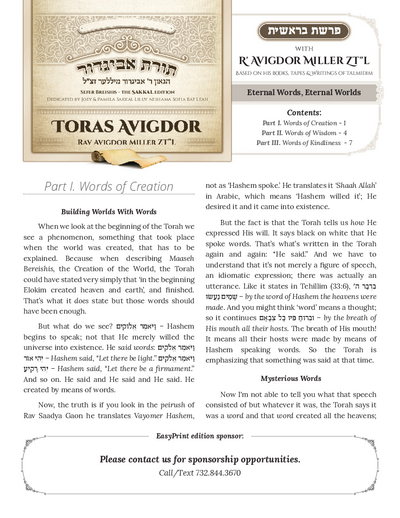
Now, when Hakadosh Boruch Hu said words at Maaseh Bereishis it was many many things. Trillions of creations and trillions of processes came into existence. Creation was almost infinite in its results and consequences. But the common denominator of all of Creation is םָלֹעו ‡≈לָמ ֹבוּטו¿ו ֹלו¿„ָּ‚. Do you recall where that is? We say it in the yotzer of Shachris, Shabbos morning. םָלֹעו ‡≈לָמ ֹבוּטו¿ו ֹלו¿„ָּ‚ – His greatness and His kindliness fill the world, which means that everything in the world is made up of those two qualities; number one, godlo, which means His greatness, His wisdom, and number two, tuvo, which mean His goodness, His kindness.

How is that so? Number one, everything in the world bespeaks the greatness of Hashem because it demonstrates plan and purpose. There’s nothing in the world that doesn’t show infinite design, infinite wisdom. Of course, you have to practice up before you’re fully convinced, but after a while it dawns on you so clearly that it’s inescapable – there's not a thing in the universe that does not demonstrate wisdom.

And the second thing that jumps out at us from Creation is tuvo, the Creator’s kindness. Wherever you turn you can see the chesed Hashem. And so these are the two common denominators that we see in the results of Hashem’s words. Wherever you look that's how it is, you see in Creation the goodness of Hashem and the wisdom of Hashem.

Wise Tomatoes

Now I could spend an hour talking about that, many hours – I would love to give a long dissertation right now about godlo v’tuvo but I’ll give just one example so that we should understand this idea better. Yesterday in the afternoon I was passing by a neighbor’s front yard and I saw he had tomatoes growing there. I stopped to admire them. How did that wonderful thing happen? Can you make a tomato? Can DuPont make a tomato? Will they ever be able to do it? Never in a million years! There’s so much science that is necessary to know, so many intricate pieces of information in just a tomato seed that they’ll never know enough to create even a poor knock-off of a tomato. As much as they try they’ll never be able to replicate that machinery.

Where did the redness come from? The tomato seed had no redness in it. And that seed put into the soil is able to produce such a wonderful result, a beautiful package of food with coloring. Just to create that color – first it’s a green color hiding among the plants and then only when it’s ready to eat it turns red – that needs such wisdom, such design that the greatest chemical company in the world will never be able to reproduce something similar to that.

Kind Tomatoes

But it’s also tuvo. It’s His kindness. Because why does the tomato turn red? Because red makes it more appetizing. The color attracts people, it makes you more interested in eating. It’s more of a pleasure to eat a brightly colored red tomato than a tomato that has no color at all. Suppose all tomatoes looked like potatoes. You might not want to eat them. You see the Creator wants to give you more cheshek to eat it.

Hakadosh Baruch Hu made fruit beautifully colored so that you should enjoy them more. And it's not a harmful color. It's a beneficial color too. When you put dyes into food in most cases they're harmful, but here is a dye that's beneficial; besides for giving it an attractive color it's also good to eat. It tastes good and it’s nourishing. It’s good because it’s tuvo.

And so just when you look at the tomato plant, you see right away the godlo v’tuvo, the wisdom and kindness, that the Creator demonstrated when He made this world.

Angelic Tailors

I can’t help myself so I’ll give you one more example. םׁ≈ ּ̆ƒב¿לַּיַו רֹעו ֹ̇נו¿ ָּ̇כ ֹוּ ׁ̇¿ ̆ƒ‡¿לּו םָ„ָ‡¿ל יםƒ ֹ̃ל¡‡ 'ה ׂ ַ̆ﬠַּיַו – And Hashem made for Adam and his wife garments to cover their skin, and He clothed them (Bereishis 3:21).

So Rabbeinu Saadya Gaon says that it doesn’t mean that Hashem gave them garments just like that. He didn’t send angels down with measuring tape and scissors to be tailors. No, Rabbeinu Saadya learns it differently. He says that Hashem, when He created the world by means of His speech, He created all the materials that mankind needs for clothing.

That's what it means ‘He gave them kosnos, garments, ohr, to cover their skin.’ When He said “The earth should bring forth plants”, included in that was clothing. Hashem created such plants that supply clothing. In His wisdom and kindness He made flax, that's linen, and cotton grow from the ground. And when He said, “The earth should bring forth living creatures according to its kind,” included in that was sheep and its wool. He made wool grow on sheep.

The truth is that wool also grows from the ground because what is wool? It’s grass. The sheep eat grass and from the grass they grow wool. Now if the sheep would eat wool and he would produce wool on his back, even then it would be a miracle. You try to eat wool and produce wool. But the sheep doesn’t even eat wool. It eats grass and changes it into wool. Suppose you have a machine that you throw in grass on one end and the other end wool comes out. If I could patent that machine, I’d become a millionaire overnight. But it’ll never be patented. Hakadosh Baruch Hu is holding that patent because there’s too much wisdom there for the human mind, for human capabilities.

It’s Growing for Us

But not only wisdom; it’s tuvo, His kindness. Because what is cotton for? What is flax for? Animals don’t eat that cotton. Insects don’t eat cotton. It’ll fall into the earth and rot away if you don’t pick it. There’s only one purpose for the cotton – that mankind should take it and turn it into clothing. And the wool, who’s that for? The sheep doesn’t need that wool. And when you shear it off every season, it grows back again. What’s it doing here?

The answer is that Hakadosh Baruch Hu, in His kindness, is supplying us with clothing. All types of clothing that grow by means of a dizzying amount of miracles. And so when you see clothing it means you’re looking at the godlo v’tuvo of Hashem.

And therefore – we could give a thousand more examples – we see that Hashem’s dibbur, His words at Maaseh Bereishis, were always directed with two purposes in mind: wisdom and kindness. Hashem didn’t open His mouth for nothing, just to say d’varim b’teilim, to crack a joke or make a good comeback, a snappy retort; only for plan and purpose, for chochmah. That’s number one, that everything in Creation displays that Hashem spoke with wisdom. And the second purpose is kindliness. Everything in Creation is for chesed. Tomatoes and clothing and so on. He gives us all the things we need in order to live happily in this world.

The Wise Woman

And therefore just like He spoke that’s how we have to speak. Just like Hashem’s word, His creation, was ֹבוּטו¿ו ֹלו¿„ָּ‚, it’s all His goodness and His greatness, so too all of the words that we produce should be like His. Mah Hu, just like He, all of His words are chochmah v’chessed, so too that’s what we have to produce; chochmah v’chessed and that’s all.

Now, it’s no coincidence that when we consult the last chapter in Mishlei where it describes the speech of the ‘Woman of Valor’ we find that it’s these two ideals that are on her tongue. Here's how it’s stated: הָמ¿כָח¿ב הָח¿ ָּ̇פ ָיהּƒפ – She opens her mouth with wisdom, הָנֹוׁ ̆¿ל לַﬠ „∆ס∆ח ַ̇רֹו ̇¿ו – and the teaching, it means the doctrine, of kindliness is on her tongue (Mishlei 31:26).

Now, it’s probable that Shlomo Hamelech is talking about his own mother. He had a wise mother and he mentions her previously in the sefer so probably it's his mother he's talking about, her way of speaking, but either way it’s intended to be a model for all of us. I say ‘all of us’ because it’s important to note that this possuk, the lesson, is not talking only to women. Only that this was Shlomo’s mashal – we’ll see later why he chose it – but this is the lesson we learn from the dibbur of Hakadosh Baruch Hu when He created the world and it applies equally to women and men, boys and girls.

The Padlocked Peh

Now what does it say about this woman? Number one is that she opens her mouth with wisdom. Otherwise, she didn't speak. It’s piha paschah; when she opens up, it’s like opening up a door. A door doesn’t open by itself. When you decide that you want to open it, you walk over and you open it up.

So this woman of valor when she decides to speak so she makes up her mind to open up the door and she unlocks her lips. It's not a simple process. She won’t open her mouth unless she first consults herself, does it have to be said? And if she considers it and decides that yes, it is appropriate, so she takes the padlock off of her lips and says her words of wisdom. And then she closes the door again.

Of course such a person won't open their mouth frequently. If you’re opening your mouth only with wisdom so there will be many occasions when the lips remain padlocked. After all, you’re thinking beforehand that maybe the circumstances don't warrant anything to be said and therefore better to keep quiet.

The Rambam in Hilchos De’os (2:4) describes such a person: יםƒרָב¿„ּƒב ֹו‡ הָמ¿כָח רַב¿„ּƒב ֹו‡ ‡ָּל∆‡ רּ≈בַ„¿י ‡ֹל ם∆הָ ל¿יךƒרָּˆׁ∆ ̆ – A wise person doesn’t shoot off his mouth; he doesn’t speak unless it’s something of wisdom or if it’s necessary. He considers, “Am I saying something wise, instructive or is it maybe necessary?” Otherwise, forget about it.

They said about Rav, a disciple of Rabbeinu Hakadosh, that he never spoke idle talk all his days. You hear such an achievement? לָּכ הָל≈טּ¿ב הָיחׂƒ ̆ חָׂ ̆ ‡ֹל יוָמָי – he never spoke unnecessary talk (ibid.). And don’t think it was easy. He had to train himself. But he succeeded. And the Rambam says, what’s idle talk? םָ„ָ‡ לָּכ בֹר ַ̇יחׂƒ ̆ ‡יƒה ֹזו – that’s what most people

PDF Preview