Preparing for Shabbos in Halachah
Limuday Moshe | January 25, 2024
Print This Article
View Original PDF

Preparing for Shabbos in Halachah

Limuday Moshe | December 10, 2025

In this week’s parsha we learn all about the manna. The Gemara in Shabbos (117b) learns out from the manna: לעולם ישכים אדם להוצאת שבת שנאמר והיה ביום הששי והכינו את אשר יביאו לאלתר - “One should get up early (on erev Shabbos) and busy himself with Shabbos preparations as it says ‘It was Friday and they prepared that which fell’, and the manna fell straight away”. Rashi explains, that by the manna it says: וילקטו אתו בבקר בבקר – “They gathered it every single morning”. Just like they gathered the manna as soon as it fell - first thing in the morning, similarly, one should busy himself with preparing for Shabbos first thing on Friday morning.

Friday Shopping

The aforementioned Gemara is mentioned by the Shulchan Aruch (250:1). There is a discussion over whether this is an actual obligation, or merely a worthy practice (see Mishnah Berurah 250:1; Aruch HaShulchan 1; Biur Halachah).

Some poskim write that one should shop first thing in the morning, even before davening, since doing so is a mitzvah. However, others explain that this is only in case there will not sufficient food to purchase after davening. Otherwise, the latter opinion maintains that it is preferable to wait until after davening before purchasing food for Shabbos (see Pri Megodim 1; Mishnah Berurah 1 and Biur Halachah).

The Mishnah Berurah writes that one should daven first unless the required goods will not be available after davening. He adds that even in this case one should recite krias shema before shopping.

It is preferable to do one’s Shabbos shopping on Friday, rather than earlier in the week, even if doing so is less convenient. The reason for this is that shopping on Friday is more recognizable as being done in honor of Shabbos (Mishnah Berurah 2; Elyah Rabbah 1; Aruch HaShulchan 2).

However, if one wishes to prepare something for Shabbos on Thursday or before, it is of course fine to buy things for Shabbos on any day of the week. Moreover, because experience shows that Friday preparations can often get hectic (especially during the winter), many are careful to purchase specifically before Friday. The pressures of short Fridays are mentioned in the context of this halachah (see Ben Ish Chai, Lech Lecha 2:6).

Do it Yourself

The Gemara (Shabbos 119a) and later halachic authorities (See Tur and Shulchan Aruch 250:1; Magen Avraham 2; Shulchan Aruch HaRav 4) note that a person should himself engage in preparations for Shabbos. Although others may be willing to make the preparations – for instance a person’s children or his wife, or a home aide – he should personally take care of some preparations.

Although the Rambam uses the word chayav, which implies that this is an obligation, the Aruch HaShulchan (3) understands that this is a hiddur mitzvah [not a full obligation, but a beautification of the mitzvah]. However, most authorities maintain that it is an obligation and in fact the Gemara (Kiddushin 41a) derives from here that one should always perform a mitzvah by himself rather than delegate its performance to a deputy.

Based on this principle, the Gemara relates how many Amoraim would do different activities in preparation for Shabbos, such as salting fish or cleaning the house. This shows that Shabbos preparations are not beneath the dignity of any individual. Everybody should participate in some way in preparations for Shabbos – whether in shopping or other preparations.

As a modern example, it is known that the Steipler himself used to sweep his house in honor of Shabbos (Orchos Rabbeinu Vol. 3, p. 228).

Learning Less

In order to ensure that a person is able to participate in the Shabbos preparations, some authorities mention that one should learn a bit less on Friday than on regular days, in order to allow time to prepare for Shabbos (see Rema 251:2; Shulchan Aruch HaRav 250:2).

For this reason, in some circles there is no Yeshiva on Friday. However, the Magen Avraham (251:6; Avraham (251:6; Mishnah Berurah 251:8) says that the principle applies only when there is much work to do on Friday in preparation for Shabbos, such as salting meat and so on. Today, when most of our preparations take far less time, some write that the principle does not apply (see Nishmas Shabbos 1:144).

There is no halachic need or precedent for diminishing the study of Yeshiva bochurim on Fridays, since all of their needs are taken care of by the Yeshiva.

Working on Erev Shabbos

The Gemara states that a person who goes to work in the afternoon of erev Shabbos “does not see berachah from that work” – a principle that is ruled by the Shulchan Aruch (251:1). The Mishnah Berurah (251:2) explains that even if he profits from this particular job, he will lose money elsewhere to balance the gain. The same principle, which derives from the obligation to honor Shabbos, applies also to Yom Tov and Yom Kippur.

The Shulchan Aruch notes a dispute concerning the time from which this halachah applies. Some say it begins from 6 ½ hours into the day (the earliest time at which one can daven Mincha), while others are more lenient and maintain it starts from 9 ½ hours into the day.

Many write that the custom is to be stringent beginning at the earlier time (see Magen Avraham 4; Taz 1; Rabbi Akiva Eiger; Aruch HaShulchan 1), but the Mishnah Berurah (3) writes that those who rely on the later time, “...do not lose.”

The Mishnah Berurah adds that the halachah applies specifically to somebody who is self-employed. With regard to an employee, the Gemara states that one must continue working past these times, in accordance with the work contract between the employee and his employer. Naturally, an employee must ensure that he can get home at a reasonable time on erev Shabbos.

This basic halachah applies specifically to fixed labor, such as doing one’s regular job (going to work). Concerning irregular labor, such as laundering, sewing, writing letters, taking haircuts, and so on, there is no prohibition on Friday afternoon (by contrast with the afternoon of erev Pesach; see Magen Avraham 5; Mishnah Berurah 7).

Even fixed labor is permitted when it is being done as preparation for Shabbos (so that an electrician can work, and be paid for his work, if he is doing work required for Shabbos by a Jewish family).

In addition to work, one must refrain from traveling long distances on Friday. We all know of unfortunate incidents in which somebody got stranded away from home on account of a Friday excursion - a person must avoid this happening.

Eating on Erev Shabbos

The Rambam (Hilchos Shabbos 30:4) and Shulchan Aruch (249:2) rule that one may not eat an unusually large meal on Friday. The reason for this is that one should come into Shabbos with an appetite, in honor of the Shabbos meal. An additional reason is that if a person is busy preparing for the Friday meal, he will not be able to make adequate preparations for the Shabbos meals (Mishnah Berurah 10).

The Rema adds that a festive meal that has to be made on Friday (such as for a bris or pidyon haben, or the Purim meal when Purim falls on Friday) can be done in the regular manner.

It is permitted to eat a regular meal on Friday, as during the entire week, yet there is a mitzvah to refrain from this after the ninth hour of the day. Eating and drinking without sitting down to a meal is permitted the entire erev Shabbos (Mishnah Berurah 15, Aruch HaShulchan 1). The Biur Halachah adds that it is always permitted to eat if this is required for alleviation of hunger pangs.

On short Fridays in the winter it is mitzvah to refrain from eating and drinking earlier in the day in order to have an appetite for Shabbos (Mishnah Berurah 17, Aruch HaShulchan 6). The Aruch HaShulchan (7) adds that when Yom Tov falls on Friday it is permitted to eat Yom Tov meals, and there is no obligation to refrain from eating a regular festive meal – though he writes that one should try to refrain from eating his fill.

Doing Something Just Before Shabbos

The Mishnah Berurah (250:2) quoting the Magen Avraham mentions something which I feel is not so well known. He says, that even if one prepares everything early Friday morning, he should do something last minute just before Shabbos. He cites a remez [hint] from the pasuk which says, והיה משנה, which he explains to mean that one should do a second preparation. Therefore, even if one is well organized, he should only plug in the hotplate just before Shabbos, take out the rubbish just before Shabbos or something similar.

Essential Preparations

In conclusion it is worth listing the preparations that a person should do in honor of Shabbos. The idea of washing oneself for Shabbos, and performing other tasks related to bodily hygiene and cleanliness, is found in an anecdote which the Gemara relates about Rabbi Yehuda bar Ilai, who used to wash himself, don his best clothes, and would resemble a Heavenly angel (Shabbos 25b).

The Shulchan Aruch (260:1) rules that a person should preferably wash his entire body in honor of Shabbos, and if this is not possible he should at least wash his face, hands and feet. It is likewise a mitzvah to wash one’s hair and to cut one’s nails, and to have a haircut if required.

It is likewise a mitzvah to clean the house (Shulchan Aruch 262:1), to wear special Shabbos clothes (262:2), and of course to make all the culinary preparations necessary for the Shabbos meals. The Shabbos table should be set before those who went to shul return on Friday night (accompanied by the Shabbos Angels), and the change from weekday to Shabbos should be apparent in all things.

We conclude with the words of Rabbi Tzadok HaCohen, who urges us to prepare well for Shabbos:

“Each person according to his means and level must prepare from weekday to Shabbos, for only those who toil before Shabbos will eat on Shabbos. Although the day is sanctified to Hashem, this sanctity is only felt to the degree that a person prepares for it. ... When a person is not ready for the sanctity of Shabbos, he cannot experience its holiness ... therefore a person sanctifies Shabbos according to his preparation.”

May we prepare carefully for Shabbos and indeed bask in its great sanctity.

(Based on a halachah write-up written by R’ Yehoshua Pfeffer)
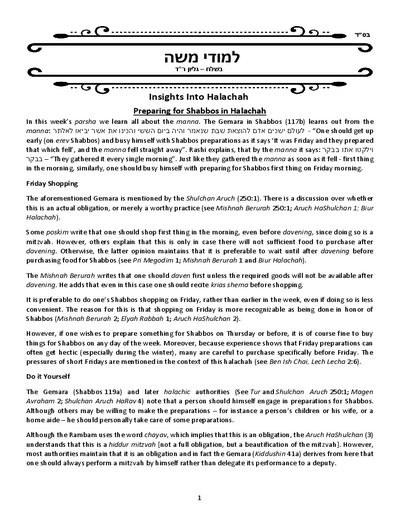
In this week’s parsha we learn all about the manna. The Gemara in Shabbos (117b) learns out from the manna: לעולם ישכים אדם להוצאת שבת שנאמר והיה ביום הששי והכינו את אשר יביאו לאלתר - “One should get up early (on erev Shabbos) and busy himself with Shabbos preparations as it says ‘It was Friday and they prepared that which fell’, and the manna fell straight away”. Rashi explains, that by the manna it says: וילקטו אתו בבקר בבקר – “They gathered it every single morning”. Just like they gathered the manna as soon as it fell - first thing in the morning, similarly, one should busy himself with preparing for Shabbos first thing on Friday morning.

Friday Shopping

The aforementioned Gemara is mentioned by the Shulchan Aruch (250:1). There is a discussion over whether this is an actual obligation, or merely a worthy practice (see Mishnah Berurah 250:1; Aruch HaShulchan 1; Biur Halachah).

Some poskim write that one should shop first thing in the morning, even before davening, since doing so is a mitzvah. However, others explain that this is only in case there will not sufficient food to purchase after davening. Otherwise, the latter opinion maintains that it is preferable to wait until after davening before purchasing food for Shabbos (see Pri Megodim 1; Mishnah Berurah 1 and Biur Halachah).

The Mishnah Berurah writes that one should daven first unless the required goods will not be available after davening. He adds that even in this case one should recite krias shema before shopping.

It is preferable to do one’s Shabbos shopping on Friday, rather than earlier in the week, even if doing so is less convenient. The reason for this is that shopping on Friday is more recognizable as being done in honor of Shabbos (Mishnah Berurah 2; Elyah Rabbah 1; Aruch HaShulchan 2).

However, if one wishes to prepare something for Shabbos on Thursday or before, it is of course fine to buy things for Shabbos on any day of the week. Moreover, because experience shows that Friday preparations can often get hectic (especially during the winter), many are careful to purchase specifically before Friday. The pressures of short Fridays are mentioned in the context of this halachah (see Ben Ish Chai, Lech Lecha 2:6).

Do it Yourself

The Gemara (Shabbos 119a) and later halachic authorities (See Tur and Shulchan Aruch 250:1; Magen Avraham 2; Shulchan Aruch HaRav 4) note that a person should himself engage in preparations for Shabbos. Although others may be willing to make the preparations – for instance a person’s children or his wife, or a home aide – he should personally take care of some preparations.

Although the Rambam uses the word chayav, which implies that this is an obligation, the Aruch HaShulchan (3) understands that this is a hiddur mitzvah [not a full obligation, but a beautification of the mitzvah]. However, most authorities maintain that it is an obligation and in fact the Gemara (Kiddushin 41a) derives from here that one should always perform a mitzvah by himself rather than delegate its performance to a deputy.

Based on this principle, the Gemara relates how many Amoraim would do different activities in preparation for Shabbos, such as salting fish or cleaning the house. This shows that Shabbos preparations are not beneath the dignity of any individual. Everybody should participate in some way in preparations for Shabbos – whether in shopping or other preparations.

As a modern example, it is known that the Steipler himself used to sweep his house in honor of Shabbos (Orchos Rabbeinu Vol. 3, p. 228).

Learning Less

In order to ensure that a person is able to participate in the Shabbos preparations, some authorities mention that one should learn a bit less on Friday than on regular days, in order to allow time to prepare for Shabbos (see Rema 251:2; Shulchan Aruch HaRav 250:2).

For this reason, in some circles there is no Yeshiva on Friday. However, the Magen Avraham (251:6; Avraham (251:6; Mishnah Berurah 251:8) says that the principle applies only when there is much work to do on Friday in preparation for Shabbos, such as salting meat and so on. Today, when most of our preparations take far less time, some write that the principle does not apply (see Nishmas Shabbos 1:144).

There is no halachic need or precedent for diminishing the study of Yeshiva bochurim on Fridays, since all of their needs are taken care of by the Yeshiva.

Working on Erev Shabbos

The Gemara states that a person who goes to work in the afternoon of erev Shabbos “does not see berachah from that work” – a principle that is ruled by the Shulchan Aruch (251:1). The Mishnah Berurah (251:2) explains that even if he profits from this particular job, he will lose money elsewhere to balance the gain. The same principle, which derives from the obligation to honor Shabbos, applies also to Yom Tov and Yom Kippur.

The Shulchan Aruch notes a dispute concerning the time from which this halachah applies. Some say it begins from 6 ½ hours into the day (the earliest time at which one can daven Mincha), while others are more lenient and maintain it starts from 9 ½ hours into the day.

Many write that the custom is to be stringent beginning at the earlier time (see Magen Avraham 4; Taz 1; Rabbi Akiva Eiger; Aruch HaShulchan 1), but the Mishnah Berurah (3) writes that those who rely on the later time, “...do not lose.”

The Mishnah Berurah adds that the halachah applies specifically to somebody who is self-employed. With regard to an employee, the Gemara states that one must continue working past these times, in accordance with the work contract between the employee and his employer. Naturally, an employee must ensure that he can get home at a reasonable time on erev Shabbos.

This basic halachah applies specifically to fixed labor, such as doing one’s regular job (going to work). Concerning irregular labor, such as laundering, sewing, writing letters, taking haircuts, and so on, there is no prohibition on Friday afternoon (by contrast with the afternoon of erev Pesach; see Magen Avraham 5; Mishnah Berurah 7).

Even fixed labor is permitted when it is being done as preparation for Shabbos (so that an electrician can work, and be paid for his work, if he is doing work required for Shabbos by a Jewish family).

In addition to work, one must refrain from traveling long distances on Friday. We all know of unfortunate incidents in which somebody got stranded away from home on account of a Friday excursion - a person must avoid this happening.

Eating on Erev Shabbos

The Rambam (Hilchos Shabbos 30:4) and Shulchan Aruch (249:2) rule that one may not eat an unusually large meal on Friday. The reason for this is that one should come into Shabbos with an appetite, in honor of the Shabbos meal. An additional reason is that if a person is busy preparing for the Friday meal, he will not be able to make adequate preparations for the Shabbos meals (Mishnah Berurah 10).

The Rema adds that a festive meal that has to be made on Friday (such as for a bris or pidyon haben, or the Purim meal when Purim falls on Friday) can be done in the regular manner.

It is permitted to eat a regular meal on Friday, as during the entire week, yet there is a mitzvah to refrain from this after the ninth hour of the day. Eating and drinking without sitting down to a meal is permitted the entire erev Shabbos (Mishnah Berurah 15, Aruch HaShulchan 1). The Biur Halachah adds that it is always permitted to eat if this is required for alleviation of hunger pangs.

On short Fridays in the winter it is mitzvah to refrain from eating and drinking earlier in the day in order to have an appetite for Shabbos (Mishnah Berurah 17, Aruch HaShulchan 6). The Aruch HaShulchan (7) adds that when Yom Tov falls on Friday it is permitted to eat Yom Tov meals, and there is no obligation to refrain from eating a regular festive meal – though he writes that one should try to refrain from eating his fill.

Doing Something Just Before Shabbos

The Mishnah Berurah (250:2) quoting the Magen Avraham mentions something which I feel is not so well known. He says, that even if one prepares everything early Friday morning, he should do something last minute just before Shabbos. He cites a remez [hint] from the pasuk which says, והיה משנה, which he explains to mean that one should do a second preparation. Therefore, even if one is well organized, he should only plug in the hotplate just before Shabbos, take out the rubbish just before Shabbos or something similar.

Essential Preparations

In conclusion it is worth listing the preparations that a person should do in honor of Shabbos. The idea of washing oneself for Shabbos, and performing other tasks related to bodily hygiene and cleanliness, is found in an anecdote which the Gemara relates about Rabbi Yehuda bar Ilai, who used to wash himself, don his best clothes, and would resemble a Heavenly angel (Shabbos 25b).

The Shulchan Aruch (260:1) rules that a person should preferably wash his entire body in honor of Shabbos, and if this is not possible he should at least wash his face, hands and feet. It is likewise a mitzvah to wash one’s hair and to cut one’s nails, and to have a haircut if required.

It is likewise a mitzvah to clean the house (Shulchan Aruch 262:1), to wear special Shabbos clothes (262:2), and of course to make all the culinary preparations necessary for the Shabbos meals. The Shabbos table should be set before those who went to shul return on Friday night (accompanied by the Shabbos Angels), and the change from weekday to Shabbos should be apparent in all things.

We conclude with the words of Rabbi Tzadok HaCohen, who urges us to prepare well for Shabbos:

“Each person according to his means and level must prepare from weekday to Shabbos, for only those who toil before Shabbos will eat on Shabbos. Although the day is sanctified to Hashem, this sanctity is only felt to the degree that a person prepares for it. ... When a person is not ready for the sanctity of Shabbos, he cannot experience its holiness ... therefore a person sanctifies Shabbos according to his preparation.”

May we prepare carefully for Shabbos and indeed bask in its great sanctity.

(Based on a halachah write-up written by R’ Yehoshua Pfeffer)

PDF Preview