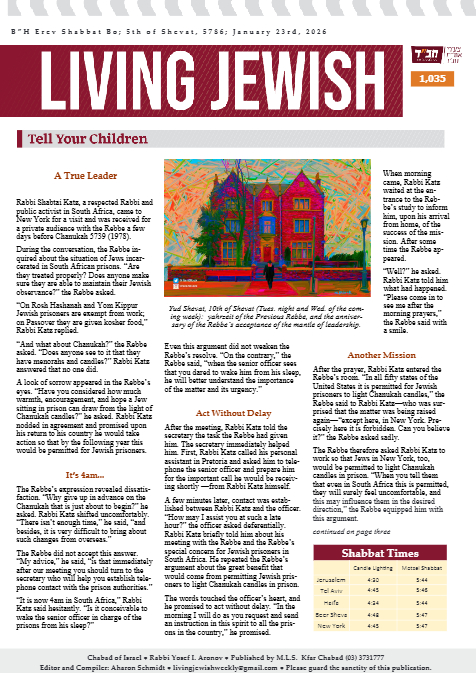
A True Leader
Rabbi Shabtai Katz, a respected Rabbi and public activist in South Africa, came to New York for a visit and was received for a private audience with the Rebbe a few days before Chanukah 5739 (1978).
During the conversation, the Rebbe inquired about the situation of Jews incarcerated in South African prisons. “Are they treated properly? Does anyone make sure they are able to maintain their Jewish observance?” the Rebbe asked.
“On Rosh Hashanah and Yom Kippur Jewish prisoners are exempt from work; on Passover they are given kosher food,” Rabbi Katz replied.
“And what about Chanukah?” the Rebbe asked. “Does anyone see to it that they have menorahs and candles?” Rabbi Katz answered that no one did.
A look of sorrow appeared in the Rebbe’s eyes. “Have you considered how much warmth, encouragement, and hope a Jew sitting in prison can draw from the light of Chanukah candles?” he asked. Rabbi Katz nodded in agreement and promised upon his return to his country he would take action so that by the following year this would be permitted for Jewish prisoners.
It’s 4am...
The Rebbe’s expression revealed dissatisfaction. “Why give up in advance on the Chanukah that is just about to begin?” he asked. Rabbi Katz shifted uncomfortably. “There isn’t enough time,” he said, “and besides, it is very difficult to bring about such changes from overseas.”
The Rebbe did not accept this answer. “My advice,” he said, “is that immediately after our meeting you should turn to the secretary who will help you establish telephone contact with the prison authorities.”
“It is now 4am in South Africa,” Rabbi Katz said hesitantly. “Is it conceivable to wake the senior officer in charge of the prisons from his sleep?”
Even this argument did not weaken the Rebbe’s resolve. “On the contrary,” the Rebbe said, “when the senior officer sees that you dared to wake him from his sleep, he will better understand the importance of the matter and its urgency.”
Act Without Delay
After the meeting, Rabbi Katz told the secretary the task the Rebbe had given him. The secretary immediately helped him. First, Rabbi Katz called his personal assistant in Pretoria and asked him to telephone the senior officer and prepare him for the important call he would be receiving shortly —from Rabbi Katz himself.
A few minutes later, contact was established between Rabbi Katz and the officer. “How may I assist you at such a late hour?” the officer asked deferentially.
Rabbi Katz briefly told him about his meeting with the Rebbe and the Rebbe’s special concern for Jewish prisoners in South Africa. He repeated the Rebbe’s argument about the great benefit that would come from permitting Jewish prisoners to light Chanukah candles in prison.
The words touched the officer’s heart, and he promised to act without delay. “In the morning I will do as you request and send an instruction in this spirit to all the prisons in the country,” he promised.
When morning came, Rabbi Katz waited at the entrance to the Rebbe’s study to inform him, upon his arrival from home, of the success of the mission. After some time the Rebbe appeared.
“Well?” he asked. Rabbi Katz told him what had happened. “Please come in to see me after the morning prayers,” the Rebbe said with a smile.
Another Mission
After the prayer, Rabbi Katz entered the Rebbe’s room. “In all fifty states of the United States it is permitted for Jewish prisoners to light Chanukah candles,” the Rebbe said to Rabbi Katz—who was surprised that the matter was being raised again—“except here, in New York. Precisely here it is forbidden. Can you believe it?” the Rebbe asked sadly.
The Rebbe therefore asked Rabbi Katz to work so that Jews in New York, too, would be permitted to light Chanukah candles in prison. “When you tell them that even in South Africa this is permitted, they will surely feel uncomfortable, and this may influence them in the desired direction,” the Rebbe equipped him with this argument.
continued on page three
A True Leader (continued)
Rabbi Katz, who was not a local resident and had no connections in New York, truly did not know how the Rebbe expected him to act in this matter. Nevertheless, the Rebbe’s instruction carried weight—especially after he had already experienced one success. Rabbi Katz turned for help to a local Jewish activist, and together they contacted the commissioner of New York’s prison system.
Rabbi Katz followed the Rebbe’s instruction and told the commissioner about the situation in South Africa.
“If even in South Africa they allow Jews to light candles in prisons, there is no reason that in an enlightened state like New York we should not permit it,” the officer responded. That Chanukah Jewish prisoners were already able to light candles in prison.
When Rabbi Katz returned and reported this to the Rebbe, the Rebbe invited him into his room again that same day. The Rebbe thanked him and in gratitude gave him a personal gift—a copy of the Tanya. The Rebbe also added two English books, to be given to the commissioner of South African prisons and to his wife.
Upon returning to his country, Rabbi Katz called the officer and told him about the gift from the Rebbe. “I’m coming immediately,” the officer said on the phone. Within a short time, the officer knocked on Rabbi Katz’s door.
“Why did you hurry?” Rabbi Katz asked. The officer’s answer astonished him: “A person who sits in New York and thinks about another person, whom he does not know at all, who is at the other end of the globe, and who makes an effort to bring him joy and illuminate his life, deserves, in my eyes, the title of ‘a true leader.’ And when a true leader sends me a gift, I wish to receive it as quickly as possible.”