And the Locusts Will Fill Your Homes and He Turned and Left Pharaoh
מגדל אור | January 22, 2026
Print This Article
View Original PDF

And the Locusts Will Fill Your Homes and He Turned and Left Pharaoh

מגדל אור | January 30, 2026

“And [the locusts] will fill your homes... and he turned and left Pharaoh” (Shemos 10:6)

Every plague came with a warning, and the plague of arbeh, locusts, was no different. Moshe painted a stark picture for Pharaoh and his servants by telling them that these locusts would come and devour any remaining vestiges of food in the already devastated land. Before Pharaoh could respond, Moshe turned on his heel and marched out of Pharaoh’s chamber.

He didn’t get far. While he was yet in the outer chamber of the palace, Pharaoh’s servants pleaded with their master. Terrified at the proposition of starvation, they implored him to let the Jews go and serve their G-d. They said, “Do you not yet know that Egypt is lost?”

Immediately, Moshe and Aharon were summoned back to Pharaoh. He accused them of nefarious scheming, and told them their plan was revealed. They had asked for their children and livestock to accompany them, and he said this belied their intent to escape and not return. He thereupon agreed that the men could all go, but not the children or animals. Thereupon, he dismissed Moshe and Aharon and hurriedly shooed them out of his palace.

There is high emotion running through these exchanges, and it behooves us to investigate a bit more. When Moshe mentioned the locusts, he turned his back on Pharaoh and left the room. This was highly offensive, because he did not take proper leave of the king. Moshe, however, was justified, since Pharaoh had admitted his own wickedness but nevertheless went back on his word and hardened his heart.

This was an insult Pharaoh would not bear. Instead, he insisted on summoning Moshe, and having him returned forcibly if necessary. Then, he said his piece and proceeded to throw Moshe out, in an almost revenge-fueled tantrum. He would not acknowledge that he acted like less than a king, and would not allow Moshe to get away with this affront. But there was a major difference between the two men.

When Moshe turned and left Pharaoh, it wasn’t personal. He wanted to give Pharaoh’s servants a chance to argue with their master. That’s why he didn’t exit the palace fully, but waited to be called back into Pharaoh when they’d finished speaking. When Pharaoh demanded that Moshe be brought back to him, in order to prove that “No one treats Pharaoh that way!” he played right into Moshe’s plan. When he summarily sent Moshe out soon after summoning him, it was supposed to show Pharaoh’s might, but it only showed his immaturity and weakness.

Moshe was content to let Pharaoh think he won the battle, and even remained there until released by Pharaoh and sent out. He knew that, ultimately, Pharaoh would acquiesce as Hashem promised, and in fact, later, Pharaoh would apologize for mistreating Moshe.

We can learn from this the difference between an eved Hashem and a person who serves himself. The servant of Hashem understands he is simply a messenger; just playing a part in Hashem’s master plan. He doesn’t lose himself and become embroiled in a battle of egos. Someone like Pharoah, though, who considers himself powerful and godlike, will act childishly to prove his strength. In the end, though, it is clear which one is the true master.

One day, a Yeshiva boy, deciding to show his strength and “superiority,” childishly grabbed away another bochur’s sefer. When asked to return it, the rascal demanded, “First, say please.” The other boy did as told, and said “Please, may I have the book back?” “Say ‘pretty’ please,” ordered the first, and the wronged student calmly did as he was told.

“Now say ‘uncle’,” said the bully with glee. This time, when the second said “Uncle,” the first seemed satisfied and returned the item. As he walked away, an incredulous onlooker asked the tormented boy, “How could you let him get away with that? You could have pounded him into the ground!”

“What difference does it make?” the boy asked calmly. “I got the sefer back and he’s happy. Besides,” he said with a grin, “Ess kost mir gelt? (Did it cost me any money?)”
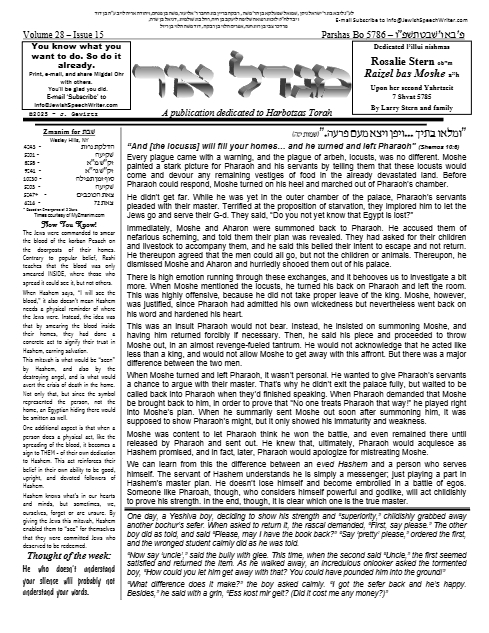
“And [the locusts] will fill your homes... and he turned and left Pharaoh” (Shemos 10:6)

Every plague came with a warning, and the plague of arbeh, locusts, was no different. Moshe painted a stark picture for Pharaoh and his servants by telling them that these locusts would come and devour any remaining vestiges of food in the already devastated land. Before Pharaoh could respond, Moshe turned on his heel and marched out of Pharaoh’s chamber.

He didn’t get far. While he was yet in the outer chamber of the palace, Pharaoh’s servants pleaded with their master. Terrified at the proposition of starvation, they implored him to let the Jews go and serve their G-d. They said, “Do you not yet know that Egypt is lost?”

Immediately, Moshe and Aharon were summoned back to Pharaoh. He accused them of nefarious scheming, and told them their plan was revealed. They had asked for their children and livestock to accompany them, and he said this belied their intent to escape and not return. He thereupon agreed that the men could all go, but not the children or animals. Thereupon, he dismissed Moshe and Aharon and hurriedly shooed them out of his palace.

There is high emotion running through these exchanges, and it behooves us to investigate a bit more. When Moshe mentioned the locusts, he turned his back on Pharaoh and left the room. This was highly offensive, because he did not take proper leave of the king. Moshe, however, was justified, since Pharaoh had admitted his own wickedness but nevertheless went back on his word and hardened his heart.

This was an insult Pharaoh would not bear. Instead, he insisted on summoning Moshe, and having him returned forcibly if necessary. Then, he said his piece and proceeded to throw Moshe out, in an almost revenge-fueled tantrum. He would not acknowledge that he acted like less than a king, and would not allow Moshe to get away with this affront. But there was a major difference between the two men.

When Moshe turned and left Pharaoh, it wasn’t personal. He wanted to give Pharaoh’s servants a chance to argue with their master. That’s why he didn’t exit the palace fully, but waited to be called back into Pharaoh when they’d finished speaking. When Pharaoh demanded that Moshe be brought back to him, in order to prove that “No one treats Pharaoh that way!” he played right into Moshe’s plan. When he summarily sent Moshe out soon after summoning him, it was supposed to show Pharaoh’s might, but it only showed his immaturity and weakness.

Moshe was content to let Pharaoh think he won the battle, and even remained there until released by Pharaoh and sent out. He knew that, ultimately, Pharaoh would acquiesce as Hashem promised, and in fact, later, Pharaoh would apologize for mistreating Moshe.

We can learn from this the difference between an eved Hashem and a person who serves himself. The servant of Hashem understands he is simply a messenger; just playing a part in Hashem’s master plan. He doesn’t lose himself and become embroiled in a battle of egos. Someone like Pharoah, though, who considers himself powerful and godlike, will act childishly to prove his strength. In the end, though, it is clear which one is the true master.

One day, a Yeshiva boy, deciding to show his strength and “superiority,” childishly grabbed away another bochur’s sefer. When asked to return it, the rascal demanded, “First, say please.” The other boy did as told, and said “Please, may I have the book back?” “Say ‘pretty’ please,” ordered the first, and the wronged student calmly did as he was told.

“Now say ‘uncle’,” said the bully with glee. This time, when the second said “Uncle,” the first seemed satisfied and returned the item. As he walked away, an incredulous onlooker asked the tormented boy, “How could you let him get away with that? You could have pounded him into the ground!”

“What difference does it make?” the boy asked calmly. “I got the sefer back and he’s happy. Besides,” he said with a grin, “Ess kost mir gelt? (Did it cost me any money?)”

PDF Preview