What happens at midnight that Pharaoh became concerned
Pardes Yehuda | January 22, 2026
Print This Article
View Original PDF

What happens at midnight that Pharaoh became concerned

Pardes Yehuda | January 30, 2026

It came to pass at midnight, and the Lord smote every firstborn in the land of Egypt, from the firstborn of Pharaoh who sits on his throne to the firstborn of the captive who is in the dungeon, and every firstborn animal. And Pharaoh arose at night, he and all his servants and all the Egyptians, and there was a great outcry in Egypt, for there was no house in which no one was dead. So he called for Moses and Aaron at night, and he said, "Get up and get out from among my people, both you, as well as the children of Israel, and go, worship the Lord as you have spoken. Take also your flocks and also your cattle, as you have spoken, and go, but you shall also bless me."

(12 :29-32)

The Torah is telling us what happened at midnight i ́¦d §i ©e" "d ̈l §i À©N ©d i ́¦v £g«©A Chazal (Megillah 10b) teach us that the word i ́¦d §i ©e "And it was" is a precursor to pain, trouble, or a, "period of misfortune". Here is was a time of trouble for the Egyptians as we see in the flow of the Pesukim.

Posuk 30 it says d ̈l §i À©l d r §x ©R m ̈w ̧ ̈I ©e And Pharaoh arose at night. There is a difficulty why does the Torah have to state that Pharaoh arose at night, when the Torah began this Parsha with “It came to pass at midnight”, which we know that it was at midnight. Therefore, when Pharaoh arose, it was at midnight. If so it could have stated plainly “And Pharaoh arose” and we would know that it was at night? Another difficulty along this line is in Posuk 31 d ̈l §i À©l o x £d «©` §l «E d ̧¤W n §l Á` ̈x §w ¦I ©e “So he called for Moses and Aaron at night”. We just stated that he woke up at midnight, why does the Posuk have to repeat that he called to Moshe and Aaron “at night”. It would have been suffice to simply state Pharaoh called then to Moshe and Aaron.

Another difficulty is, what was the breaking point that happened here that Pharaoh was willing to send out the Yidden. What broke his arrogance? Finally, Pharaoh concludes in Posuk 32 m−¤Y §x ©A ¦C x¬¤W £`«©M E ²g §w m¬¤k §x ©w §A m©B m ̧¤k §p` «v m©B i «¦z ` m©B m−¤Y §k ©x«¥aE Ek®¥l ̈e “Take also your flocks and also your cattle, as you have spoken, and go, but you shall also bless me.” Why did Pharaoh ask Moshe to bless him?

To understand this Parsha, we have to see what Dovid Hamelech says in Tehilim 119:62

K® ̈l z e ́c ed §l mEw † ̈` d ̈l §i À©l z e «v £g :L «¤w §c ¦v i¬¥h §R §W ¦n lÀ©¹r“At midnight, I rise to give thanks to You for Your just judgments”. Midnight or Chatzos is a time of Rachamim, Divine Mercy. His Attribute of Mercy,” which is most in evidence on “Yom Kippur,” the “Day of Atonement. The opposite is Middas HaDin, Divine Attribute of Strict Justice. Generally speaking, it is “Hashem’s Attribute of Strict Justice,” which is most in evidence on “Rosh Hashanah,” the “Day of Judgment.” In the Zohar Parshas Teruma page 135, which we recite on friday night in the prayer of Kegavna, all Dinim or harsh judgements go away on Shabbos. Therefore, Shabbos is a day of Simcha. Therefore, Dovid Hamelech said his prayers at midnight when there is Divine Mercy in the world.

Pharaoh was a scholar, and knew that after midnight was the time of Divine Mercy, and he was shocked, that at that time, there would occur such a harsh punishment on the Egyptians. That is the reason it says i ́¦d §i ©e "And it was" a precursor to pain, but the problem Pharaoh had was d ̈l §i À©N ©d i ́¦v £g«©AIt came to pass at midnight!

Now we can understand d ̈l §i À©l o x £d «©` §l «E d ̧¤W n §l Á` ̈x §w ¦I ©e “So he called for Moses and Aaron at night”. Pharaoh complained to them that is was now midnight, and a time of Midas Rachamim, Divine Mercy!

However, it was revealed to him that Hashem has a different approach to Egypt. The Navi Yeshaya 19:22

s ̄©b ̈p §e :m « ̈` ̈t §xE m−¤d ̈l x¬©Y §r¤p §e 'd c ©r ÆEaÆ ̈W §e ` e ®t ̈x §e s ́ b ̈p m ¦i −©x §v ¦n z ¤` 'd Hashem will first afflict and then heal the Egyptians: when they turn back, Hashem will respond to their entreats and heal them. The Zohar explains that the plagues afflicted the Egyptians and healed the Jewish people. Pharaoh understood that at this time of midnight, even though it is the time of Divine Mercy, it must be the same idea of the plagues, and for the Jews it was a healing, and for the Egyptians it was pain. This same idea was by the splitting of the sea, which was also at midnight. The sea split for the Jews, and it was a healer. Yet at the same time the water covered the Egyptians.

Therefore, since it was still a time of Divine Mercy in the world, Pharaoh asked Moshe to pray for him, at was a time of prayers being answered by Hashem. According to the Meforshim, Pharaoh was spared and survived the drowning of the Egyptians. This proves that prayer helps when it is done with sincerity.

(Yehuda Z. Klitnick)
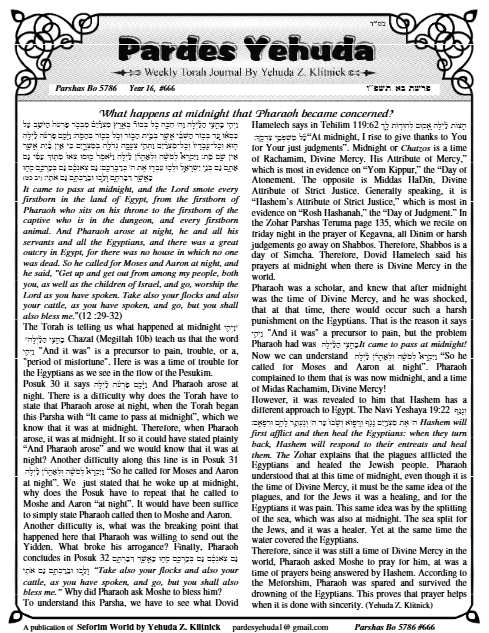
It came to pass at midnight, and the Lord smote every firstborn in the land of Egypt, from the firstborn of Pharaoh who sits on his throne to the firstborn of the captive who is in the dungeon, and every firstborn animal. And Pharaoh arose at night, he and all his servants and all the Egyptians, and there was a great outcry in Egypt, for there was no house in which no one was dead. So he called for Moses and Aaron at night, and he said, "Get up and get out from among my people, both you, as well as the children of Israel, and go, worship the Lord as you have spoken. Take also your flocks and also your cattle, as you have spoken, and go, but you shall also bless me."

(12 :29-32)

The Torah is telling us what happened at midnight i ́¦d §i ©e" "d ̈l §i À©N ©d i ́¦v £g«©A Chazal (Megillah 10b) teach us that the word i ́¦d §i ©e "And it was" is a precursor to pain, trouble, or a, "period of misfortune". Here is was a time of trouble for the Egyptians as we see in the flow of the Pesukim.

Posuk 30 it says d ̈l §i À©l d r §x ©R m ̈w ̧ ̈I ©e And Pharaoh arose at night. There is a difficulty why does the Torah have to state that Pharaoh arose at night, when the Torah began this Parsha with “It came to pass at midnight”, which we know that it was at midnight. Therefore, when Pharaoh arose, it was at midnight. If so it could have stated plainly “And Pharaoh arose” and we would know that it was at night? Another difficulty along this line is in Posuk 31 d ̈l §i À©l o x £d «©` §l «E d ̧¤W n §l Á` ̈x §w ¦I ©e “So he called for Moses and Aaron at night”. We just stated that he woke up at midnight, why does the Posuk have to repeat that he called to Moshe and Aaron “at night”. It would have been suffice to simply state Pharaoh called then to Moshe and Aaron.

Another difficulty is, what was the breaking point that happened here that Pharaoh was willing to send out the Yidden. What broke his arrogance? Finally, Pharaoh concludes in Posuk 32 m−¤Y §x ©A ¦C x¬¤W £`«©M E ²g §w m¬¤k §x ©w §A m©B m ̧¤k §p` «v m©B i «¦z ` m©B m−¤Y §k ©x«¥aE Ek®¥l ̈e “Take also your flocks and also your cattle, as you have spoken, and go, but you shall also bless me.” Why did Pharaoh ask Moshe to bless him?

To understand this Parsha, we have to see what Dovid Hamelech says in Tehilim 119:62

K® ̈l z e ́c ed §l mEw † ̈` d ̈l §i À©l z e «v £g :L «¤w §c ¦v i¬¥h §R §W ¦n lÀ©¹r“At midnight, I rise to give thanks to You for Your just judgments”. Midnight or Chatzos is a time of Rachamim, Divine Mercy. His Attribute of Mercy,” which is most in evidence on “Yom Kippur,” the “Day of Atonement. The opposite is Middas HaDin, Divine Attribute of Strict Justice. Generally speaking, it is “Hashem’s Attribute of Strict Justice,” which is most in evidence on “Rosh Hashanah,” the “Day of Judgment.” In the Zohar Parshas Teruma page 135, which we recite on friday night in the prayer of Kegavna, all Dinim or harsh judgements go away on Shabbos. Therefore, Shabbos is a day of Simcha. Therefore, Dovid Hamelech said his prayers at midnight when there is Divine Mercy in the world.

Pharaoh was a scholar, and knew that after midnight was the time of Divine Mercy, and he was shocked, that at that time, there would occur such a harsh punishment on the Egyptians. That is the reason it says i ́¦d §i ©e "And it was" a precursor to pain, but the problem Pharaoh had was d ̈l §i À©N ©d i ́¦v £g«©AIt came to pass at midnight!

Now we can understand d ̈l §i À©l o x £d «©` §l «E d ̧¤W n §l Á` ̈x §w ¦I ©e “So he called for Moses and Aaron at night”. Pharaoh complained to them that is was now midnight, and a time of Midas Rachamim, Divine Mercy!

However, it was revealed to him that Hashem has a different approach to Egypt. The Navi Yeshaya 19:22

s ̄©b ̈p §e :m « ̈` ̈t §xE m−¤d ̈l x¬©Y §r¤p §e 'd c ©r ÆEaÆ ̈W §e ` e ®t ̈x §e s ́ b ̈p m ¦i −©x §v ¦n z ¤` 'd Hashem will first afflict and then heal the Egyptians: when they turn back, Hashem will respond to their entreats and heal them. The Zohar explains that the plagues afflicted the Egyptians and healed the Jewish people. Pharaoh understood that at this time of midnight, even though it is the time of Divine Mercy, it must be the same idea of the plagues, and for the Jews it was a healing, and for the Egyptians it was pain. This same idea was by the splitting of the sea, which was also at midnight. The sea split for the Jews, and it was a healer. Yet at the same time the water covered the Egyptians.

Therefore, since it was still a time of Divine Mercy in the world, Pharaoh asked Moshe to pray for him, at was a time of prayers being answered by Hashem. According to the Meforshim, Pharaoh was spared and survived the drowning of the Egyptians. This proves that prayer helps when it is done with sincerity.

(Yehuda Z. Klitnick)

PDF Preview