Being Different I
The Weekly Farbrengen | January 22, 2026
Print This Article
View Original PDF

Being Different I

The Weekly Farbrengen | January 30, 2026

STANDING APART

Moshe Rabbeinu davened to HaShem that the Yidden should be distinguished from all the other nations, even during the time of golus. This is expressed even in mundane activities, as a Yid stands apart from the nations around him.

The Midrash writes that the Yidden were redeemed from Mitzrayim in the merit of keeping themselves separate. They did this by holding onto their Yiddishe names, speaking a Yiddishe language and wearing Yiddishe clothing.

The Torah states clearly, “In the way of their statutes you should not walk.” The Rambam explains that just as a Yid is different in his emuna and observance of Torah and mitzvos, so too, HaShem wants us to remain distinct in our dress and hair styles, and in the architecture of the shuls we build.

Sefer HaChinuch explains that the purpose of this mitzva is to ensure that we distance ourselves and despise the behavior of the goyim, even their clothing. The Shulchan Aruch paskens that one is not allowed to dress like the other nations or imitate their actions in other areas.

The Midrash writes that HaShem tells the Yidden, “If you are separate from the nations, then you are mine (and can live a life of geula in Eretz Yisroel), but if not, you will be delivered into the hands of Nevuchadnetzar, or others like him, and you will go into golus.”

A certain maskil, seeking to ridicule the tzaddik Reb Simcha Bunim of P’shischa, asked, “Did Avraham Avinu also wear a shtreimel and silk kapota?” Reb Simcha Bunim answered, “Exactly what kind of garments he wore – I do not know, but I do know that he looked to see how the goyim were dressed, and made sure that he dressed differently.”

DIFFERENT IN SPEECH

Throughout all generations, Yidden have had a language of their own and spoke differently from the nations around them. Generally, this was done by intentionally jumbling the local language, and adding many words from lashon hakodesh. (In fact some speakers of Yiddish call it not “Yiddish,” but “zhargon.”)

Some opinions consider speaking like the nations to be part of the Torah’s explicit prohibition against following chukos hagoyim, the ways of the non-Jews, while the Talmud Yerushalmi includes this practice among the decrees that Chazal instituted during the days of Hillel and Shammai, to keep Yidden separate..

Some tzaddikim have explained that the language of a nation expresses its nature, and speaking that language influences the speaker.

The Rebbe spoke about the importance of speaking Yiddish several times. Once at yechidus the Rebbe expressed surprise at the fact that in Russia no Yid would think of speaking in Russian among themselves, while in America it has been considered acceptable even among fluent Yiddish speakers to converse in the goyishe language...

Once, during the time of the czarist decree against distinctively Yiddishe dress, the son of the Tzemach Tzedek, the Maharil, was walking in Lubavitch dressed in full chassidishe levush, when he was stopped by a police officer. Attempting to tell him that he had paid the tax, the Maharil, who could not speak Russian, said, “I am one of the rebels.” (The Russian words for ‘tax’ and ‘rebels’ are somewhat similar.) The officer laughed and let him go.

A HOLY CALENDAR

The mashpia Reb Volf Greenglass related:

When the Rebbe went to the Frierdiker Rebbe’s Ohel for the first time, he looked around at the matzeivos of anash that surrounded the Ohel. Upon seeing that some of them listed goyishe dates, he was very disturbed and expressed his displeasure.

The wealthy baron Reb Shimon Rothschild wished to fulfill the mitzva of writing a sefer Torah, and wanted it to be written by a talmid chacham and yerei Shamayim. He heard of a sofer from Russia who met his criteria and had him brought over to Germany, where he lived. Under Reb Shimon’s careful watch, the sofer began writing, and received payment in increments, enabling him to send funds home for his family’s support.

Finally, as the sefer Torah neared completion, Reb Shimon asked the sofer how much he still owed him. The sofer took out his notebook, where he had listed the payments according to the secular months. Seeing this, Reb Shimon was filled with anger: “You calculate according to the secular months?! Someone like you should follow either the Yiddishe months, or the parshiyos!” He gave him the rest of the payment and sent him home... together with the sefer Torah.

CONSIDER

Is goyishe dress forbidden because it is inappropriate or because of the identity it gives us?

What constitutes goyishe language?

In merit of this publication's founder ר' אהרן בן חנה • May the zechus of the thousands of readers bring him a total and immediate recovery

לע"נ מרת ציפא אסתר בת ר' שלום דובער ע"ה
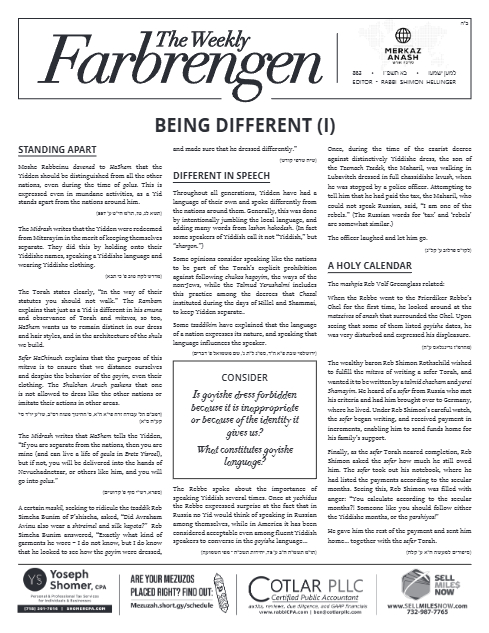
STANDING APART

Moshe Rabbeinu davened to HaShem that the Yidden should be distinguished from all the other nations, even during the time of golus. This is expressed even in mundane activities, as a Yid stands apart from the nations around him.

The Midrash writes that the Yidden were redeemed from Mitzrayim in the merit of keeping themselves separate. They did this by holding onto their Yiddishe names, speaking a Yiddishe language and wearing Yiddishe clothing.

The Torah states clearly, “In the way of their statutes you should not walk.” The Rambam explains that just as a Yid is different in his emuna and observance of Torah and mitzvos, so too, HaShem wants us to remain distinct in our dress and hair styles, and in the architecture of the shuls we build.

Sefer HaChinuch explains that the purpose of this mitzva is to ensure that we distance ourselves and despise the behavior of the goyim, even their clothing. The Shulchan Aruch paskens that one is not allowed to dress like the other nations or imitate their actions in other areas.

The Midrash writes that HaShem tells the Yidden, “If you are separate from the nations, then you are mine (and can live a life of geula in Eretz Yisroel), but if not, you will be delivered into the hands of Nevuchadnetzar, or others like him, and you will go into golus.”

A certain maskil, seeking to ridicule the tzaddik Reb Simcha Bunim of P’shischa, asked, “Did Avraham Avinu also wear a shtreimel and silk kapota?” Reb Simcha Bunim answered, “Exactly what kind of garments he wore – I do not know, but I do know that he looked to see how the goyim were dressed, and made sure that he dressed differently.”

DIFFERENT IN SPEECH

Throughout all generations, Yidden have had a language of their own and spoke differently from the nations around them. Generally, this was done by intentionally jumbling the local language, and adding many words from lashon hakodesh. (In fact some speakers of Yiddish call it not “Yiddish,” but “zhargon.”)

Some opinions consider speaking like the nations to be part of the Torah’s explicit prohibition against following chukos hagoyim, the ways of the non-Jews, while the Talmud Yerushalmi includes this practice among the decrees that Chazal instituted during the days of Hillel and Shammai, to keep Yidden separate..

Some tzaddikim have explained that the language of a nation expresses its nature, and speaking that language influences the speaker.

The Rebbe spoke about the importance of speaking Yiddish several times. Once at yechidus the Rebbe expressed surprise at the fact that in Russia no Yid would think of speaking in Russian among themselves, while in America it has been considered acceptable even among fluent Yiddish speakers to converse in the goyishe language...

Once, during the time of the czarist decree against distinctively Yiddishe dress, the son of the Tzemach Tzedek, the Maharil, was walking in Lubavitch dressed in full chassidishe levush, when he was stopped by a police officer. Attempting to tell him that he had paid the tax, the Maharil, who could not speak Russian, said, “I am one of the rebels.” (The Russian words for ‘tax’ and ‘rebels’ are somewhat similar.) The officer laughed and let him go.

A HOLY CALENDAR

The mashpia Reb Volf Greenglass related:

When the Rebbe went to the Frierdiker Rebbe’s Ohel for the first time, he looked around at the matzeivos of anash that surrounded the Ohel. Upon seeing that some of them listed goyishe dates, he was very disturbed and expressed his displeasure.

The wealthy baron Reb Shimon Rothschild wished to fulfill the mitzva of writing a sefer Torah, and wanted it to be written by a talmid chacham and yerei Shamayim. He heard of a sofer from Russia who met his criteria and had him brought over to Germany, where he lived. Under Reb Shimon’s careful watch, the sofer began writing, and received payment in increments, enabling him to send funds home for his family’s support.

Finally, as the sefer Torah neared completion, Reb Shimon asked the sofer how much he still owed him. The sofer took out his notebook, where he had listed the payments according to the secular months. Seeing this, Reb Shimon was filled with anger: “You calculate according to the secular months?! Someone like you should follow either the Yiddishe months, or the parshiyos!” He gave him the rest of the payment and sent him home... together with the sefer Torah.

CONSIDER

Is goyishe dress forbidden because it is inappropriate or because of the identity it gives us?

What constitutes goyishe language?

In merit of this publication's founder ר' אהרן בן חנה • May the zechus of the thousands of readers bring him a total and immediate recovery

לע"נ מרת ציפא אסתר בת ר' שלום דובער ע"ה

PDF Preview