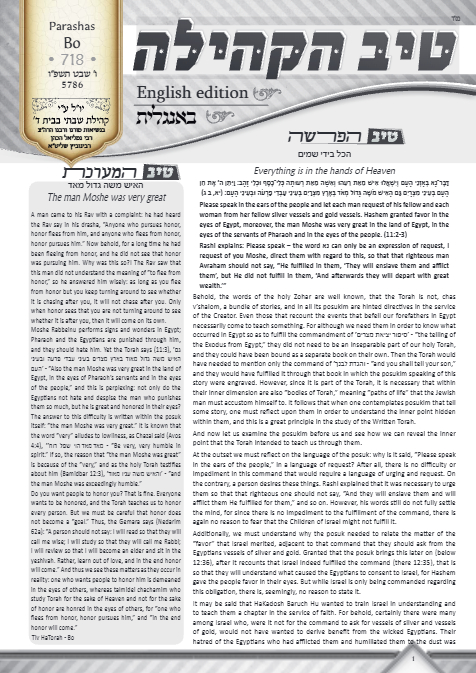
Everything is in the hands of Heaven
וַיִּתֵּן ה’ אֶת חֵן בְּאָזְנֵי הָעָם וְיִשְׁאֲלוּ אִישׁ מֵאֵת רֵעֵהוּ וְאִשָּׁה מֵאֵת רְעוּתָהּ כְּלֵי־כֶסֶף וּכְלֵי זָהָב: דַּבֶּר־נָא הָעָם בְּעֵינֵי מִצְרָיִם גַּם הָאִישׁ מֹשֶׁה גָּדוֹל מְאֹד בְּאֶרֶץ מִצְרַיִם בְּעֵינֵי עַבְדֵי פַרְעֹה וּבְעֵינֵי הָעָם: (יא, ב ג)
Please speak in the ears of the people and let each man request of his fellow and each woman from her fellow silver vessels and gold vessels. Hashem granted favor in the eyes of Egypt, moreover, the man Moshe was very great in the land of Egypt, in the eyes of the servants of Pharaoh and in the eyes of the people. )11:2-3(
Rashi explains: Please speak – the word נא can only be an expression of request, I request of you Moshe, direct them with regard to this, so that that righteous man Avraham should not say, “He fulfilled in them, ’They will enslave them and afflict them’, but He did not fulfill in them, ’And afterwards they will depart with great wealth.’”
Behold, the words of the holy Zohar are well known, that the Torah is not, chas v’shalom, a bundle of stories, and in all its posukim are hinted directives in the service of the Creator. Even those that recount the events that befell our forefathers in Egypt necessarily come to teach something. For although we need them in order to know what occurred in Egypt so as to fulfill the commandment of ‘סיפור יציאת מצרים’ - “the telling of the Exodus from Egypt,” they did not need to be an inseparable part of our holy Torah, and they could have been bound as a separate book on their own. Then the Torah would have needed to mention only the command of ‘והגדת לבנך - “and you shall tell your son,” and they would have fulfilled it through that book in which the posukim speaking of this story were engraved. However, since it is part of the Torah, it is necessary that within their inner dimension are also “bodies of Torah,” meaning “paths of life” that the Jewish man must accustom himself to. It follows that when one contemplates posukim that tell some story, one must reflect upon them in order to understand the inner point hidden within them, and this is a great principle in the study of the Written Torah.
And now let us examine the posukim before us and see how we can reveal the inner point that the Torah intended to teach us through them.
At the outset we must reflect on the language of the posuk: why is it said, “Please speak in the ears of the people,” in a language of request? After all, there is no difficulty or impediment in this command that would require a language of urging and request. On the contrary, a person desires these things. Rashi explained that it was necessary to urge them so that that righteous one should not say, “And they will enslave them and will afflict them He fulfilled for them,” and so on. However, his words still do not fully settle the mind, for since there is no impediment to the fulfillment of the command, there is again no reason to fear that the Children of Israel might not fulfill it.
Additionally, we must understand why the posuk needed to relate the matter of the “favor” that Israel merited, adjacent to that command that they should ask from the Egyptians vessels of silver and gold. Granted that the posuk brings this later on (below 12:36), after it recounts that Israel indeed fulfilled the command (there 12:35), that is so that they will understand what caused the Egyptians to consent to Israel, for Hashem gave the people favor in their eyes. But while Israel is only being commanded regarding this obligation, there is, seemingly, no reason to state it.
It may be said that HaKadosh Baruch Hu wanted to train Israel in understanding and to teach them a chapter in the service of faith. For behold, certainly there were many among Israel who, were it not for the command to ask for vessels of silver and vessels of gold, would not have wanted to derive benefit from the wicked Egyptians. Their hatred of the Egyptians who had afflicted them and humiliated them to the dust was engraved deep in their hearts, and they did not want at all that those people should do them good, lest this good stand for them as a merit, and lest their giving be considered appeasement. These Israelites did not want there to be forgiveness for the Egyptians for the magnitude of their evil, and they preferred that their sin be engraved upon their bones forever.
On the other hand, there were also those whose line of thought was the opposite. From their perspective they would have been glad if the Egyptians would grant them their request, but they thought that even if they were to ask, the Egyptians would not agree to comply with their request. After all, from days of old they knew that those people hated them with a hatred of death, so why would they now be appeased to satisfy them?!
Accordingly, HaKadosh Baruch Hu saw fit to urge them in the fulfillment of this command and to entreat them with the expression “please,” that they should not make any calculations, neither that they do not want to ask, nor that the Egyptians do not want to give. They should compel themselves to ask from the Egyptians. And it is well understood His intention Yisbarach in saying, “lest that righteous one say,” and so on. For if the Children of Israel make calculations that they should not ask, the promise that HaKadosh Baruch Hu promised Avraham, “and afterward they shall go out with great wealth,” will not be fulfilled.
And so that the Children of Israel would understand why they are being asked to do things that, according to their own calculations or desires, it is not appropriate for them to do, HaKadosh Baruch Hu revealed to them in that very command that from now on they would merit to find favor in the eyes of the Egyptians. This would be for them a sign that the choice to hate them or to love them does not depend on the Egyptians, but only on HaKadosh Baruch Hu. For if the hatred of the Egyptians toward Israel depended on their own personal will, why would their skin be turned to love them after they had suffered harsh and faithful blows because of them?! You are therefore compelled to conclude that their disposition is not in their own hands. HaKadosh Baruch Hu decreed whether Israel would be hated or loved by the Egyptians. And so it is also regarding their sufferings: we must know that the Egyptians were not the true strikers; they were only the instruments for the decree of HaKadosh Baruch Hu. He is the One who saw that it was for the benefit of Israel that they be struck and persecuted by the Egyptians, and therefore He would arouse hatred toward Israel within them. But after their rectification had already been completed, HaKadosh Baruch Hu would arouse affection toward Israel within them.
And from now on there is no place for all the calculations that prevented them from fulfilling the will of the Creator. If they know that everything is in the hands of Heaven, and that even “the will of a person” is included, then there is no impediment to asking from the Egyptians vessels of silver and gold. For now there is no reason at all either to hate them or to consider them as enemies and understand this.
This is also knowledge for all generations. When a person is harmed by inanimate matter or by other causes that are not in the hands of man, he understands that HaKadosh Baruch Hu is the One who arranged the matters. However, if he was pained by a person who possesses free choice, he forgets to recognize that this person is a cause from Heaven. Here he blames the person and complains against him for having harmed him: he struck him, he disgraced him.
The truth is that there is a difference between “harm caused by inanimate matter” and “harm caused by a person.” The inanimate does not intend at all to cause harm, and in a situation where it nevertheless caused damage, one can easily attribute it to Divine providence and justify the judgment. Whereas the person who causes harm is indeed a “being with free choice,” and a claim is aroused against him: Why did he choose to do evil? Why am I hated before him? However, one must know that even the thought of hatred is rolled about by HaKadosh Baruch Hu for good and for atonement. And since this is so, there is no place at all for hatred.
Even one who is indeed on a high level, and at the time he is disgraced by another he believes that ‘אלקים אמר לו קלל’ - “G-d said to him, curse,” (Shmuel II 16:10) can sometimes err and think that nevertheless the one who cursed him has now become his enemy until further notice. And to the extent that he would need his benefit, he would refrain from asking him, lest his request be in vain. But the true believer knows that no single moment is bound to its fellow. In the first moment he needed atonement, and HaKadosh Baruch Hu arranged that this person would be a cause to merit him with it. And in the next moment, after he has already merited atonement, there is again no reason that the other should provoke and pain him further. It is also possible that the other greatly regrets his actions.