Rav Menachem Mordechai Eisenbach ztl
טיב הקהילה English | January 24, 2026
Print This Article
View Original PDF

Rav Menachem Mordechai Eisenbach ztl

טיב הקהילה English | January 30, 2026

Rav Menachem Mordechai Eisenbach zt”l

One of the cherished figures of Karta deShufreya [the beautiful city] was Rav Menachem Mordechai, son of his esteemed father the righteous Rav Shalom Zeev Eisenbach zt”l, whose yahrzeit occurs on the 9th of Shevat. Within this column, we periodically—with siyatta diShmaya—recall the noble memory of those exalted souls of Yerushalayim shel maalah, whom our master and teacher, knew personally and with whom he was acquainted. We have therefore gathered a few select reminiscences in his honor, drawn from the various talks in which our teacher mentioned him and recounted matters concerning him. These words will surely serve us as ethical instruction, drawn from the pure yiras Shamayim that characterized the people of Yerushalayim, whose entire way of life stands for us as a sign and a model. May this also stand as a merit and an elevation for his soul, Amen.

“לְמַעַן תְּסַפֵּר בְּאָזְנֵי בִנְךָ וּבֶן בִּנְךָ אֵת אֲשֶׁר הִתְעַלַּלְתִּי בְּמִצְרַיִם, וְאֶת אֹתֹתַי אֲשֶׁר שַׂמְתִּי בָם, וִידַעְתֶּם כִּי אֲנִי ה”’ (י, ב).

So that you shall tell in the ears of your son and of your son’s son what I wrought in Egypt, and My signs that I placed among them, and you shall know that I am Hashem (10:2).

Scripture equates your son and your son’s son, placing them side by side, teaching that both are equal with regard to the obligation of recounting the Exodus from Mitzrayim. Although with respect to the commandment of Torah study it is explicitly ruled in Shulchan Aruch (Yoreh De‘ah 245:3) that one’s son takes precedence over one’s grandson—and likewise in the Rambam (Hilchos Talmud Torah 1:2)—nevertheless, in the matter of recounting the Exodus from Mitzrayim, it is evident that just as one is commanded with respect to himself, so too is he equally obligated toward his son and toward his son’s son. This is unlike the obligation of Torah study, in which one’s son precedes one’s grandson.

The reason appears to be that the commandment of recounting the Exodus from Mitzrayim is unique, for it stands at the very foundations of the faith and at the root of the belief of the people of Israel. As the pasuk testifies in the very first utterance of the commandment of faith: אָנֹכִי ה› אֱלֹקֶיךָ אֲשֶׁר הוֹצֵאתִיךָ מֵאֶרֶץ מִצְרַיִם מִבֵּית עֲבָדִים - I am Hashem your God, Who took you out of the land of Egypt, from the house of bondage (20:2). All the miracles that the Borei Yisbarach performed for us in the Exodus were wrought in order to establish the foundation of the Jewish faith, which rests upon perfect emunah, so as to bequeath the heritage of faith to all future generations.

Therefore, with regard to this commandment—recounting the roots of faith—all generations are equal. Its very essence is the establishment of generations grounded in faith, that Israel be believers, the children of believers. In this matter, son and grandson are equal, for its core purpose is the transmission of the foundation of faith from generation to generation.

Included within this faith is also the telling to our children and our children’s children about our own generations and about all the generations of Your servants, the seed of Yisrael—so that future generations may know and recognize our forefathers and our teachers, and the elders of Yisrael of past generations who were God-fearing and wholehearted. Through this, the continuity of the generational chain is preserved, and all future generations will recognize what earlier generations prepared for them, through their self-sacrifice for the preservation of this faith and for the observance of Torah and mitzvos, for the glory and splendor of Beis Yisrael.

The illustrious Eisenbach Dynasty

A great and illustrious household was established in Yerushalayim, the Holy City, by his esteemed father, the renowned righteous Rav Shalom Zeev (Velvel) Eisenbach zt”l, son of the famous tzaddik Rav Chaim Tzvi (Hersh) Eisenbach zt”l of Batei Rand, and one of the venerable elders of Jerusalem. Rav Shalom Zeev left behind numerous descendants, all for renown and splendor—truly a seed blessed by Hashem. At the time of his passing, at a ripe old age of over one hundred years, he left behind more than two thousand descendants, who continue in the path of their forebears, faithfully preserving the flame of Beis Yisrael in holiness and purity, in accordance with the tradition of the Eisenbach family for many generations.

Many fine and fruitful plantings did Rav Velvel implant in the vineyard Klal Yisrael. By the kindness of Hashem, I too merited to become related to him by marriage, when his son, Rav Asher Anshel Eisenbach zt”l, became my mechutan. From him I heard much about the amazing Eisenbach family.

One of the most distinguished sons of the venerable Rav Velevl Eisenbach was Rav Menachem Mordechai zt”l. We shall recount, with siyatta diShmaya, not only something of his personal greatness, his awe of Heaven, his integrity in Torah and yiras Shamayim, but also a glimpse of the elevated atmosphere in which he merited to be raised in his father’s great home. In this way, we may gain insight into the roots from which this fine tree grew, and into the righteous figures of earlier generations whom his eyes beheld—figures from whom he learned and received the ways of Torah, yiras Shamayim, and upright and refined character traits, as will become evident to the discerning reader.

In his youth, Rav Menachem Mordechai zt”l was raised in his father’s home, where he became accustomed to—and firmly acquired—all three pillars upon which the world stands. The home was permeated with Torah, Divine service, and acts of kindness.

His righteous father, that great and beloved man, Rav Velvel Eisenbach zt”l, was among the venerable elders and long-standing residents of Jerusalem, Karta deShofreya, one of the precious remnants whom Hashem calls—among those God-fearing and wholesome souls of Yerushalayim. He was deeply engaged in the inner wisdom as well, regularly attending the Kabbalistic discourses held in the Beis Midrash Anshei Ma‘amad.

Likewise, Rav Menachem Mordechai was accustomed in his father’s home to pray all the daily prayers for many years at the Kosel. There, at the place known as the Gate of Heaven, he would pour out his supplications, from where the tefillos of Yisrael ascend on high.

Beyond the fact that all the conduct of this great household revolved constantly around Torah—family members moving from study hall to yeshivah, and Rav Velvel being known among local residents as the masmid of Yerushalayim —the home was also deeply engaged in acts of chesed. This was so despite their consistent effort to conceal these deeds and keep them free of publicity, in keeping with their general manner of living simply and modestly.

Nevertheless, from mouth to ear, the charity administrators of Jerusalem were well aware of the many families who regularly received meaningful support from the Eisenbach household—support that was, for the most part, given in the form of matan b’seser, discreet charity giving. In addition to this, Rav Velvel served as ...
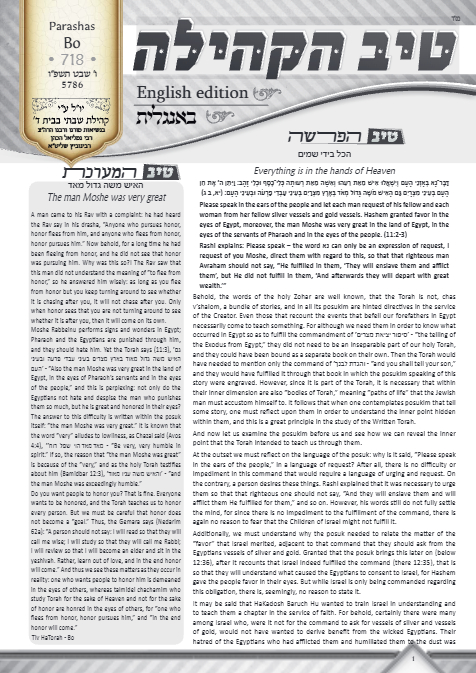

Rav Menachem Mordechai Eisenbach zt”l

One of the cherished figures of Karta deShufreya [the beautiful city] was Rav Menachem Mordechai, son of his esteemed father the righteous Rav Shalom Zeev Eisenbach zt”l, whose yahrzeit occurs on the 9th of Shevat. Within this column, we periodically—with siyatta diShmaya—recall the noble memory of those exalted souls of Yerushalayim shel maalah, whom our master and teacher, knew personally and with whom he was acquainted. We have therefore gathered a few select reminiscences in his honor, drawn from the various talks in which our teacher mentioned him and recounted matters concerning him. These words will surely serve us as ethical instruction, drawn from the pure yiras Shamayim that characterized the people of Yerushalayim, whose entire way of life stands for us as a sign and a model. May this also stand as a merit and an elevation for his soul, Amen.

“לְמַעַן תְּסַפֵּר בְּאָזְנֵי בִנְךָ וּבֶן בִּנְךָ אֵת אֲשֶׁר הִתְעַלַּלְתִּי בְּמִצְרַיִם, וְאֶת אֹתֹתַי אֲשֶׁר שַׂמְתִּי בָם, וִידַעְתֶּם כִּי אֲנִי ה”’ (י, ב).

So that you shall tell in the ears of your son and of your son’s son what I wrought in Egypt, and My signs that I placed among them, and you shall know that I am Hashem (10:2).

Scripture equates your son and your son’s son, placing them side by side, teaching that both are equal with regard to the obligation of recounting the Exodus from Mitzrayim. Although with respect to the commandment of Torah study it is explicitly ruled in Shulchan Aruch (Yoreh De‘ah 245:3) that one’s son takes precedence over one’s grandson—and likewise in the Rambam (Hilchos Talmud Torah 1:2)—nevertheless, in the matter of recounting the Exodus from Mitzrayim, it is evident that just as one is commanded with respect to himself, so too is he equally obligated toward his son and toward his son’s son. This is unlike the obligation of Torah study, in which one’s son precedes one’s grandson.

The reason appears to be that the commandment of recounting the Exodus from Mitzrayim is unique, for it stands at the very foundations of the faith and at the root of the belief of the people of Israel. As the pasuk testifies in the very first utterance of the commandment of faith: אָנֹכִי ה› אֱלֹקֶיךָ אֲשֶׁר הוֹצֵאתִיךָ מֵאֶרֶץ מִצְרַיִם מִבֵּית עֲבָדִים - I am Hashem your God, Who took you out of the land of Egypt, from the house of bondage (20:2). All the miracles that the Borei Yisbarach performed for us in the Exodus were wrought in order to establish the foundation of the Jewish faith, which rests upon perfect emunah, so as to bequeath the heritage of faith to all future generations.

Therefore, with regard to this commandment—recounting the roots of faith—all generations are equal. Its very essence is the establishment of generations grounded in faith, that Israel be believers, the children of believers. In this matter, son and grandson are equal, for its core purpose is the transmission of the foundation of faith from generation to generation.

Included within this faith is also the telling to our children and our children’s children about our own generations and about all the generations of Your servants, the seed of Yisrael—so that future generations may know and recognize our forefathers and our teachers, and the elders of Yisrael of past generations who were God-fearing and wholehearted. Through this, the continuity of the generational chain is preserved, and all future generations will recognize what earlier generations prepared for them, through their self-sacrifice for the preservation of this faith and for the observance of Torah and mitzvos, for the glory and splendor of Beis Yisrael.

The illustrious Eisenbach Dynasty

A great and illustrious household was established in Yerushalayim, the Holy City, by his esteemed father, the renowned righteous Rav Shalom Zeev (Velvel) Eisenbach zt”l, son of the famous tzaddik Rav Chaim Tzvi (Hersh) Eisenbach zt”l of Batei Rand, and one of the venerable elders of Jerusalem. Rav Shalom Zeev left behind numerous descendants, all for renown and splendor—truly a seed blessed by Hashem. At the time of his passing, at a ripe old age of over one hundred years, he left behind more than two thousand descendants, who continue in the path of their forebears, faithfully preserving the flame of Beis Yisrael in holiness and purity, in accordance with the tradition of the Eisenbach family for many generations.

Many fine and fruitful plantings did Rav Velvel implant in the vineyard Klal Yisrael. By the kindness of Hashem, I too merited to become related to him by marriage, when his son, Rav Asher Anshel Eisenbach zt”l, became my mechutan. From him I heard much about the amazing Eisenbach family.

One of the most distinguished sons of the venerable Rav Velevl Eisenbach was Rav Menachem Mordechai zt”l. We shall recount, with siyatta diShmaya, not only something of his personal greatness, his awe of Heaven, his integrity in Torah and yiras Shamayim, but also a glimpse of the elevated atmosphere in which he merited to be raised in his father’s great home. In this way, we may gain insight into the roots from which this fine tree grew, and into the righteous figures of earlier generations whom his eyes beheld—figures from whom he learned and received the ways of Torah, yiras Shamayim, and upright and refined character traits, as will become evident to the discerning reader.

In his youth, Rav Menachem Mordechai zt”l was raised in his father’s home, where he became accustomed to—and firmly acquired—all three pillars upon which the world stands. The home was permeated with Torah, Divine service, and acts of kindness.

His righteous father, that great and beloved man, Rav Velvel Eisenbach zt”l, was among the venerable elders and long-standing residents of Jerusalem, Karta deShofreya, one of the precious remnants whom Hashem calls—among those God-fearing and wholesome souls of Yerushalayim. He was deeply engaged in the inner wisdom as well, regularly attending the Kabbalistic discourses held in the Beis Midrash Anshei Ma‘amad.

Likewise, Rav Menachem Mordechai was accustomed in his father’s home to pray all the daily prayers for many years at the Kosel. There, at the place known as the Gate of Heaven, he would pour out his supplications, from where the tefillos of Yisrael ascend on high.

Beyond the fact that all the conduct of this great household revolved constantly around Torah—family members moving from study hall to yeshivah, and Rav Velvel being known among local residents as the masmid of Yerushalayim —the home was also deeply engaged in acts of chesed. This was so despite their consistent effort to conceal these deeds and keep them free of publicity, in keeping with their general manner of living simply and modestly.

Nevertheless, from mouth to ear, the charity administrators of Jerusalem were well aware of the many families who regularly received meaningful support from the Eisenbach household—support that was, for the most part, given in the form of matan b’seser, discreet charity giving. In addition to this, Rav Velvel served as ...

PDF Preview


