The Secret History of Donkeys and GOATs
Torah Papers | January 19, 2024
Print This Article
View Original PDF

The Secret History of Donkeys and GOATs

Torah Papers | December 10, 2025

The last three makkot are found in our Parsha, with the final one being Makat Bechorot. Interestingly, while this plague is the final one to be executed, it was the plague included in the first warning delivered to Pharoah.

וְאָמַרְ תָּ אֶל־פַּרְ עֹה כֹּה אָמַר ה' בְּנִי בְכֹרִ י יִשְׂרָ אֵל׃ ַח אֶ ת־ שׁ ַ ל ָ וָאֹמַ ר אֵ לֶיך ׃ ָ בְּכֹרֶ ך ָ ְחוֹ הִנֵּה אָנֹכִי הֹרֵ ג אֶת־בִּנְך ּ בְּנִי וְיַעַבְדֵנִי וַתְּמָאֵן לְשׁ ַל

You will say to Pharaoh, “This is what Hashem said, ‘Yisrael is My son, My firstborn. And I have said to you, send out My son and let him serve Me. If you refuse to send him, behold, I will slay your own firstborn son.’”

Rashi explains, Hakadosh Baruch Hu chose this as the initial warning for the makkot because it was the most severe of them all. He adds, a human who wishes to avenge himself against another human keeps his plans secret in order to maintain the element of surprise and not give his opponent a way out. Hakadosh Baruch Hu, on the other hand, is so mighty that there is no possibility of escape except by returning through Teshuva and thus, the warning is as strong as possible. The Ohr HaChaim Hakadosh explains it differently, saying Hakadosh Baruch Hu aimed to prevent a scenario in which Moshe Rabbeinu would witness Pharaoh enduring plague after plague but to no effect and with no impact on him budging. Such a prolonged resistance might have disheartened or shaken Moshe's faith. Therefore, Hakadosh Baruch Hu informed him from the outset that the ultimate plague would be Makat Bechorot, signaling that no relenting from Pharaoh should be expected until that point.

I’d like to now dive into this final plague, but not the punishment itself. Of note, at no point during our week do we bring up or focus on nine of the ten plagues. It is only Makat Bechorot that is recalled (alongside the crossing of Yam Suf), as directed by Halacha, and this occurs immediately following Kriyat Shema. Additionally, none of the other nine plagues resulted in a takeaway for future generations. Aside from mentioning them once each year at the Pesach Seder, we don’t have any ritual involving blood or frogs that is performed in commemoration of these two plagues. Nor for any of the other makkot, with the exception of Makat Bechorot.

This final plague was the impetus for a series of three Mitzvot: the sanctity and of our bechor (firstborn) and Pidyon HaBen (his redemption); the sanctification and offering of the firstborn of pure animals; and the mitzvah of Petter Chamor – redemption of a firstborn donkey by way of offering a lamb to the Kohen in place of the donkey. These three mitzvot are listed at the end of our Parsha:

קַדֶּשׁ ־לִי כָל־בְּכוֹר פֶּטֶר כָּל־רֶ חֶם בִּבְנֵי יִשְׂרָ אֵל בָּאָדָם וּבַבְּהֵמָה לִי הוּא׃

Sanctify to me all the firstborn, whatever opens the womb among the children of Yisrael, both of man and beast: it is mine.

Followed shortly thereafter by:

וְ הַ עֲבַ רְ תָּ כָ ל־פּ ֶ טֶ ר־רֶ חֶ ם לַה' הַזְּכָרִ ים ָ וְכָל־פֶּטֶר שׁ ֶגֶר בְּהֵמָה אֲשׁ ֶר יִהְיֶה לְך לַה'׃ וְ כָל פֶּטֶר חֲמֹר תִּפְדֶּה בְשֶׂה וְאִם לֹא תִפְדֶּה וַעֲרַ פְתּוֹ וְכֹל בְּכוֹר אָדָם תִּ פְ דֶּ ה׃ ָ בְּ בָנֶיך

You shall set apart to the Lord all that opens the womb, and every firstling that comes of a beast which belong to you; the males shall be the Lord’s. Redeem each firstling donkey with a sheep. If it is not redeemed, you must break its neck. Redeem every first-born male among your sons.

In terms of where the Mitzvah of Petter Chamor is to be observed, the Ramban learns from the introductory wording אֶ רֶ ץ הַ כּ ְ נַ עֲ נִ י אֶ ל ה' ָ יְ בִ אֲ ך וְ הָ יָה כִּ י , that it applies solely within Eretz Yisrael. And the reason for this practice is then presented in the Torah – it serves as an answer to the unknowing child:

מָחָר לֵאמֹר מַה־זֹּאת וְאָמַרְ תָּ אֵלָיו בְּחֹזֶק יָד הוֹצִיאָנוּ ָ בִנְך ָ וְהָיָה כִּי־יִשְׁאָלְך ה' מִ מִּ צְ רַ יִ ם מִ בֵּ ית עֲ בָ דִ ים׃ ַהֲרֹג ה ּ ְחֵנוּ וַי ּ וַיְהִי כִּי־הִקְ שׁ ָה פַרְ עֹה לְשׁ ַל' כָּל־ בְּכוֹר בְּאֶרֶ ץ מִצְרַיִם מִבְּכֹר אָדָם וְעַד־בְּכוֹר בְּהֵמָה עַל־כֵּן אֲנִי זֹבֵחַ לַה' כָּ ל־ פֶּטֶר רֶ חֶם הַזְּכָרִ ים וְכָל־בְּכוֹר בָּנַי אֶפְדֶּה׃ וְהָיָה לְאוֹת עַל־יָדְ כָה וּלְטוֹטָפֹת כִּי בְּחֹזֶק יָד הוֹצִיאָנוּ ָ בֵּין עֵינֶיךה' מִ מּ ִ צְ רָ יִ ם ׃

When your son asks you at a later time saying, ‘What is this?’ You should say to him, “With a strong hand Hashem brought us out of Egypt from the house of slavery. When Pharaoh stubbornly refused to send us out, Hashem killed every first-born in the land of Egypt, from the first-born of man to the first-born of beast. I am therefore sacrificing to Hashem all that is first to open the womb which are male, and the first-born of my sons I redeem.’ These words shall be a sign on your hand and for totafot between your eyes, for with a strong hand Hashem brought us out of Egypt.”

It is the topic of Petter Chamor we’ll focus on during this shiur, but without going into all its Halachic details and ramifications. Of note, the donkey must be killed in the exact manner prescribed – by breaking the back of its neck – and not through any other potential means, whether a knife, a stick, starvation, or other. Is breaking the donkey’s neck a commandment or punishment for one who does not redeem the firstborn? Rashi says it is a punishment. The individual did not give the Kohen a lamb in place of their firstborn, so they, too, will not benefit from having an animal. The Rambam (Hilchot Bikurim 12:1) dedicates a full chapter to this mitzvah:

ִשְׂ רָ אֵל פֶּטֶר חֲמוֹר בְּשֶׂה. וְאִם לֹא רָ צָה ּ מִצְוַת עֲשֵׂה לִפְדּוֹת כָּל אדָם מִי לִפְ דּ וֹתוֹ מִ צְ וַת עֲשֵׂ ה לְעָרְ פוֹ ...ָה קוֹדֶמֶת לְמִצְוַת עֲרִ יפָה: ּ וּמִצְוַת פְּדִ י

It is a positive commandment for every Jewish man to redeem the first male issue of a donkey with a lamb. If he does not desire to redeem it, it is a mitzvah for him to behead it... The mitzvah of redemption takes precedence over the mitzvah of beheading the donkey.

It is puzzling how there can be a positive commandment to break the donkey’s neck, given it is a fallback action in scenarios where the owner doesn’t wish to redeem their firstborn donkey with a lamb (or the monetary value of a lamb). The Ra'avad suggests the initial act of redeeming the donkey is in fact a Mitzvah, but questions whether the substitute act should not be the opposite – a sin. The Radbaz, however, is not comfortable with this question. He compares the case of Petter Chamor to the mitzvah of Yibum, where a man is commanded to marry his deceased brother's childless widow but has a fallback commandment – Chalitza – should he not want to follow through. In the case of Yibum, both actions are considered as distinct Mitzvot, so why should that not be the case for Petter Chamor as well? He eloquently states that he’s perplexed by the Ra’avad referring to the secondary act of breaking the donkey’s neck as a sin, given his fluency in the secrets of the Torah.

I’d like to add another question to the mix, based on what we read earlier – namely, that the mitzvah of Petter Chamor is to commemorate the killing of Egyptian firstborns during Makat Bechorot. We’re told the mitzvah of redeeming the donkey takes precedence over the mitzvah to break its neck, but if the commemoration is for the killing of firstborns, should we not prioritize breaking the donkey’s neck? Would that not be a more appropriate commemoration?

Let’s now dive into the topic, according to the commentary of Rabbi Ovadiah Seforno. We’ll begin with the question posed by the son – ָ בִ נְך ָ וְ הָ יָה כִּ י־יִשׁ ְ אָ לְ ך – which prefaces the explanation for the mitzvah of Petter Chamor and its connection to Makat Bechorot. Seforno points out this is the question of the simple son (Tam) who is unaware yet the question itself is not so simple. It is a very perceptive question, when considering the donkey is an impure animal suddenly finding itself sanctified and redeemed in a manner of holiness. Yishmael is compared to a donkey and there is no kedusha whatsoever to Yishmael; so, the son asks, why should this donkey be treated in a spiritually elevated manner. Neither can ever become kadosh. Furthermore, if there’s a need to kill this animal, why insist on breaking its neck from behind? Why not kill it with whatever means available? This are the child’s intelligent questions.

The answer lies in the words: בְּ חֹזֶק יָד הוֹצִ יאָ נוּ . Hakadosh Baruch Hu redeemed Bnei Yisrael from the strong hand of Egypt, and due to the urgency with which the Egyptians wanted them gone, they could not depart Egypt in wagons (agalot) – i.e., the method with which they had arrived in the days of Yaacov Avinu. They had to instead settle for donkeys. However, a miracle occurred, and the wagons materialized together with the many donkeys needed to transport all the newfound riches of the people. The constructive role donkeys played in the redemption of Bnei Yisrael is reflected in their not being treated like all other impure animals. Thus, their firstborn may be redeemed in exchange for a pure animal, so that the donkey can then be used in the regular way. We are instructed to explain to our children why the donkey, exclusively amongst all impure animals, received this minor element of kedusha.

Seforno continues his commentary on the pesukim, pointing out that Pharaoh had put so many obstacles in the path of Bnei Yisrael’s eventual liberation that he himself is compared to a donkey. Yechezkel HaNavi (Yechezkel 23:20) describes the Egyptians as donkeys, and Pharaoh is the chief donkey among them. He had full control and could have easily redeemed himself by releasing Bnei Yisrael, but after failing to do so, the firstborns of Egypt were killed instead. Had only Pharoah followed his orders and given the lamb – i.e., Bnei Yisrael – to the Kohen – i.e., Hakadosh Baruch Hu – he’d have redeemed himself.

The Midrash (Tanchuma Bamidar 24; Bamidar Rabbah 4:5) also brings forth these answers of Rabbi Ovadiah Seforno. For the sake of Bnei Yisrael, and on account of His love of Bnei Yisrael, Hakadosh Baruch Hu changed the order of the world. Rather than redeeming a donkey through a sheep, He redeemed the sheep – i.e., Bnei Yisrael – by taking the life of a donkey.

The Gemara (Bechorot 5b) that deals with this mitzvah and the reasoning quoted by Rashi – namely, that the donkeys were of transportation assistance to Bnei Yisrael when they left Egypt – teaches us that each member of Bnei Yisrael left with ninety Nubian donkeys (חֲ מ ו ֹ רִ י ם ל ו ּ בִ י ם ). These donkeys were considered to be of superior quality, and they were loaded up with gold and silver. Rashi quotes this Gemara, but leaves out the number ninety, instead stating “many”. The Midrash HaGadol says the minimum number of donkeys each took out with them was seventy, also a fair number. According to the Midrash Rabbah (Esther), Haman spoke lashon hara about Bnei Yisrael to Achashverosh. He didn’t know what he was talking about, nor did he comprehend the evidence he himself submitted, but just like the case against Israel in the Hague, a grand and elaborate case was presented. Haman claimed the Egyptians graciously hosted Bnei Yisrael, allowing them to build two cities and become world-class developers. The Egyptians treated Bnei Yisrael well and fed them generously, he continued, only for the Jewish people to stab them in the back. According to his filing, they sent their representative witch – Moshe Rabbeinu – who inflicted great suffering on the Egyptians, allowing the guests to steal from their hosts and walk off with all their wealth and belongings, including their donkeys. He, too, does not mention a specific number. The Ohr HaChaim Hakadosh (Shemot 25:2), in reflecting on the gifts Bnei Yisrael brought to construct the Mishkan, says Moshe questioned the people’s financial ability to bring forth the necessary material. In His response to Moshe, Hakadosh Baruch Hu said even the poorest member of Bnei Yisrael had the means to contribute, as from the spoils of the Egyptians who drowned in the sea, each collected a minimum of forty donkeys loaded up with precious stones and metals.

So, how many donkeys did each of Bnei Yisrael leave Egypt with? The Gemara says ninety, the Midrash says seventy, the Ohr HaChaim says forty, and Haman’s testimony is moot, because just like its current reincarnation, his words were absurd, groundless, and devoid of all substance. If you ask me why it matters exactly how many donkeys each took from Egypt, I’d have to be honest with you. It really doesn’t matter. If you take the largest number of ninety, and multiply it by 600,000, the total is 54-million donkeys. And if you replace that with the smallest number, forty, it is still 24-million donkeys that accompanied Bnei Yisrael out of Egypt. Neither number is comprehensible. Even in today’s world, thousands of years later, it is simply impossible to obtain that number of donkeys. So, how is it possible that Hakadosh Baruch Hu set them up with such a fleet and made it possible for them to load them up and transport them out of Egypt? When they inform their children that they couldn't leave with wagons and had to settle for donkeys instead, what response should they give when asked how they managed to feed tens of millions in a desert that grew no grass or plants?

I asked this question yesterday, and someone told me donkeys were the primary means of transportation back then, and if that were the case today, we’d see Subaru, Mercedes, and Toyota all producing donkeys. They’d be imported from the Far East, the Houthis would swipe some along the way, and they’d eventually reach our streets. It's akin to driving on the highway between Beersheva and Arad at 8:00 am and being forced to come to a complete stop as thirty donkeys cross the road, shuttling thirty Bedouin kids to school. Each of these villages has hundreds of donkeys for that purpose (right next to the Toyota and Mercedes jeeps parked at the tin huts). That is what they use, so they can be found there, just like in Egypt and in the desert as Bnei Yisrael travelled. What seems ungraspable to us today was the norm at one time, even in the quantities discussed. And with regards to food, Tosafot says the layer of dew that covered the manna would melt, and from it the dessert would produce a thin layer of vegetation that these donkeys would sustain themselves with.

But my friend’s answer clearly was not good enough for the Ben Yehoyada, asks these questions with regards to the quantity of donkeys and all the surrounding logistics. In his opinion, not every member of Bnei Yisrael left with that number of donkeys. Even though the Gemara says each left with ninety, he says this refers to the head of each family, resulting in a far smaller number who collected spoils from the Egyptians and loaded up donkeys. In another location, he says some may have taken ninety, but most took closer to ten or twelve donkeys, also lowering the total number.

I’d like to share one final thought on this topic before moving on. What is the significance of ninety? One hundred is a nice and big round number, but ninety is nisht ahin, nisht aher – neither here nor there. Eighty-six would have significance in gematria (Elokim), but ninety isn’t even a number of guzma – a number we find used to represent exaggeration. Numerous commentators ask this question. Perhaps ninety of them.

In sefer B'Yam Derech, an idea is brought from the Maggid of Kozhnitz, referencing a piyyut found in the Yotzrot for Shabbat Hagadol. As an aside, it is very enjoyable to read and study such piyyutim nowadays, with translations and explanations available to help us comprehend these magnificent masterpieces. It is incredible how, in a few poetic lines, so many ideas from such an array of sources can be beautifully presented, each adding to our understanding of a subject. These are not modern-day rhymes, l’havdil, where the sound patterns of its words match up but without any context or meaning other than to produce something that can be copyrighted and broadcast. The piyyut in question is Kerem Chemed, and it contains the following line:

ְצָהּ מִבֵּין פּוֹשְׁעִים. בְּחֵיל אֲלָפִים רְ בָבוֹת תִּשְׁעִים. וּבְצֶדֶק נִפְקַד ּ וְנִגְלֵיתָ לְחַל לְתֵשׁ ַע וְתִשְׁעִים. הוּעֲמָסָה מַשָּׂא פְרָ דִ ים תִּשְׁעִים.

Hakadosh Baruch Hu revealed Himself to save Bnei Yisrael from wicked Egyptians; together with ninety riboh angels; Therefore, Bnei Yisrael took for themselves ninety donkeys.

Bnei Yisrael took ninety donkeys because Hakadosh Baruch Hu, together with ninety riboh angels (900,000), took them out of Egypt. The source of this statement is Targum Yonatan ben Uziel (Shemot 12:12). The Maggid of Kozhnitz says, to commemorate Yetziat Mitzrayim, each took ninety donkeys.

Another idea, found in Megaleh Amukot, is that the ninety donkeys were in honor of Moshe Rabbeinu, the leader of Bnei Yisrael as they exited Egypt, and the one who pushed them to ask for and then collect all these donkeys and riches. Moshe Rabbeinu is also referred to as Tzaddik (Nedarim 31b), and the name ַדִּ יק ּ צ begins with the letter צ, whose numerical value is ninety.

The Zohar (1:196) provides a similar reason for the quantity of ninety donkeys. The inspiration for that amount stems from Yosef HaTzaddik, as it was to his merit that Bnei Yisrael received silver and gold before their departure. This served as a reward for their moral conduct in the realm of forbidden and immoral relations, and the strength to uphold this holiness was derived from the example set by Yosef HaTzaddik during the episode with Potiphar’s wife, where he turned down payment and great reward in choosing to remain ethical and pure.

If you’d like, these last two answers can be combined, based on what we’ll read next week: ַח מֹשׁ ֶה אֶת־עַצְמוֹת יוֹסֵף ִּק ּ וַי – Moshe took the bones of Yosef with him. Mishlei says (10:8): ָבֵט׃ ּ ַח מִצְוֺת וֶאֱוִיל שְׂפָתַיִם יִל ּ חֲכַם־לֵב יִק He whose heart is wise accepts commands, but he whose speech is foolish comes to grief. This pasuk refers to Moshe Rabbeinu, the tzaddik, taking the remains of Yosef, the tzaddik, while the rest of Bnei Yisrael at that very moment were running around Egypt collecting their reward in the merit of these two tzaddikim.

There is another opinion, however, that states the number ninety is not in honor of Yosef or Moshe, but rather Avraham Avinu, who was told hundreds of years earlier that Bnei Yisrael would be enslaved prior to leaving with great wealth. The Gemara (Berachot 9a) says, Bnei Yisrael were instructed to ask the Egyptians for silver and gold with an expression of supplication (נָא). Hakadosh Baruch Hu said to Moshe Rabbeinu, “Please, go and tell Bnei Yisrael to borrow vessels of silver and vessels of gold, in order to fulfill the promise I made to Avraham, so that that righteous person, Avraham, will not say I fulfilled My promise to enslave them but not My promise to have them exit with great possessions.” Once again, there is a righteous person – a ַדִּ יק ּ צ – in play, but it is Avraham Avinu according to this opinion.

The Ba’al HaTurim holds the number ninety was in the merit of Yitzchak Avinu. He points to the key word at the opening of last week’s Parsha – וָ אֵ רָ א – whose numerical value (208) equals יִצְ חָ ק . It was in Yitzchak Avinu’s merit that Bnei Yisrael were taken out of Egypt, and he cites a Midrash as his source. While we have no such Midrash in our possession today, we do know that many Midrashim were lost to us throughout history. His father, the Rosh, also cites this Midrash and gives us more detail as to its context (Shemot 6:2). When Bnei Yisrael were at their deepest point of suffering, their cries were heard in Heaven not only by Hakadosh Baruch Hu but also by the Avot, who begged for the redemption to begin. The response from Hakadosh Baruch Hu was shocking: “Whoever gives me a letter from their name, in his merit I will end the suffering.” Avraham and Yaacov were unable to modify their names, responding that their given names were already changed by Hakadosh Baruch Hu, and the new names were intentional and necessary for Bnei Yisrael in the future. Yitzchak responded, “My name was supposed to be written as יִ שְׂ חָ ק (Tehillim 105:9), but I am willing to forgo my honor and have it written as יִצְ חָ ק .” The difference between shin (300) and tzadi (90) is 210, and thus, in the merit of Yitzchak Avinu, Bnei Yisrael would be rescued from slavery after an abbreviated 210 years.

The Chida questions this approach, however, pointing out that according to this Midrash, Bnei Yisrael should have been saved after 190 years of slavery – the planned 400 minus the 210 Yitzchak sacrificed – rather than after 210 years. I’ll leave you with this interesting question, to sort out over Shabbat with your friends and family.

Another idea relates to the custom of breaking the middle matza at the Pesach Seder, a matza that represents Yitzchak Avinu. This idea can be found in Ne'imot Yomeiru and Haggadah Baruch Yomeiru.
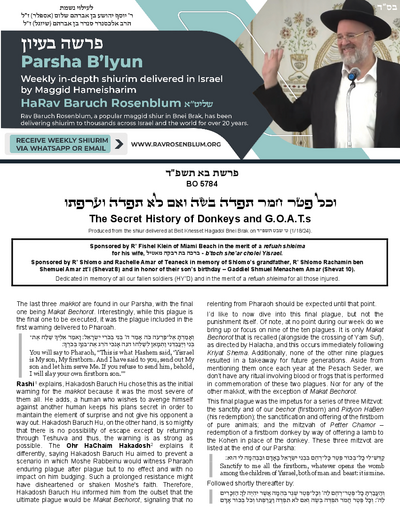
The last three makkot are found in our Parsha, with the final one being Makat Bechorot. Interestingly, while this plague is the final one to be executed, it was the plague included in the first warning delivered to Pharoah.

וְאָמַרְ תָּ אֶל־פַּרְ עֹה כֹּה אָמַר ה' בְּנִי בְכֹרִ י יִשְׂרָ אֵל׃ ַח אֶ ת־ שׁ ַ ל ָ וָאֹמַ ר אֵ לֶיך ׃ ָ בְּכֹרֶ ך ָ ְחוֹ הִנֵּה אָנֹכִי הֹרֵ ג אֶת־בִּנְך ּ בְּנִי וְיַעַבְדֵנִי וַתְּמָאֵן לְשׁ ַל

You will say to Pharaoh, “This is what Hashem said, ‘Yisrael is My son, My firstborn. And I have said to you, send out My son and let him serve Me. If you refuse to send him, behold, I will slay your own firstborn son.’”

Rashi explains, Hakadosh Baruch Hu chose this as the initial warning for the makkot because it was the most severe of them all. He adds, a human who wishes to avenge himself against another human keeps his plans secret in order to maintain the element of surprise and not give his opponent a way out. Hakadosh Baruch Hu, on the other hand, is so mighty that there is no possibility of escape except by returning through Teshuva and thus, the warning is as strong as possible. The Ohr HaChaim Hakadosh explains it differently, saying Hakadosh Baruch Hu aimed to prevent a scenario in which Moshe Rabbeinu would witness Pharaoh enduring plague after plague but to no effect and with no impact on him budging. Such a prolonged resistance might have disheartened or shaken Moshe's faith. Therefore, Hakadosh Baruch Hu informed him from the outset that the ultimate plague would be Makat Bechorot, signaling that no relenting from Pharaoh should be expected until that point.

I’d like to now dive into this final plague, but not the punishment itself. Of note, at no point during our week do we bring up or focus on nine of the ten plagues. It is only Makat Bechorot that is recalled (alongside the crossing of Yam Suf), as directed by Halacha, and this occurs immediately following Kriyat Shema. Additionally, none of the other nine plagues resulted in a takeaway for future generations. Aside from mentioning them once each year at the Pesach Seder, we don’t have any ritual involving blood or frogs that is performed in commemoration of these two plagues. Nor for any of the other makkot, with the exception of Makat Bechorot.

This final plague was the impetus for a series of three Mitzvot: the sanctity and of our bechor (firstborn) and Pidyon HaBen (his redemption); the sanctification and offering of the firstborn of pure animals; and the mitzvah of Petter Chamor – redemption of a firstborn donkey by way of offering a lamb to the Kohen in place of the donkey. These three mitzvot are listed at the end of our Parsha:

קַדֶּשׁ ־לִי כָל־בְּכוֹר פֶּטֶר כָּל־רֶ חֶם בִּבְנֵי יִשְׂרָ אֵל בָּאָדָם וּבַבְּהֵמָה לִי הוּא׃

Sanctify to me all the firstborn, whatever opens the womb among the children of Yisrael, both of man and beast: it is mine.

Followed shortly thereafter by:

וְ הַ עֲבַ רְ תָּ כָ ל־פּ ֶ טֶ ר־רֶ חֶ ם לַה' הַזְּכָרִ ים ָ וְכָל־פֶּטֶר שׁ ֶגֶר בְּהֵמָה אֲשׁ ֶר יִהְיֶה לְך לַה'׃ וְ כָל פֶּטֶר חֲמֹר תִּפְדֶּה בְשֶׂה וְאִם לֹא תִפְדֶּה וַעֲרַ פְתּוֹ וְכֹל בְּכוֹר אָדָם תִּ פְ דֶּ ה׃ ָ בְּ בָנֶיך

You shall set apart to the Lord all that opens the womb, and every firstling that comes of a beast which belong to you; the males shall be the Lord’s. Redeem each firstling donkey with a sheep. If it is not redeemed, you must break its neck. Redeem every first-born male among your sons.

In terms of where the Mitzvah of Petter Chamor is to be observed, the Ramban learns from the introductory wording אֶ רֶ ץ הַ כּ ְ נַ עֲ נִ י אֶ ל ה' ָ יְ בִ אֲ ך וְ הָ יָה כִּ י , that it applies solely within Eretz Yisrael. And the reason for this practice is then presented in the Torah – it serves as an answer to the unknowing child:

מָחָר לֵאמֹר מַה־זֹּאת וְאָמַרְ תָּ אֵלָיו בְּחֹזֶק יָד הוֹצִיאָנוּ ָ בִנְך ָ וְהָיָה כִּי־יִשְׁאָלְך ה' מִ מִּ צְ רַ יִ ם מִ בֵּ ית עֲ בָ דִ ים׃ ַהֲרֹג ה ּ ְחֵנוּ וַי ּ וַיְהִי כִּי־הִקְ שׁ ָה פַרְ עֹה לְשׁ ַל' כָּל־ בְּכוֹר בְּאֶרֶ ץ מִצְרַיִם מִבְּכֹר אָדָם וְעַד־בְּכוֹר בְּהֵמָה עַל־כֵּן אֲנִי זֹבֵחַ לַה' כָּ ל־ פֶּטֶר רֶ חֶם הַזְּכָרִ ים וְכָל־בְּכוֹר בָּנַי אֶפְדֶּה׃ וְהָיָה לְאוֹת עַל־יָדְ כָה וּלְטוֹטָפֹת כִּי בְּחֹזֶק יָד הוֹצִיאָנוּ ָ בֵּין עֵינֶיךה' מִ מּ ִ צְ רָ יִ ם ׃

When your son asks you at a later time saying, ‘What is this?’ You should say to him, “With a strong hand Hashem brought us out of Egypt from the house of slavery. When Pharaoh stubbornly refused to send us out, Hashem killed every first-born in the land of Egypt, from the first-born of man to the first-born of beast. I am therefore sacrificing to Hashem all that is first to open the womb which are male, and the first-born of my sons I redeem.’ These words shall be a sign on your hand and for totafot between your eyes, for with a strong hand Hashem brought us out of Egypt.”

It is the topic of Petter Chamor we’ll focus on during this shiur, but without going into all its Halachic details and ramifications. Of note, the donkey must be killed in the exact manner prescribed – by breaking the back of its neck – and not through any other potential means, whether a knife, a stick, starvation, or other. Is breaking the donkey’s neck a commandment or punishment for one who does not redeem the firstborn? Rashi says it is a punishment. The individual did not give the Kohen a lamb in place of their firstborn, so they, too, will not benefit from having an animal. The Rambam (Hilchot Bikurim 12:1) dedicates a full chapter to this mitzvah:

ִשְׂ רָ אֵל פֶּטֶר חֲמוֹר בְּשֶׂה. וְאִם לֹא רָ צָה ּ מִצְוַת עֲשֵׂה לִפְדּוֹת כָּל אדָם מִי לִפְ דּ וֹתוֹ מִ צְ וַת עֲשֵׂ ה לְעָרְ פוֹ ...ָה קוֹדֶמֶת לְמִצְוַת עֲרִ יפָה: ּ וּמִצְוַת פְּדִ י

It is a positive commandment for every Jewish man to redeem the first male issue of a donkey with a lamb. If he does not desire to redeem it, it is a mitzvah for him to behead it... The mitzvah of redemption takes precedence over the mitzvah of beheading the donkey.

It is puzzling how there can be a positive commandment to break the donkey’s neck, given it is a fallback action in scenarios where the owner doesn’t wish to redeem their firstborn donkey with a lamb (or the monetary value of a lamb). The Ra'avad suggests the initial act of redeeming the donkey is in fact a Mitzvah, but questions whether the substitute act should not be the opposite – a sin. The Radbaz, however, is not comfortable with this question. He compares the case of Petter Chamor to the mitzvah of Yibum, where a man is commanded to marry his deceased brother's childless widow but has a fallback commandment – Chalitza – should he not want to follow through. In the case of Yibum, both actions are considered as distinct Mitzvot, so why should that not be the case for Petter Chamor as well? He eloquently states that he’s perplexed by the Ra’avad referring to the secondary act of breaking the donkey’s neck as a sin, given his fluency in the secrets of the Torah.

I’d like to add another question to the mix, based on what we read earlier – namely, that the mitzvah of Petter Chamor is to commemorate the killing of Egyptian firstborns during Makat Bechorot. We’re told the mitzvah of redeeming the donkey takes precedence over the mitzvah to break its neck, but if the commemoration is for the killing of firstborns, should we not prioritize breaking the donkey’s neck? Would that not be a more appropriate commemoration?

Let’s now dive into the topic, according to the commentary of Rabbi Ovadiah Seforno. We’ll begin with the question posed by the son – ָ בִ נְך ָ וְ הָ יָה כִּ י־יִשׁ ְ אָ לְ ך – which prefaces the explanation for the mitzvah of Petter Chamor and its connection to Makat Bechorot. Seforno points out this is the question of the simple son (Tam) who is unaware yet the question itself is not so simple. It is a very perceptive question, when considering the donkey is an impure animal suddenly finding itself sanctified and redeemed in a manner of holiness. Yishmael is compared to a donkey and there is no kedusha whatsoever to Yishmael; so, the son asks, why should this donkey be treated in a spiritually elevated manner. Neither can ever become kadosh. Furthermore, if there’s a need to kill this animal, why insist on breaking its neck from behind? Why not kill it with whatever means available? This are the child’s intelligent questions.

The answer lies in the words: בְּ חֹזֶק יָד הוֹצִ יאָ נוּ . Hakadosh Baruch Hu redeemed Bnei Yisrael from the strong hand of Egypt, and due to the urgency with which the Egyptians wanted them gone, they could not depart Egypt in wagons (agalot) – i.e., the method with which they had arrived in the days of Yaacov Avinu. They had to instead settle for donkeys. However, a miracle occurred, and the wagons materialized together with the many donkeys needed to transport all the newfound riches of the people. The constructive role donkeys played in the redemption of Bnei Yisrael is reflected in their not being treated like all other impure animals. Thus, their firstborn may be redeemed in exchange for a pure animal, so that the donkey can then be used in the regular way. We are instructed to explain to our children why the donkey, exclusively amongst all impure animals, received this minor element of kedusha.

Seforno continues his commentary on the pesukim, pointing out that Pharaoh had put so many obstacles in the path of Bnei Yisrael’s eventual liberation that he himself is compared to a donkey. Yechezkel HaNavi (Yechezkel 23:20) describes the Egyptians as donkeys, and Pharaoh is the chief donkey among them. He had full control and could have easily redeemed himself by releasing Bnei Yisrael, but after failing to do so, the firstborns of Egypt were killed instead. Had only Pharoah followed his orders and given the lamb – i.e., Bnei Yisrael – to the Kohen – i.e., Hakadosh Baruch Hu – he’d have redeemed himself.

The Midrash (Tanchuma Bamidar 24; Bamidar Rabbah 4:5) also brings forth these answers of Rabbi Ovadiah Seforno. For the sake of Bnei Yisrael, and on account of His love of Bnei Yisrael, Hakadosh Baruch Hu changed the order of the world. Rather than redeeming a donkey through a sheep, He redeemed the sheep – i.e., Bnei Yisrael – by taking the life of a donkey.

The Gemara (Bechorot 5b) that deals with this mitzvah and the reasoning quoted by Rashi – namely, that the donkeys were of transportation assistance to Bnei Yisrael when they left Egypt – teaches us that each member of Bnei Yisrael left with ninety Nubian donkeys (חֲ מ ו ֹ רִ י ם ל ו ּ בִ י ם ). These donkeys were considered to be of superior quality, and they were loaded up with gold and silver. Rashi quotes this Gemara, but leaves out the number ninety, instead stating “many”. The Midrash HaGadol says the minimum number of donkeys each took out with them was seventy, also a fair number. According to the Midrash Rabbah (Esther), Haman spoke lashon hara about Bnei Yisrael to Achashverosh. He didn’t know what he was talking about, nor did he comprehend the evidence he himself submitted, but just like the case against Israel in the Hague, a grand and elaborate case was presented. Haman claimed the Egyptians graciously hosted Bnei Yisrael, allowing them to build two cities and become world-class developers. The Egyptians treated Bnei Yisrael well and fed them generously, he continued, only for the Jewish people to stab them in the back. According to his filing, they sent their representative witch – Moshe Rabbeinu – who inflicted great suffering on the Egyptians, allowing the guests to steal from their hosts and walk off with all their wealth and belongings, including their donkeys. He, too, does not mention a specific number. The Ohr HaChaim Hakadosh (Shemot 25:2), in reflecting on the gifts Bnei Yisrael brought to construct the Mishkan, says Moshe questioned the people’s financial ability to bring forth the necessary material. In His response to Moshe, Hakadosh Baruch Hu said even the poorest member of Bnei Yisrael had the means to contribute, as from the spoils of the Egyptians who drowned in the sea, each collected a minimum of forty donkeys loaded up with precious stones and metals.

So, how many donkeys did each of Bnei Yisrael leave Egypt with? The Gemara says ninety, the Midrash says seventy, the Ohr HaChaim says forty, and Haman’s testimony is moot, because just like its current reincarnation, his words were absurd, groundless, and devoid of all substance. If you ask me why it matters exactly how many donkeys each took from Egypt, I’d have to be honest with you. It really doesn’t matter. If you take the largest number of ninety, and multiply it by 600,000, the total is 54-million donkeys. And if you replace that with the smallest number, forty, it is still 24-million donkeys that accompanied Bnei Yisrael out of Egypt. Neither number is comprehensible. Even in today’s world, thousands of years later, it is simply impossible to obtain that number of donkeys. So, how is it possible that Hakadosh Baruch Hu set them up with such a fleet and made it possible for them to load them up and transport them out of Egypt? When they inform their children that they couldn't leave with wagons and had to settle for donkeys instead, what response should they give when asked how they managed to feed tens of millions in a desert that grew no grass or plants?

I asked this question yesterday, and someone told me donkeys were the primary means of transportation back then, and if that were the case today, we’d see Subaru, Mercedes, and Toyota all producing donkeys. They’d be imported from the Far East, the Houthis would swipe some along the way, and they’d eventually reach our streets. It's akin to driving on the highway between Beersheva and Arad at 8:00 am and being forced to come to a complete stop as thirty donkeys cross the road, shuttling thirty Bedouin kids to school. Each of these villages has hundreds of donkeys for that purpose (right next to the Toyota and Mercedes jeeps parked at the tin huts). That is what they use, so they can be found there, just like in Egypt and in the desert as Bnei Yisrael travelled. What seems ungraspable to us today was the norm at one time, even in the quantities discussed. And with regards to food, Tosafot says the layer of dew that covered the manna would melt, and from it the dessert would produce a thin layer of vegetation that these donkeys would sustain themselves with.

But my friend’s answer clearly was not good enough for the Ben Yehoyada, asks these questions with regards to the quantity of donkeys and all the surrounding logistics. In his opinion, not every member of Bnei Yisrael left with that number of donkeys. Even though the Gemara says each left with ninety, he says this refers to the head of each family, resulting in a far smaller number who collected spoils from the Egyptians and loaded up donkeys. In another location, he says some may have taken ninety, but most took closer to ten or twelve donkeys, also lowering the total number.

I’d like to share one final thought on this topic before moving on. What is the significance of ninety? One hundred is a nice and big round number, but ninety is nisht ahin, nisht aher – neither here nor there. Eighty-six would have significance in gematria (Elokim), but ninety isn’t even a number of guzma – a number we find used to represent exaggeration. Numerous commentators ask this question. Perhaps ninety of them.

In sefer B'Yam Derech, an idea is brought from the Maggid of Kozhnitz, referencing a piyyut found in the Yotzrot for Shabbat Hagadol. As an aside, it is very enjoyable to read and study such piyyutim nowadays, with translations and explanations available to help us comprehend these magnificent masterpieces. It is incredible how, in a few poetic lines, so many ideas from such an array of sources can be beautifully presented, each adding to our understanding of a subject. These are not modern-day rhymes, l’havdil, where the sound patterns of its words match up but without any context or meaning other than to produce something that can be copyrighted and broadcast. The piyyut in question is Kerem Chemed, and it contains the following line:

ְצָהּ מִבֵּין פּוֹשְׁעִים. בְּחֵיל אֲלָפִים רְ בָבוֹת תִּשְׁעִים. וּבְצֶדֶק נִפְקַד ּ וְנִגְלֵיתָ לְחַל לְתֵשׁ ַע וְתִשְׁעִים. הוּעֲמָסָה מַשָּׂא פְרָ דִ ים תִּשְׁעִים.

Hakadosh Baruch Hu revealed Himself to save Bnei Yisrael from wicked Egyptians; together with ninety riboh angels; Therefore, Bnei Yisrael took for themselves ninety donkeys.

Bnei Yisrael took ninety donkeys because Hakadosh Baruch Hu, together with ninety riboh angels (900,000), took them out of Egypt. The source of this statement is Targum Yonatan ben Uziel (Shemot 12:12). The Maggid of Kozhnitz says, to commemorate Yetziat Mitzrayim, each took ninety donkeys.

Another idea, found in Megaleh Amukot, is that the ninety donkeys were in honor of Moshe Rabbeinu, the leader of Bnei Yisrael as they exited Egypt, and the one who pushed them to ask for and then collect all these donkeys and riches. Moshe Rabbeinu is also referred to as Tzaddik (Nedarim 31b), and the name ַדִּ יק ּ צ begins with the letter צ, whose numerical value is ninety.

The Zohar (1:196) provides a similar reason for the quantity of ninety donkeys. The inspiration for that amount stems from Yosef HaTzaddik, as it was to his merit that Bnei Yisrael received silver and gold before their departure. This served as a reward for their moral conduct in the realm of forbidden and immoral relations, and the strength to uphold this holiness was derived from the example set by Yosef HaTzaddik during the episode with Potiphar’s wife, where he turned down payment and great reward in choosing to remain ethical and pure.

If you’d like, these last two answers can be combined, based on what we’ll read next week: ַח מֹשׁ ֶה אֶת־עַצְמוֹת יוֹסֵף ִּק ּ וַי – Moshe took the bones of Yosef with him. Mishlei says (10:8): ָבֵט׃ ּ ַח מִצְוֺת וֶאֱוִיל שְׂפָתַיִם יִל ּ חֲכַם־לֵב יִק He whose heart is wise accepts commands, but he whose speech is foolish comes to grief. This pasuk refers to Moshe Rabbeinu, the tzaddik, taking the remains of Yosef, the tzaddik, while the rest of Bnei Yisrael at that very moment were running around Egypt collecting their reward in the merit of these two tzaddikim.

There is another opinion, however, that states the number ninety is not in honor of Yosef or Moshe, but rather Avraham Avinu, who was told hundreds of years earlier that Bnei Yisrael would be enslaved prior to leaving with great wealth. The Gemara (Berachot 9a) says, Bnei Yisrael were instructed to ask the Egyptians for silver and gold with an expression of supplication (נָא). Hakadosh Baruch Hu said to Moshe Rabbeinu, “Please, go and tell Bnei Yisrael to borrow vessels of silver and vessels of gold, in order to fulfill the promise I made to Avraham, so that that righteous person, Avraham, will not say I fulfilled My promise to enslave them but not My promise to have them exit with great possessions.” Once again, there is a righteous person – a ַדִּ יק ּ צ – in play, but it is Avraham Avinu according to this opinion.

The Ba’al HaTurim holds the number ninety was in the merit of Yitzchak Avinu. He points to the key word at the opening of last week’s Parsha – וָ אֵ רָ א – whose numerical value (208) equals יִצְ חָ ק . It was in Yitzchak Avinu’s merit that Bnei Yisrael were taken out of Egypt, and he cites a Midrash as his source. While we have no such Midrash in our possession today, we do know that many Midrashim were lost to us throughout history. His father, the Rosh, also cites this Midrash and gives us more detail as to its context (Shemot 6:2). When Bnei Yisrael were at their deepest point of suffering, their cries were heard in Heaven not only by Hakadosh Baruch Hu but also by the Avot, who begged for the redemption to begin. The response from Hakadosh Baruch Hu was shocking: “Whoever gives me a letter from their name, in his merit I will end the suffering.” Avraham and Yaacov were unable to modify their names, responding that their given names were already changed by Hakadosh Baruch Hu, and the new names were intentional and necessary for Bnei Yisrael in the future. Yitzchak responded, “My name was supposed to be written as יִ שְׂ חָ ק (Tehillim 105:9), but I am willing to forgo my honor and have it written as יִצְ חָ ק .” The difference between shin (300) and tzadi (90) is 210, and thus, in the merit of Yitzchak Avinu, Bnei Yisrael would be rescued from slavery after an abbreviated 210 years.

The Chida questions this approach, however, pointing out that according to this Midrash, Bnei Yisrael should have been saved after 190 years of slavery – the planned 400 minus the 210 Yitzchak sacrificed – rather than after 210 years. I’ll leave you with this interesting question, to sort out over Shabbat with your friends and family.

Another idea relates to the custom of breaking the middle matza at the Pesach Seder, a matza that represents Yitzchak Avinu. This idea can be found in Ne'imot Yomeiru and Haggadah Baruch Yomeiru.

PDF Preview