The Uniqueness of the Plague of Locusts
Zera Shimshon | January 29, 2025
Print This Article
View Original PDF

The Uniqueness of the Plague of Locusts

Zera Shimshon | June 27, 2025

And Hashem said to Moshe, "Go to Paroah for I have hardened his heart and the heart of his servants in order to put My signs in his midst. And in order that you will relate in the ears of your sons and your son's sons how I made fools of the Egyptians and the signs I put in them. And you will realize that I am Hashem. And Moshe and Aharon came before Paroah and they said to him, "This is what Hashem the God of the Ivrim said, 'Until when will you refuse to humble yourself before Me. Send out My people and they will serve Me. For if you refuse to send out my people I will bring locust in your boundaries’." (Shemos 10 /1-4)

When Hashem told Moshe to inform Paroah that Hashem will be bringing a new makkah, what that makkah will be is not mentioned. It is only written, "And in order that you will relate in the ears of your sons and your son's sons how I made fools of the Egyptians and the signs I put in them". However, when Moshe warned Paroah that if he doesn't send Bnei Yisroel out of Mitzrayim, Hashem will punish him with another makkah, Moshe tells Paroah that the makkah will be locust. If Hashem never told Moshe what the makkah will be, how did Moshe know that it will be locust?

The Medrash (Shemos Rabbah 13/5) explains, "HaKodesh Baruch Hu revealed to Moshe the specific makkah that He was going to bring on Paroah, but Moshe only alluded to it in the phrase, “in order that you will relate in the ears of your sons and your grandchildren how I made fools of the Egyptians.” This is referring to the makkah of locust as it is written concerning he makkah of locust in the days of Yoel; “Relate to your children about it.”

In other words, the Medrash teaches us that Hashem really told Moshe that the coming makkah will be locust but Moshe didn't want to write it openly and only alluded to it with the words; "in order that you will relate in the ears of your sons how I made fools of the Egyptians".

Zera Shimshon asks what is unique about the makkah of locusts that it is the only makkah that Moshe only alluded to it and didn't write it openly?

Secondly, why only in this makkah is it written that the purpose of the Makkah is; in order to relate it in ears of your children? Seemingly, the purpose of all of the makkos was to tell their children how Hashem punished the Mitzriyim for oppressing Bnei Yisroel!

A third question is why in possuk 10, after Hashem struck Mitzrayim with the locust and Paroah agreed that Bnei Yisroel can leave to make their sacrifice, Paroah said, "... realize that evil is opposite you." Why only after this makkah did he try to frighten Moshe by saying that something bad is going to happen?

Zera Shimshon answers these three questions in light of another Medrash.

On the possuk (10/4), "...for if you refuse to send out my people I will bring locust in your boundaries." the Medrash explains, "in your boundaries and not in the boundaries of the rest of the descendants of Cham...". From this Medrash we learn a way to establish the exact territory and borders of Mitzrayim; wherever there was locust- was Mitzrayim. In a place that there was no locust it was not Mitzrayim.

Zera Shimshon explains the reason why Hashem showed the borders of Mitzrayim specifically with this makkah was because the other makkos did not affect Bnei Yisroel at all. For instance, the water of the Mitzriyim turned into blood but the water of Bnei Yisroel was unaffected. Bnei Yisroel lived interspersed with the Mitzriyim so the Makkah didn't fall in the whole territory of Mitzrayim. Wherever one of Bnei Yisroel lived, even though he lived in the middle of Mitzrayim, there was no makkah. Therefore, the makkah did not show the exact boundaries of Mitzrayim.

Concerning locust, though, it was different. Since some types of locust are kosher, Bnei Yisroel could benefit from them. Hashem therefore didn't want to withhold locust from them, and locust also appeared in Jewish neighborhoods and in Jewish homes. True, there were not as many locusts in the dwelling places of Bnei Yisroel as in the rest of Mitzrayim, but still these places were not "locust free". Therefore, one could determine the boundaries of Mitzrayim through the locust. Wherever there was locust, either a lot or a little, was Mitzrayim and wherever there was none, was not Mitzrayim.

Paroah didn't make this distinction between kosher locust and non-kosher locust so from the fact that locust also fell near Bnei Yisroel, Paroah understood that Bnei Yisroel also deserve to be punished. He therefore told Moshe, "... realize that evil is opposite you." It wasn't simply an exaggerated threat, but he really thought that Bnei Yisroel are being punished for their sins just like he was being punished for his sins and Moshe should rethink about taking Bnei Yisroel out of Mitzrayim into the Desert.

Since locust also appeared to Bnei Yisroel, even though not as a curse, but as something from which they benefited, Moshe didn't want to mention it by name and only alluded to it.

This is also the explanation why only concerning the makkah of locust did the Torah write; And in order that you will relate in the ears of your sons and your son's sons how I made fools of the Egyptians." Since this is the only makkah that Bnei Yisroel experienced firsthand, it is only concerning this makkah can they, "relate in the ears of your sons and your son's sons how I made fools of the Egyptians"!
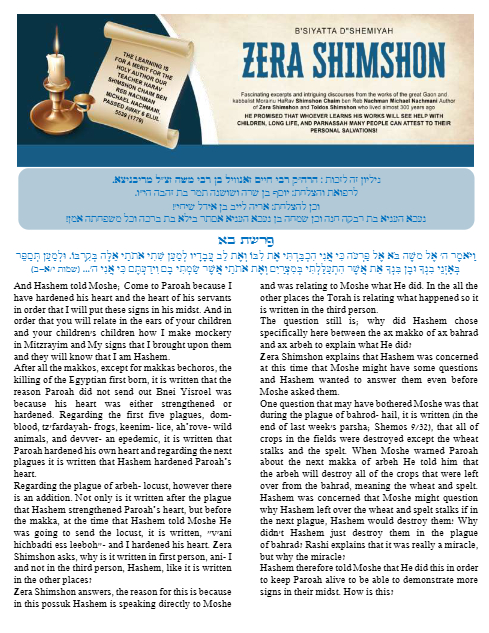

And Hashem said to Moshe, "Go to Paroah for I have hardened his heart and the heart of his servants in order to put My signs in his midst. And in order that you will relate in the ears of your sons and your son's sons how I made fools of the Egyptians and the signs I put in them. And you will realize that I am Hashem. And Moshe and Aharon came before Paroah and they said to him, "This is what Hashem the God of the Ivrim said, 'Until when will you refuse to humble yourself before Me. Send out My people and they will serve Me. For if you refuse to send out my people I will bring locust in your boundaries’." (Shemos 10 /1-4)

When Hashem told Moshe to inform Paroah that Hashem will be bringing a new makkah, what that makkah will be is not mentioned. It is only written, "And in order that you will relate in the ears of your sons and your son's sons how I made fools of the Egyptians and the signs I put in them". However, when Moshe warned Paroah that if he doesn't send Bnei Yisroel out of Mitzrayim, Hashem will punish him with another makkah, Moshe tells Paroah that the makkah will be locust. If Hashem never told Moshe what the makkah will be, how did Moshe know that it will be locust?

The Medrash (Shemos Rabbah 13/5) explains, "HaKodesh Baruch Hu revealed to Moshe the specific makkah that He was going to bring on Paroah, but Moshe only alluded to it in the phrase, “in order that you will relate in the ears of your sons and your grandchildren how I made fools of the Egyptians.” This is referring to the makkah of locust as it is written concerning he makkah of locust in the days of Yoel; “Relate to your children about it.”

In other words, the Medrash teaches us that Hashem really told Moshe that the coming makkah will be locust but Moshe didn't want to write it openly and only alluded to it with the words; "in order that you will relate in the ears of your sons how I made fools of the Egyptians".

Zera Shimshon asks what is unique about the makkah of locusts that it is the only makkah that Moshe only alluded to it and didn't write it openly?

Secondly, why only in this makkah is it written that the purpose of the Makkah is; in order to relate it in ears of your children? Seemingly, the purpose of all of the makkos was to tell their children how Hashem punished the Mitzriyim for oppressing Bnei Yisroel!

A third question is why in possuk 10, after Hashem struck Mitzrayim with the locust and Paroah agreed that Bnei Yisroel can leave to make their sacrifice, Paroah said, "... realize that evil is opposite you." Why only after this makkah did he try to frighten Moshe by saying that something bad is going to happen?

Zera Shimshon answers these three questions in light of another Medrash.

On the possuk (10/4), "...for if you refuse to send out my people I will bring locust in your boundaries." the Medrash explains, "in your boundaries and not in the boundaries of the rest of the descendants of Cham...". From this Medrash we learn a way to establish the exact territory and borders of Mitzrayim; wherever there was locust- was Mitzrayim. In a place that there was no locust it was not Mitzrayim.

Zera Shimshon explains the reason why Hashem showed the borders of Mitzrayim specifically with this makkah was because the other makkos did not affect Bnei Yisroel at all. For instance, the water of the Mitzriyim turned into blood but the water of Bnei Yisroel was unaffected. Bnei Yisroel lived interspersed with the Mitzriyim so the Makkah didn't fall in the whole territory of Mitzrayim. Wherever one of Bnei Yisroel lived, even though he lived in the middle of Mitzrayim, there was no makkah. Therefore, the makkah did not show the exact boundaries of Mitzrayim.

Concerning locust, though, it was different. Since some types of locust are kosher, Bnei Yisroel could benefit from them. Hashem therefore didn't want to withhold locust from them, and locust also appeared in Jewish neighborhoods and in Jewish homes. True, there were not as many locusts in the dwelling places of Bnei Yisroel as in the rest of Mitzrayim, but still these places were not "locust free". Therefore, one could determine the boundaries of Mitzrayim through the locust. Wherever there was locust, either a lot or a little, was Mitzrayim and wherever there was none, was not Mitzrayim.

Paroah didn't make this distinction between kosher locust and non-kosher locust so from the fact that locust also fell near Bnei Yisroel, Paroah understood that Bnei Yisroel also deserve to be punished. He therefore told Moshe, "... realize that evil is opposite you." It wasn't simply an exaggerated threat, but he really thought that Bnei Yisroel are being punished for their sins just like he was being punished for his sins and Moshe should rethink about taking Bnei Yisroel out of Mitzrayim into the Desert.

Since locust also appeared to Bnei Yisroel, even though not as a curse, but as something from which they benefited, Moshe didn't want to mention it by name and only alluded to it.

This is also the explanation why only concerning the makkah of locust did the Torah write; And in order that you will relate in the ears of your sons and your son's sons how I made fools of the Egyptians." Since this is the only makkah that Bnei Yisroel experienced firsthand, it is only concerning this makkah can they, "relate in the ears of your sons and your son's sons how I made fools of the Egyptians"!

PDF Preview