A Thought on Bitachon
Hashgacha Pratis | November 10, 2023
Print This Article
View Original PDF

A Thought on Bitachon

Hashgacha Pratis | December 31, 2025

Dancing with Hashem Yisbarach

Rav Shach zt”l related tearfully a story that a Yid had told him. They were a group of Jews in a Nazi camp, and one of them said, “Today is Simchas Torah. Let us dance for hakafos!” His friends said, “How can we dance? We have no Sefer Torah!” This dear Yid, who was burning with love for Hashem, said, “True, we have no Sifrei Torah, but we have the Ribbono shel Olam! He is here with us, and we will dance with the Ribbono shel Olam!”

Immediately, those Yidden burst out in dance for the hakafos. It was a dance with Hashem yisbarach, just them and Him.

When Rav Shach concluded this story, he added, “I would have given the entire world to be able to participate in such hakafos! The Kotzker Rebbe zy”a says: “Heitivu nagen bitruah” (Tehillim 33) – teruah comes from the root of ra’ua, meaning broken. The teruah call of the shofar is a series of broken sounds. Especially during times when we are broken, heitivu nagen – it’s a great art to know how to make music. What is the tune that one plays during times of difficulty and brokenness? As the perek continues, “For Hashem’s Word is just, and all His deeds can be trusted.” This is the niggun we need when we are broken.

The Vizhnitzer Rebbe the Imrei Chaim zy”a, who gathered the broken people after the Holocaust, would say that the words we say in Ne’ilah on Yom Kippur, when we ask Hashem, “And save us from all gezeiros kashos – difficult decrees,” are also a request to save us from decrees about which there are kushiyos – questions. Before bein hazmanim he would warn the yeshivah bachurim, “Be careful not to get into discussions with people who went through the Holocaust. Be careful, because they are liable to bring up all sorts of questions, and it is not your job to answer them.”

On one occasion two brothers, the sole survivors of their whole extended family, came to see him. They themselves had lost wives and children, and they were shattered. They told him in tears what they had endured, and they expressed their complaints – why did Hashem do this to them?

The Divrei Chaim answered them from the depths of his merciful heart: “I would not want to serve a G-d Whose ways I am able to understand.”

In Yiddish we refer to Hakadosh Baruch Hu as the Eibishter. The literal translation of the word eibishter is above. He is above all, as it says, “My ways are higher than your ways, my thoughts [higher] than your thoughts” (Yeshayahu 55:9). Hakadosh Baruch Hu is the Creator, the Overseer, the One Who makes plans and Who carries them out, the First and the Last, and He sees from the beginning of time until the end of time. We are human beings, created by Him, here in the world for a short time, and we have no ability to understand anything. Would you want a G-d Whom you could understand?! That would be like a child who wants a father on his own level. A child’s entire sense of security, the feeling that his father can provide all his needs and protect him, stems from the fact that he knows and believes that his father is wiser and stronger than he is. And if his father decided to withhold from him something good, or to cause him pain, that is only because he cares for him and wants it to be good for him.

How good it is and how fortunate are we, that we do not understand the ways of Hashem, and we are able to rely on Him, knowing without a doubt that He is doing what is best for us.

The Future Is Already Here

When you ask someone what time it is, he can answer, “6:30” – half past six. In Yiddish we say the opposite – halb ziben – a half hour before seven, for that is how a Jew experiences life: At this moment the present is unclear, but I have no doubt that it is a preparation for the future, when we will see that everything is for the good.

During the Holocaust people asked the Shefa Chaim, “What do you say now?” He responded, “Whether I will survive this war or not, I don’t know, but I am sure that the war will end, and Hakadosh Baruch Hu will help us, and Yiddishkeit will be renewed, homes will be built, yeshivos will be built, talmudei Torah will be built, shuls will be built, and Am Yisrael will flourish anew. Am Yisrael will remain forever!”

The Shefa Chaim’s words, spoken then in pain and fear, came true. Am Yisrael lives, and now too, during these difficult days, we are being strengthened by the words of our holy rabbanim, and anticipating, with hearts full of emunah and bitachon, that Hashem yisbarach is leading us all toward the final geulah, speedily in our days; amen.
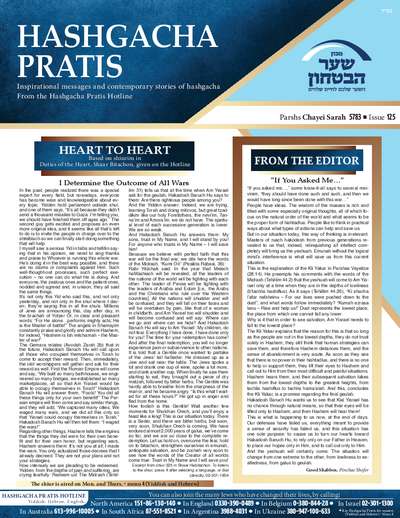
Dancing with Hashem Yisbarach

Rav Shach zt”l related tearfully a story that a Yid had told him. They were a group of Jews in a Nazi camp, and one of them said, “Today is Simchas Torah. Let us dance for hakafos!” His friends said, “How can we dance? We have no Sefer Torah!” This dear Yid, who was burning with love for Hashem, said, “True, we have no Sifrei Torah, but we have the Ribbono shel Olam! He is here with us, and we will dance with the Ribbono shel Olam!”

Immediately, those Yidden burst out in dance for the hakafos. It was a dance with Hashem yisbarach, just them and Him.

When Rav Shach concluded this story, he added, “I would have given the entire world to be able to participate in such hakafos! The Kotzker Rebbe zy”a says: “Heitivu nagen bitruah” (Tehillim 33) – teruah comes from the root of ra’ua, meaning broken. The teruah call of the shofar is a series of broken sounds. Especially during times when we are broken, heitivu nagen – it’s a great art to know how to make music. What is the tune that one plays during times of difficulty and brokenness? As the perek continues, “For Hashem’s Word is just, and all His deeds can be trusted.” This is the niggun we need when we are broken.

The Vizhnitzer Rebbe the Imrei Chaim zy”a, who gathered the broken people after the Holocaust, would say that the words we say in Ne’ilah on Yom Kippur, when we ask Hashem, “And save us from all gezeiros kashos – difficult decrees,” are also a request to save us from decrees about which there are kushiyos – questions. Before bein hazmanim he would warn the yeshivah bachurim, “Be careful not to get into discussions with people who went through the Holocaust. Be careful, because they are liable to bring up all sorts of questions, and it is not your job to answer them.”

On one occasion two brothers, the sole survivors of their whole extended family, came to see him. They themselves had lost wives and children, and they were shattered. They told him in tears what they had endured, and they expressed their complaints – why did Hashem do this to them?

The Divrei Chaim answered them from the depths of his merciful heart: “I would not want to serve a G-d Whose ways I am able to understand.”

In Yiddish we refer to Hakadosh Baruch Hu as the Eibishter. The literal translation of the word eibishter is above. He is above all, as it says, “My ways are higher than your ways, my thoughts [higher] than your thoughts” (Yeshayahu 55:9). Hakadosh Baruch Hu is the Creator, the Overseer, the One Who makes plans and Who carries them out, the First and the Last, and He sees from the beginning of time until the end of time. We are human beings, created by Him, here in the world for a short time, and we have no ability to understand anything. Would you want a G-d Whom you could understand?! That would be like a child who wants a father on his own level. A child’s entire sense of security, the feeling that his father can provide all his needs and protect him, stems from the fact that he knows and believes that his father is wiser and stronger than he is. And if his father decided to withhold from him something good, or to cause him pain, that is only because he cares for him and wants it to be good for him.

How good it is and how fortunate are we, that we do not understand the ways of Hashem, and we are able to rely on Him, knowing without a doubt that He is doing what is best for us.

The Future Is Already Here

When you ask someone what time it is, he can answer, “6:30” – half past six. In Yiddish we say the opposite – halb ziben – a half hour before seven, for that is how a Jew experiences life: At this moment the present is unclear, but I have no doubt that it is a preparation for the future, when we will see that everything is for the good.

During the Holocaust people asked the Shefa Chaim, “What do you say now?” He responded, “Whether I will survive this war or not, I don’t know, but I am sure that the war will end, and Hakadosh Baruch Hu will help us, and Yiddishkeit will be renewed, homes will be built, yeshivos will be built, talmudei Torah will be built, shuls will be built, and Am Yisrael will flourish anew. Am Yisrael will remain forever!”

The Shefa Chaim’s words, spoken then in pain and fear, came true. Am Yisrael lives, and now too, during these difficult days, we are being strengthened by the words of our holy rabbanim, and anticipating, with hearts full of emunah and bitachon, that Hashem yisbarach is leading us all toward the final geulah, speedily in our days; amen.

PDF Preview