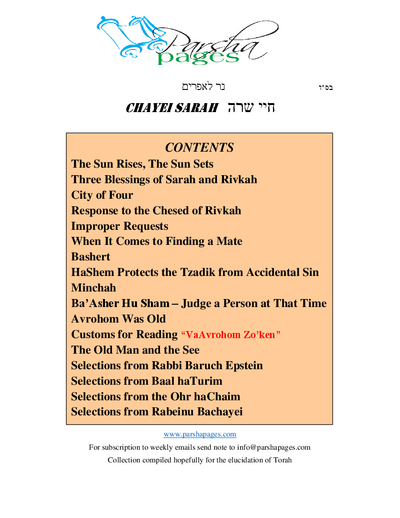
Minchah
Parsha Pages | November 06, 2023
Print This Article
View Original PDF

Minchah

Parsha Pages | December 31, 2025

QUESTION: The Shacharis prayer is called Shacharis because it is the morning ("Shachar") prayer, and it corresponds to the morning Tamid offering. The nighttime prayer, Arvis (or Ma'ariv) is called such because it is said at night (Erev). Why, though, is the afternoon prayer called Minchah (which Yitzchak established per Gemara Berachos 26a)?

ANSWERS:

(a) TOSFOS (Pesachim 107a, DH Samuch) explains that a Minchah (flour) offering was brought together with the afternoon Tamid, and therefore the prayer that corresponds to the afternoon Tamid is called Minchah. Even though a Minchah offering was also brought with the *morning* Tamid, for the morning-prayer there is a more general name that can be used ("Shacharis"). The word that is used to refer to the afternoon ("Erev"), though, is already being used to refer to the nighttime prayer, Arvis.

(b) TOSFOS (ibid.) answers further that the Gemara (Berachos 6b) says that Minchah is a special prayer, because that was the time of day that G-d answered Eliyahu and the idolaters were proven wrong. Perhaps Eliyahu was bringing a Minchah offering at the time, and HaShem answered his prayers because it was a propitious time of Divine favor. We therefore call the afternoon prayer, "The prayer of the Minchah (of Eliyahu)," to remind ourselves that it is prayed during a time of Divine favor.

(c) The VILNA GAON in Shenos Eliyahu adds that we find that a person is allowed to recite Minchah until the very end of the day. The Minchah prayer was instituted to correspond not to the offering of the Tamid, but to the Minchah offering that was brought with the Korban Tamid (during which Eliyahu's prayers were answered), which could be brought until the very end of the day. In the morning, the time of prayer is determined by the *first* part of the Korban, which is the sacrificing of the Korban (and not the morning Minchah). Whereas in the afternoon, one may Daven until the *last* part of the Korban Tamid, which is the Minchah offering. Thus, we called the afternoon prayer Minchah.

(d) RAMBAM (Perush ha'Mishnayos) says that the late afternoon is called "Minchah" in Hebrew, and therefore the afternoon prayer is called as such. The AVUDRAHAM adds that the Torah refers to the late afternoon as "Ruach ha'Yom" (Bereishis 3:8), which the Targum translates as "*li'Menach* Yoma", which means the time when the sun can be seen to be setting. Hence, the prayer said at that time is called Minchah.

(e) ASARES HAMAMROS states that the first prayer was offered by Adam hsRishon after the Sin in the afternoon לרוח היום (near the sunset).

(e) RABBI SHIMSHON RAPHAEL HIRSCH (Commentary to Tehillim 141,2) tells us that the two Tamid offerings are complementary expressions of dedications of our conduct to HaShem. The morning (rising of the sun) is symbolical of the rising prosperity and happiness in our lives. The afternoon (time of the descent of the sun) symbolizes the time of struggles for parnasah and political misfortune. Yet exactly in those times of trials and defeats we must also dedicate our conduct to HaShem especially with our material processions which is the Minchah, the flour offering.

(f) SHELOH HAKODESH (Torah Ohr dalet) states that Yitzchak established the Minchah prayer at the Akeidah. Yitzchak said there is an Oleh offering but where is the Minchah (flour) offering. Then, Yitzchak stood up and established the afternoon prayer (in place of the flour offering) and is thus, called the Minchah prayer. We also see that the time of the Akeidah was after noon and not in the morning.
QUESTION: The Shacharis prayer is called Shacharis because it is the morning ("Shachar") prayer, and it corresponds to the morning Tamid offering. The nighttime prayer, Arvis (or Ma'ariv) is called such because it is said at night (Erev). Why, though, is the afternoon prayer called Minchah (which Yitzchak established per Gemara Berachos 26a)?

ANSWERS:

(a) TOSFOS (Pesachim 107a, DH Samuch) explains that a Minchah (flour) offering was brought together with the afternoon Tamid, and therefore the prayer that corresponds to the afternoon Tamid is called Minchah. Even though a Minchah offering was also brought with the *morning* Tamid, for the morning-prayer there is a more general name that can be used ("Shacharis"). The word that is used to refer to the afternoon ("Erev"), though, is already being used to refer to the nighttime prayer, Arvis.

(b) TOSFOS (ibid.) answers further that the Gemara (Berachos 6b) says that Minchah is a special prayer, because that was the time of day that G-d answered Eliyahu and the idolaters were proven wrong. Perhaps Eliyahu was bringing a Minchah offering at the time, and HaShem answered his prayers because it was a propitious time of Divine favor. We therefore call the afternoon prayer, "The prayer of the Minchah (of Eliyahu)," to remind ourselves that it is prayed during a time of Divine favor.

(c) The VILNA GAON in Shenos Eliyahu adds that we find that a person is allowed to recite Minchah until the very end of the day. The Minchah prayer was instituted to correspond not to the offering of the Tamid, but to the Minchah offering that was brought with the Korban Tamid (during which Eliyahu's prayers were answered), which could be brought until the very end of the day. In the morning, the time of prayer is determined by the *first* part of the Korban, which is the sacrificing of the Korban (and not the morning Minchah). Whereas in the afternoon, one may Daven until the *last* part of the Korban Tamid, which is the Minchah offering. Thus, we called the afternoon prayer Minchah.

(d) RAMBAM (Perush ha'Mishnayos) says that the late afternoon is called "Minchah" in Hebrew, and therefore the afternoon prayer is called as such. The AVUDRAHAM adds that the Torah refers to the late afternoon as "Ruach ha'Yom" (Bereishis 3:8), which the Targum translates as "*li'Menach* Yoma", which means the time when the sun can be seen to be setting. Hence, the prayer said at that time is called Minchah.

(e) ASARES HAMAMROS states that the first prayer was offered by Adam hsRishon after the Sin in the afternoon לרוח היום (near the sunset).

(e) RABBI SHIMSHON RAPHAEL HIRSCH (Commentary to Tehillim 141,2) tells us that the two Tamid offerings are complementary expressions of dedications of our conduct to HaShem. The morning (rising of the sun) is symbolical of the rising prosperity and happiness in our lives. The afternoon (time of the descent of the sun) symbolizes the time of struggles for parnasah and political misfortune. Yet exactly in those times of trials and defeats we must also dedicate our conduct to HaShem especially with our material processions which is the Minchah, the flour offering.

(f) SHELOH HAKODESH (Torah Ohr dalet) states that Yitzchak established the Minchah prayer at the Akeidah. Yitzchak said there is an Oleh offering but where is the Minchah (flour) offering. Then, Yitzchak stood up and established the afternoon prayer (in place of the flour offering) and is thus, called the Minchah prayer. We also see that the time of the Akeidah was after noon and not in the morning.

PDF Preview