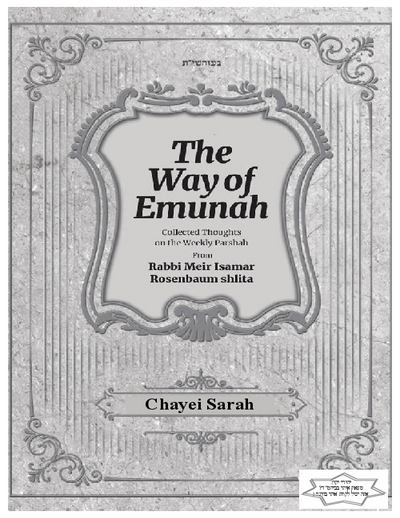
The Way Of Emunah
The Way of Emunah | November 10, 2023
Print This Article
View Original PDF

The Way Of Emunah

The Way of Emunah | December 31, 2025

The Imrei Noam further notes that the words “vayomer eved Avrohom anochi” have a gematriah of “Akasrie-il”, which signifies the connection between the two stories that show how Hashem fulfills what a tzadik decrees.

He Sold Everything He Had For Tzedakah:

Sefer Toras Hamidos (Tzedakah, page 332) relates the following story about Rav Moshe Rivkis zt”l, author of Be’er Hagoleh, who lived in Vilna during the times of the Shach.

Rav Moshe would always give a large portion of his income to the poor. One year, there was a terrible hunger in the city and many people were in need of sustenance. Rav Moshe sold all of his furniture, pots and pans and even his wife’s jewelry in order to support them. His wife had a silver leichter that she used for Shabbos, which she had inherited from her mother. She hid it so that her husband wouldn’t sell it.

A year later, when the situation in town changed for the better, she took our her leichter and set it up to use for Shabbos. When Rav Moshe saw it, he fainted. When he was revived, he cried, “Oy! How many Jewish people could have been fed if I had sold that leichter!”

Giving Tzedakah While Still Alive:

The same sefer relates (page 336) that the Dubno Magid zt”l was once going door to door to collect money for tzedakah. He entered the home of a wealthy man who was known to be a miser and said, “Mr. A, who is not considered to be wealthy, gave me such-and-such amount. Mr. B., who is also not rich, also gave me a large donation...”

The wealthy man interrupted him and said, “Those people have very few possessions. When they die, they won’t leave anything for charity. I have a large fortune. In my will, I will leave the majority of my money to tzedakah. I don’t need to give anything now.”

The Magid said, “I will answer you with a moshol. There are two distinct animals – the chicken and the pig. The chicken only gives its owner a small egg. It gives a ‘small donation’. But every villager is fond of his chickens and lets it play in his house. A pig gives a ‘large donation’ of pork and fat. Still and all, non-Jewish villagers don’t like them and won’t allow them into their homes. Why is that?

“It is because the chicken only gives a small amount, but it gives it while it is alive. The pig, however, gives a large amount but only after it is dead.”

The Joy of Recognizing Hashem’s Ways:

Rav Henoch of Alexander zy”a (Sefer Chashbah L’Tova) explains this pasuk by saying that it is known that a person who recognizes that Hashem is always overseeing whatever he does will naturally be happy.

Thus, the pasuk is saying: “V’Yitzchok bah.” Happiness comes to a person. (The word “Yitzchok” represents happiness and laughter as is seen from Bereishis 21:6.) Where does this happiness come from? From “Be’er Lachai Ro’i.” A person attains this joy when he recognizes that Hashem is watching him. (The word “ro’i” indicates “watching”.) Even if a person “dwell in the land of the negev”, i.e., a dry and desolate place, and he possesses nothing, Hashem is still always overseeing him. When one knows this, he will be happy.

Not Believing Lashon Hara:

Sefer Ach Pri Tevuah sees a remez in this verse about the importance of refraining from lashon hara about one’s friend, even if he heard that his friend spoke badly about him.

The word “mishma” connotes when one “hears” someone speak badly about him. If that person is “dumah and masa”, meaning that he is silent (“domeh’) and “carries the burden” (“masah”) without responding, he will be “yitur nafish” – he will have increase (“yeser nafish”) merits because, as the Chovos Halevavos says, when one speaks lashon hara about someone else, his merits are given to that person. Furthermore, “v’kedmah” – whatever merits he had before (“kodem”) will remain with him.

The Imrei Noam further notes that the words “vayomer eved Avrohom anochi” have a gematriah of “Akasrie-il”, which signifies the connection between the two stories that show how Hashem fulfills what a tzadik decrees.

He Sold Everything He Had For Tzedakah:

Sefer Toras Hamidos (Tzedakah, page 332) relates the following story about Rav Moshe Rivkis zt”l, author of Be’er Hagoleh, who lived in Vilna during the times of the Shach.

Rav Moshe would always give a large portion of his income to the poor. One year, there was a terrible hunger in the city and many people were in need of sustenance. Rav Moshe sold all of his furniture, pots and pans and even his wife’s jewelry in order to support them. His wife had a silver leichter that she used for Shabbos, which she had inherited from her mother. She hid it so that her husband wouldn’t sell it.

A year later, when the situation in town changed for the better, she took our her leichter and set it up to use for Shabbos. When Rav Moshe saw it, he fainted. When he was revived, he cried, “Oy! How many Jewish people could have been fed if I had sold that leichter!”

Giving Tzedakah While Still Alive:

The same sefer relates (page 336) that the Dubno Magid zt”l was once going door to door to collect money for tzedakah. He entered the home of a wealthy man who was known to be a miser and said, “Mr. A, who is not considered to be wealthy, gave me such-and-such amount. Mr. B., who is also not rich, also gave me a large donation...”

The wealthy man interrupted him and said, “Those people have very few possessions. When they die, they won’t leave anything for charity. I have a large fortune. In my will, I will leave the majority of my money to tzedakah. I don’t need to give anything now.”

The Magid said, “I will answer you with a moshol. There are two distinct animals – the chicken and the pig. The chicken only gives its owner a small egg. It gives a ‘small donation’. But every villager is fond of his chickens and lets it play in his house. A pig gives a ‘large donation’ of pork and fat. Still and all, non-Jewish villagers don’t like them and won’t allow them into their homes. Why is that?

“It is because the chicken only gives a small amount, but it gives it while it is alive. The pig, however, gives a large amount but only after it is dead.”

The Joy of Recognizing Hashem’s Ways:

Rav Henoch of Alexander zy”a (Sefer Chashbah L’Tova) explains this pasuk by saying that it is known that a person who recognizes that Hashem is always overseeing whatever he does will naturally be happy.

Thus, the pasuk is saying: “V’Yitzchok bah.” Happiness comes to a person. (The word “Yitzchok” represents happiness and laughter as is seen from Bereishis 21:6.) Where does this happiness come from? From “Be’er Lachai Ro’i.” A person attains this joy when he recognizes that Hashem is watching him. (The word “ro’i” indicates “watching”.) Even if a person “dwell in the land of the negev”, i.e., a dry and desolate place, and he possesses nothing, Hashem is still always overseeing him. When one knows this, he will be happy.

Not Believing Lashon Hara:

Sefer Ach Pri Tevuah sees a remez in this verse about the importance of refraining from lashon hara about one’s friend, even if he heard that his friend spoke badly about him.

The word “mishma” connotes when one “hears” someone speak badly about him. If that person is “dumah and masa”, meaning that he is silent (“domeh’) and “carries the burden” (“masah”) without responding, he will be “yitur nafish” – he will have increase (“yeser nafish”) merits because, as the Chovos Halevavos says, when one speaks lashon hara about someone else, his merits are given to that person. Furthermore, “v’kedmah” – whatever merits he had before (“kodem”) will remain with him.

PDF Preview