The Depth of Loss
Pulse of Emunah | August 01, 2025
Print This Article
View Original PDF

The Depth of Loss

Pulse of Emunah | December 10, 2025

By Rabbi Dovid Sapirman, Dean, Ani Maamin Foundation

Tisha b’Av, the saddest day of the year. We mourn the Beis Hamikdash, and all the sorrows that have befallen us over 2,000 years of bitter exile. Yet not everyone feels the intensity of sadness to the same degree. Many years ago, I heard the following mashal quoted from the Yiddish commentary on Tanach Maaseh Ilfas: Long ago in Europe, entire districts were the property of a nobleman, and all the towns in the area belonged to him. In one of those shtetlach lived an industrious Jewish working man who saved week after week and eventually managed to amass 500 rubles. This was an unusually large sum of money for a plain laborer, and he kept it safely in a desk drawer.

One day, in the town marketplace, he heard the poritz announce, “I am in desperate need of 500 rubles, cash, right away. I am willing to sign over the rights to the entire forest around this town, worth 10,000 rubles, to anyone who can bring me the cash immediately.” The Jew was excited—this was the opportunity of a lifetime! He informed the nobleman that he could indeed supply the money and ran home to get it.

Meanwhile, back at home, the Jew’s little boy was looking for something to play with. He opened a drawer and found colorful papers. With his little scissors he began cutting up the bills to shreds. When his mother saw what he had done, she grabbed the scissors and papers and started to cry. The boy cried too, because his mother had taken away his toy. When the father walked into the house, he saw everything—and he too began to cry.

Three people, crying over the same colored papers. The child cried over his game, the mother over 500 rubles, and the father over ten thousand.

So it is with us. Some people have little appreciation for the tremendous loss of the Beis Hamikdash and merely go through the motions of observing Tisha b’Av. Others wish that Mashiach would come and rebuild the Beis Hamikdash, putting an end to our tzaros. And greater people realize that the Beis Hamikdash was the dwelling place of the Shechinah.

Hashem wants to station His presence among us once again, as in days of old. He has been waiting for 2,000 years for His beloved people to finally return in teshuvah.
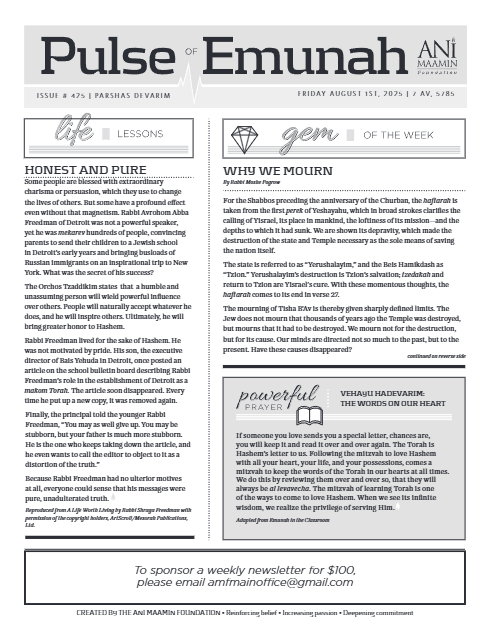

By Rabbi Dovid Sapirman, Dean, Ani Maamin Foundation

Tisha b’Av, the saddest day of the year. We mourn the Beis Hamikdash, and all the sorrows that have befallen us over 2,000 years of bitter exile. Yet not everyone feels the intensity of sadness to the same degree. Many years ago, I heard the following mashal quoted from the Yiddish commentary on Tanach Maaseh Ilfas: Long ago in Europe, entire districts were the property of a nobleman, and all the towns in the area belonged to him. In one of those shtetlach lived an industrious Jewish working man who saved week after week and eventually managed to amass 500 rubles. This was an unusually large sum of money for a plain laborer, and he kept it safely in a desk drawer.

One day, in the town marketplace, he heard the poritz announce, “I am in desperate need of 500 rubles, cash, right away. I am willing to sign over the rights to the entire forest around this town, worth 10,000 rubles, to anyone who can bring me the cash immediately.” The Jew was excited—this was the opportunity of a lifetime! He informed the nobleman that he could indeed supply the money and ran home to get it.

Meanwhile, back at home, the Jew’s little boy was looking for something to play with. He opened a drawer and found colorful papers. With his little scissors he began cutting up the bills to shreds. When his mother saw what he had done, she grabbed the scissors and papers and started to cry. The boy cried too, because his mother had taken away his toy. When the father walked into the house, he saw everything—and he too began to cry.

Three people, crying over the same colored papers. The child cried over his game, the mother over 500 rubles, and the father over ten thousand.

So it is with us. Some people have little appreciation for the tremendous loss of the Beis Hamikdash and merely go through the motions of observing Tisha b’Av. Others wish that Mashiach would come and rebuild the Beis Hamikdash, putting an end to our tzaros. And greater people realize that the Beis Hamikdash was the dwelling place of the Shechinah.

Hashem wants to station His presence among us once again, as in days of old. He has been waiting for 2,000 years for His beloved people to finally return in teshuvah.

PDF Preview