The Importance of Living with Joy
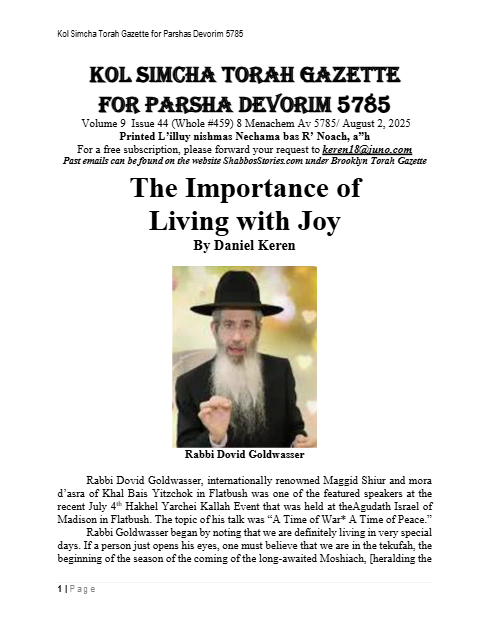
Rabbi Dovid Goldwasser
Rabbi Dovid Goldwasser, internationally renowned Maggid Shiur and mora d’asra of Khal Bais Yitzchok in Flatbush was one of the featured speakers at the recent July 4th Hakhel Yarchei Kallah Event that was held at the Agudath Israel of Madison in Flatbush. The topic of his talk was “A Time of War* A Time of Peace.”
Rabbi Goldwasser began by noting that we are definitely living in very special days. If a person just opens his eyes, one must believe that we are in the tekufah, the beginning of the season of the coming of the long-awaited Moshiach, [heralding the day of the geulah, redemption of the Jewish people from our long and bitter galus, exile.] Even if a person give up on the hope of the geulah, the great day of Moshiach Tzidkeinu’s coming appears to be eminent.
The War of Gog and Magog
All of the various simanim (signs foretold by our Sages of blessed memory) regarding the geulah have been revealed in recent times. The names given to the recent War (i.e. the Rising of the Lion) are significant. Rabbi Goldwasser declared that the last war will be the War of Gog and Magog.
All of the nations of the world were afraid of Iran. Israel said they would take care of Iran [by knocking out their missiles and nuclear centers] Biyad (with the help of) Hashem, they were successful. Without Hashem’s help, Rabbi Goldwasser warned, Israel would not have been able to succeed [and survive the grave threat posed by Iran.]
We see that the world has greatly degenerated. Things that had always been forbidden and looked down up by even the non-Jewish world has in recent years become not only permitted but actually in a perverse manner celebrated. What should be the response of a Jew. It should be Rabbi Goldwasser noted that the response of the Jew should be the opposite. Recognizing this growing decay in the world’s moral compass, we as Jews must strive to strengthen our belief and trust in Hashem by increasing our learning of Torah and the careful performance of Hashem’s holy mitzvahs.
The Importance of Appreciating Everything Hashem Does for Us
A Jew should always focus on reciting the psalm Mizmor Lisoda (Psalm 100) – “A psalm for the thanksgiving offering...” with great enthusiasm and joy declared Rabbi Goldwasser. Hashem appreciates our joy that we express and that which demonstrates that we appreciate everything He is doing for us because of His great love for each and every one of us.
Rabbi Goldwasser challenged the audience by asking: “Who would you rather see in your group? Someone who is joyful and cheerful or someone who is constantly sad or depressed?
Anyone who feels the pain of his fellow Jews will merit to see the refuah or the redemption that Hashem has promised the Jewish people. Rabbi Goldwasser noted that Moshe Rabbeinu sat on a hard rock when the Jews were fighting Amalek. Why? Because he wanted to share in the distress of the Jewish soldiers who were in danger and risking their lives to eliminate a mortal danger to the Jewish nation. He wanted to share in the distress of the families of the soldiers who were worried the wellbeing of their husbands and fathers.
An Incredibly Great Protection for the Entire Klal Yisroel
When Jews in danger come together and daven (pray) to Hashem, this creates a powerful protection (both spiritually and physically). When yeshiva students study Torah, that mitzvah and spiritual action gives an incredibly great protection not only to themselves but also for the entire Klal Yisroel, Jewish nation.
Rav Yaakov Kamenetzky asks why do we stand up in the morning prayers when reciting Vayivorach Dovid (Chronicles 29:10-13). We do so to show our appreciation to those who occupy themselves for the benefit of their fellow Jews.
Rabbi Goldwasser recalled once being asked a question by a Hatzolah volunteer member who responded to calls from the Jewish community for varying degrees of medical emergencies. It once happened in the course of rushing to respond to a desperate call for medical assistance this Hatzolah volunteer slipped on the ice and himself had to be taken by other Hatzolah members to the hospital where he required serious initial treatment and subsequent painful surgeries until he could recover and be healed.
A Painful Setback Can Be a Sign of Hashem’s Great Mercy
The Hatzolah member asked Rabbi Goldwasser if a person performing a mitzvah is supposed to be protected, why did he get injured so badly? The explanation is that this painful setback like all similar disappointments in life is truly a good thing. It is a kappara, atonement for a sin that may have been performed. Perhaps a more severe takana from Shomayim, heaven had been decreed to this particular Hatzolah volunteer, but Hashem in infinite mercy replaced that punishment with an albeit painful but less severe punishment.
The Torah teaching that one should follow is that of Darchei Shalom, the path of peace. A teacher must not hide his love and concern for each of his talmidim, students. This is more important than instituting fear and awe, for this alone will not today anyways inspire the children to love learning Torah and doing mitzvahs with joy.
Every one of us has the ability to improve in some inyan, aspect of our avodas Hashem (service of Hashem.) It could be the smallest thing, but it would result, Rabbi Goldwasser said, in a great bonus from Hashem. It could even be something as simple as making a commitment to smile at others or to express kind words to another Jew.
Reprinted from the July 24, 2025 edition of the Flatbush Jewish Journal.