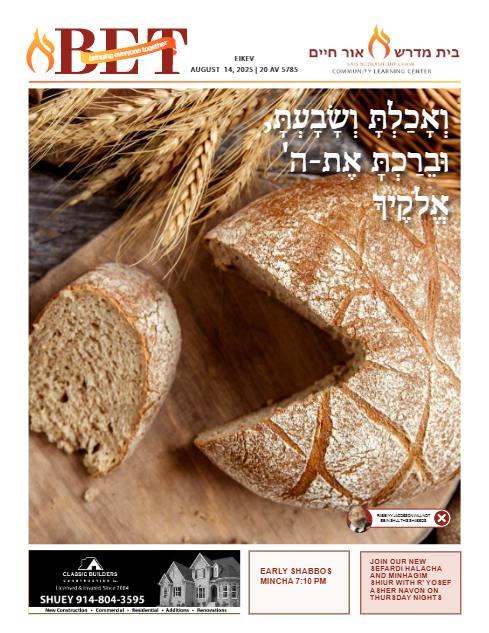
Bircas Hamazon
This week’s parshah contains the mitzvah of Bircas Hamazon. Let me share with you a thought about bentching that I also hope to incorporate.
Bircas Hamazon is only mid’Oraisa if one eats k’dei seviah, enough to be satisfied, but we bentch even on a k’zayis or k’beitzah. Chazal say the malachim complained to Hashem that He shows favoritism to Klal Yisrael, as the pasuk says: ישא ה' פניו אליך. And Hashem answered that it is in response to Klal Yisrael showing favoritism to Him by bentching on even a k’zayis or k’beitzah.
Rav Pam asked, Why is Hashem’s answer the d’Rabbanan of bentching? Aren’t there so many other mitzvos d’Rabbanan that are much more difficult? So many issurim of shemiras Shabbos? The Mishnah says in Maseches Succah that one who sits in a succah when he is patur, such as when it is raining, is called a hedyet. The Rema writes that one receives no reward for sitting in a succah when it is raining; it’s not a mitzvah. Why is this different than any other mitzvah we do even though we are not commanded to? Don’t we bentch even on a k’zayis even though we don’t have to?
The Be’er Sheva asks on this: If so, how do we live? We have thousands of issurim mid’Rabbanan!
We can answer as follows. Tefillin doesn’t need sirtut besides the top line, and the Magen Avraham wonders if doing sirtut on the whole thing deems one to be called a hedyet. Yet, we do sirtut. The Gra there explains that to take on a stringency that is something logical and beneficial to protect from doing an issur d’Oraisa, or it’s a hiddur, or it brings kirvas Elokim, that is fine and even recommended. Only when it is a technical thing that one is just imagining to be a mitzvah, such as sitting in the succah in the rain, that is not a mitzvah at all, that is when one is called a hedyet for doing so. The Shulchan Aruch HaRav (32:8) writes similarly.
We see from this that the mitzvos mid’Rabbanan that we do are supposed to be an enhancement of our avodas Hashem. Coming back to bentching, Rav Pam explains that Bircas Hamazon is an expression of gratitude for all we have. Mid’Oraisa, we are obligated to express this only when we are satiated, but we express our gratitude on even a k’zayis or k’beitzah. It’s not just magical incantations, imagining it’s a mitzvah. It’s a real enhancement of expressing our thankfulness to Hashem. That is why Hashem answers the malachim specifically with this mitzvah. “Klal Yisrael appreciates everything I give them, should I not appreciate them, too?”
We tend to bentch out of habit, without thinking too much, because we’re commanded to. We should take the time out to think about what we are saying, thanking Hashem for food. Isn’t it amazing that every single day of our lives, Hashem prepares food for us? Even the construction workers sitting around a manhole on Ocean Parkway open their lunch boxes and paper bags, and everyone has something they like to eat! Therefore, we should take a moment when we bentch, especially on a k’zayis or k’beitzah, to feel appreciation and gratitude for food because that is really what bentching is all about. If it will motivate you more, the Shulchan Aruch HaRav writes that bentching properly is a segulah for parnassah. Let us all try as best we can to have this in mind when we bentch.
RABBI YISRAEL REISMAN