Parshat Eikev Rain In Its Time
Ben Chamesh L'Mikra | July 30, 2023
Print This Article
View Original PDF

Parshat Eikev Rain In Its Time

Ben Chamesh L'Mikra | December 31, 2025

Parshat Eikev describes G-d’s promise to provide blessings to the Jewish people, upon their fulfillment of His mitzvot. Rashi’s commentary on the verse, however, prompts a series of questions. This Sicha analyzes Rashi’s specific wording and provides an enriched appreciation of the blessings’ meanings.

This week’s parsha discusses the corollaries of listening to or ignoring G-d’s statutes and the blessings that ensue when one listens to G-d. The verse states:

Text 1

And it will be, if you hearken to My commandments that I command you this day to love the Lord, your G-d, and to serve Him with all your heart and with all your soul, I will give the rain of your land at its time, the early rain and the latter rain, and you will gather in your grain, your wine, and your oil.
Devarim 11:13-14

On the words of the verse, “I will give the rain of your land,” Rashi comments, and explains the reason for these blessings:

Text 2

You will have done what is [incumbent upon] you; [so] I will do what is [incumbent] upon Me.
Rashi, Devarim 11:14

Rashi elucidates that the reason that the Almighty will give rain is because the Jewish people fulfilled those mitzvot that they were obligated to keep.
There are a number of difficulties with Rashi’s explanation of these words “I will give the rain of your land.”

  • In general, Rashi only adds explanation to the verse when there is a question in the simple understanding which necessitates elucidation. What is the difficulty in this verse that Rashi wished to explain?
  • Rashi’s clarification does not seem to add anything that is not directly understood from the text itself. The verse already stated, “If you hearken to My commandments...I will give.” What is added to the straightforward meaning of this statement in Rashi’s explanation?
  • Rashi’s elucidation seems to revolve around the words, “I will give,” in that he explains the reason that G-d will give rain. If that is indeed the case, why does he quote the words, “the rain of your land,” as well as this is a part of the verse that seems to need no explanation?

All that is incumbent

There are those that explain that Rashi’s intent is to contrast the blessings that are stated here, in Parshat Eikev, with the blessings that are stated earlier, in the parsha of Bechukotai. In Bechukotai the verse states:

Text 3

If you follow My statutes and observe My commandments and perform them, I will give your rains in their time, the Land will yield its produce, and the tree of the field will give forth its fruit.
Vayikra 26:3-4

It is because of the differences between the two verses and the blessings that are stated in each parsha, that Rashi sees the need to explain our verse.

Text 4

[Rashi’s] intent is to provide a reason why here [in Parshat Eikev] the blessings are multiplied in a way that it is not in other places. For regarding the statement, “If you follow My statutes and observe My commandments and perform them,” the verse merely writes, “I will give your rains in their time,” however it does not state [as our verse does] that there will be “early rain and the latter rain” or that “I will give grass in your field”...all these various details are written in this parsha. It is for this reason [that Rashi explains that this is because] “You will have done what is [incumbent upon] you; [so] I will do what is [incumbent] upon Me.” Meaning to say, that because...you fulfilled all of my precepts out of love...I too must do what is incumbent on Myself to the point that there is no good that I do not do for you.
R. Eliyahu Mizrachi, Devarim 11:14

He explains that Rashi wishes to explain the reason that the blessings stated in our parsha are greater than those stated in Bechukotai. The reason that is explained is “because...you fulfilled all of my precepts out of love...I too must do what is incumbent on Myself to the point that there is no good that I do not do for you.”
This explanation, though, is difficult for the following reasons:

  • When Rashi quotes part of a verse in his introductory statement it is because the words that he quotes are those which necessitate his explanation. The words that Rashi cites for his commentary are, “I will give the rain of your land,” which are the same idea as the words, “I will give your rains in their time,” which were stated in Parshat Bechukotai. According to the above explanation though, what triggered Rashi’s explanation was the rest of the verse wherein is expressed the difference between these two parsha’s, and not these words that Rashi quotes.
  • According to the above explanation, the blessings that are found in Parshat Eikev are greater than those blessings mentioned in Bechukotai (as here, G-d details the various aspects of blessing that He will provide). This though, does not fit with what Rashi himself explains. Rashi explains in Parshat Bechukotai, on the words, “the tree of the field will give forth its fruit,” that “This refers to trees that do not bear fruit, but are destined to bear fruit in the future.” Meaning to say, that the verse in Bechukotai discusses supernatural blessings. Yet, the blessings in our parsha are those that are enclothed in nature. It is therefore clear that the blessings mentioned in Bechukotai are greater than those mentioned in our parsha and not vice-versa.

It is therefore clear that the explanation offered above cannot possibly be the reason that Rashi explains “You will have done what is [incumbent upon] you; [so] I will do what is [incumbent] upon Me.” We therefore must analyze the verses mentioned above to discover the reason for Rashi’s explanation.

Differences in Rashi

In the continuation of the above verse, G-d promises that the rain will come “at its time,” which is similar to the statement in Bechukotai which declares, “I will give your rains in their time.” However, there are differences between the way Rashi elucidates these words in our parsha and the way that he explains them in the parsha of Bechukotai:

  • Parshat Eikev: “At night, so it will not disturb you. Another explanation of “at its time” is: On Shabbat [Friday] nights, when everyone is at home.”
  • Parshat Bechukotai: “At a time when people do not usually go out, for example, on Shabbat Eve.”

While the explanations are similar, there are a number of differences which provoke the following questions:

  • Why is it that in Parshat Bechukotai Rashi is satisfied with the explanation, “for example, on Shabbat Eve,” while in our parsha he prefaces another explanation of “at night, so it will not disturb you?
  • In our parsha, the explanation that rain will fall Friday nights is brought as a second explanation. Meaning to say, that the primary explanation of the words “at its time” according to Rashi, is that the rain will fall at night. This is in contradistinction with that which is explained in Parshat Bechukotai, where, on the words “in their times” he only mentions Friday nights.
  • The order of the explanation in reference to the rain falling on Shabbat is different as well. Whereas in Parshat Bechukotai Rashi begins by explaining, “at a time when people do not usually go out,” and only afterwards does he give an example of “Shabbat Eve,” in our parsha he does the opposite. He first explains, “On Shabbat nights,” and only then does he add that it is a time “when everyone is at home.”
  • In Bechukotai, he phrases his statement in the negative: “At a time when people do not usually go out.” In our parsha, he focuses on the positive: “when everyone is at home.” Why the difference?
  • In Bechukotai, Rashi uses the term “people,” (are home on Shabbat) as if to say that it is not everyone and in our parsha, Rashi writes “everyone.”
  • In our parsha, in introducing his second explanation Rashi adds a seemingly superfluous phrase by saying, “Another explanation of ‘at its time,’” repeating the words from the verse, which seems to be unnecessary.

The explanation

There is a focal difference between the blessings that are stated in Bechukotai and the blessings that are stated in our parsha.
Concerning the blessings of Bechukotai the verse states, “I will give your rains in their time”—the rains of the Jewish people, whereas in our parsha the verse states, “I will give the rain of your land at its time”—the blessing of the land.
In Bechukotai the primary blessing is to the Jewish people, whereas and in our parsha the primary blessing is on the land, but that by extension the owners of the land are blessed as well.
It is for this reason that the blessings in Bechukotai transcend nature, while the blessings in our parsha are limited to nature. When the blessings are directed at the Jewish people, the blessings are supernatural, according to the needs of the individual, even when those needs are not natural.
However, when the blessings are on the land, they are unable to transcend nature, as the entire idea of the land is nature.
This is expressed in the verse, “So long as the land exists, seedtime and harvest, cold and heat, summer and winter, and day and night shall not cease.” When the Torah wishes to express that the natural order will last, it tells us about the land. A blessing in land is found within the confines of nature—it does not transcend it.

Reason for the difference

Rashi reveals the intention behind the differences of the blessings expressed in our parsha versus those blessings expressed in Bechukotai in his statement, “You will have done what is [incumbent upon] you; [so] I will do what is [incumbent] upon Me.”
It is for this reason that the blessing in Parshat Eikev is, “I will give the rain of your land.”
The reason that the blessings here are only limited to nature, is because “You will have done what is [incumbent upon] you.” Given the fact that the Jewish people only did what they were obligated to do but not more, so too, G-d blesses them in the same way. “I will do what is [incumbent] upon Me,” but not more, in a way that would transcend nature.

Bereishis 8:22.
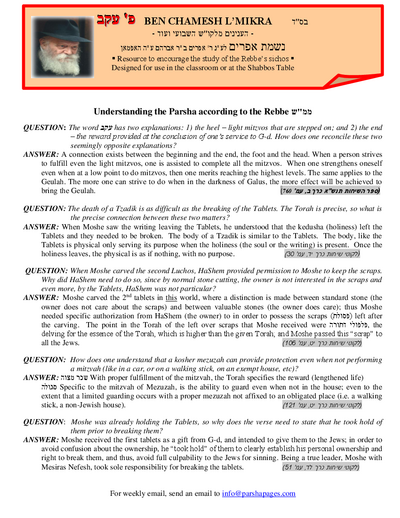
Parshat Eikev describes G-d’s promise to provide blessings to the Jewish people, upon their fulfillment of His mitzvot. Rashi’s commentary on the verse, however, prompts a series of questions. This Sicha analyzes Rashi’s specific wording and provides an enriched appreciation of the blessings’ meanings.

This week’s parsha discusses the corollaries of listening to or ignoring G-d’s statutes and the blessings that ensue when one listens to G-d. The verse states:

Text 1

And it will be, if you hearken to My commandments that I command you this day to love the Lord, your G-d, and to serve Him with all your heart and with all your soul, I will give the rain of your land at its time, the early rain and the latter rain, and you will gather in your grain, your wine, and your oil.
Devarim 11:13-14

On the words of the verse, “I will give the rain of your land,” Rashi comments, and explains the reason for these blessings:

Text 2

You will have done what is [incumbent upon] you; [so] I will do what is [incumbent] upon Me.
Rashi, Devarim 11:14

Rashi elucidates that the reason that the Almighty will give rain is because the Jewish people fulfilled those mitzvot that they were obligated to keep.
There are a number of difficulties with Rashi’s explanation of these words “I will give the rain of your land.”

  • In general, Rashi only adds explanation to the verse when there is a question in the simple understanding which necessitates elucidation. What is the difficulty in this verse that Rashi wished to explain?
  • Rashi’s clarification does not seem to add anything that is not directly understood from the text itself. The verse already stated, “If you hearken to My commandments...I will give.” What is added to the straightforward meaning of this statement in Rashi’s explanation?
  • Rashi’s elucidation seems to revolve around the words, “I will give,” in that he explains the reason that G-d will give rain. If that is indeed the case, why does he quote the words, “the rain of your land,” as well as this is a part of the verse that seems to need no explanation?

All that is incumbent

There are those that explain that Rashi’s intent is to contrast the blessings that are stated here, in Parshat Eikev, with the blessings that are stated earlier, in the parsha of Bechukotai. In Bechukotai the verse states:

Text 3

If you follow My statutes and observe My commandments and perform them, I will give your rains in their time, the Land will yield its produce, and the tree of the field will give forth its fruit.
Vayikra 26:3-4

It is because of the differences between the two verses and the blessings that are stated in each parsha, that Rashi sees the need to explain our verse.

Text 4

[Rashi’s] intent is to provide a reason why here [in Parshat Eikev] the blessings are multiplied in a way that it is not in other places. For regarding the statement, “If you follow My statutes and observe My commandments and perform them,” the verse merely writes, “I will give your rains in their time,” however it does not state [as our verse does] that there will be “early rain and the latter rain” or that “I will give grass in your field”...all these various details are written in this parsha. It is for this reason [that Rashi explains that this is because] “You will have done what is [incumbent upon] you; [so] I will do what is [incumbent] upon Me.” Meaning to say, that because...you fulfilled all of my precepts out of love...I too must do what is incumbent on Myself to the point that there is no good that I do not do for you.
R. Eliyahu Mizrachi, Devarim 11:14

He explains that Rashi wishes to explain the reason that the blessings stated in our parsha are greater than those stated in Bechukotai. The reason that is explained is “because...you fulfilled all of my precepts out of love...I too must do what is incumbent on Myself to the point that there is no good that I do not do for you.”
This explanation, though, is difficult for the following reasons:

  • When Rashi quotes part of a verse in his introductory statement it is because the words that he quotes are those which necessitate his explanation. The words that Rashi cites for his commentary are, “I will give the rain of your land,” which are the same idea as the words, “I will give your rains in their time,” which were stated in Parshat Bechukotai. According to the above explanation though, what triggered Rashi’s explanation was the rest of the verse wherein is expressed the difference between these two parsha’s, and not these words that Rashi quotes.
  • According to the above explanation, the blessings that are found in Parshat Eikev are greater than those blessings mentioned in Bechukotai (as here, G-d details the various aspects of blessing that He will provide). This though, does not fit with what Rashi himself explains. Rashi explains in Parshat Bechukotai, on the words, “the tree of the field will give forth its fruit,” that “This refers to trees that do not bear fruit, but are destined to bear fruit in the future.” Meaning to say, that the verse in Bechukotai discusses supernatural blessings. Yet, the blessings in our parsha are those that are enclothed in nature. It is therefore clear that the blessings mentioned in Bechukotai are greater than those mentioned in our parsha and not vice-versa.

It is therefore clear that the explanation offered above cannot possibly be the reason that Rashi explains “You will have done what is [incumbent upon] you; [so] I will do what is [incumbent] upon Me.” We therefore must analyze the verses mentioned above to discover the reason for Rashi’s explanation.

Differences in Rashi

In the continuation of the above verse, G-d promises that the rain will come “at its time,” which is similar to the statement in Bechukotai which declares, “I will give your rains in their time.” However, there are differences between the way Rashi elucidates these words in our parsha and the way that he explains them in the parsha of Bechukotai:

  • Parshat Eikev: “At night, so it will not disturb you. Another explanation of “at its time” is: On Shabbat [Friday] nights, when everyone is at home.”
  • Parshat Bechukotai: “At a time when people do not usually go out, for example, on Shabbat Eve.”

While the explanations are similar, there are a number of differences which provoke the following questions:

  • Why is it that in Parshat Bechukotai Rashi is satisfied with the explanation, “for example, on Shabbat Eve,” while in our parsha he prefaces another explanation of “at night, so it will not disturb you?
  • In our parsha, the explanation that rain will fall Friday nights is brought as a second explanation. Meaning to say, that the primary explanation of the words “at its time” according to Rashi, is that the rain will fall at night. This is in contradistinction with that which is explained in Parshat Bechukotai, where, on the words “in their times” he only mentions Friday nights.
  • The order of the explanation in reference to the rain falling on Shabbat is different as well. Whereas in Parshat Bechukotai Rashi begins by explaining, “at a time when people do not usually go out,” and only afterwards does he give an example of “Shabbat Eve,” in our parsha he does the opposite. He first explains, “On Shabbat nights,” and only then does he add that it is a time “when everyone is at home.”
  • In Bechukotai, he phrases his statement in the negative: “At a time when people do not usually go out.” In our parsha, he focuses on the positive: “when everyone is at home.” Why the difference?
  • In Bechukotai, Rashi uses the term “people,” (are home on Shabbat) as if to say that it is not everyone and in our parsha, Rashi writes “everyone.”
  • In our parsha, in introducing his second explanation Rashi adds a seemingly superfluous phrase by saying, “Another explanation of ‘at its time,’” repeating the words from the verse, which seems to be unnecessary.

The explanation

There is a focal difference between the blessings that are stated in Bechukotai and the blessings that are stated in our parsha.
Concerning the blessings of Bechukotai the verse states, “I will give your rains in their time”—the rains of the Jewish people, whereas in our parsha the verse states, “I will give the rain of your land at its time”—the blessing of the land.
In Bechukotai the primary blessing is to the Jewish people, whereas and in our parsha the primary blessing is on the land, but that by extension the owners of the land are blessed as well.
It is for this reason that the blessings in Bechukotai transcend nature, while the blessings in our parsha are limited to nature. When the blessings are directed at the Jewish people, the blessings are supernatural, according to the needs of the individual, even when those needs are not natural.
However, when the blessings are on the land, they are unable to transcend nature, as the entire idea of the land is nature.
This is expressed in the verse, “So long as the land exists, seedtime and harvest, cold and heat, summer and winter, and day and night shall not cease.” When the Torah wishes to express that the natural order will last, it tells us about the land. A blessing in land is found within the confines of nature—it does not transcend it.

Reason for the difference

Rashi reveals the intention behind the differences of the blessings expressed in our parsha versus those blessings expressed in Bechukotai in his statement, “You will have done what is [incumbent upon] you; [so] I will do what is [incumbent] upon Me.”
It is for this reason that the blessing in Parshat Eikev is, “I will give the rain of your land.”
The reason that the blessings here are only limited to nature, is because “You will have done what is [incumbent upon] you.” Given the fact that the Jewish people only did what they were obligated to do but not more, so too, G-d blesses them in the same way. “I will do what is [incumbent] upon Me,” but not more, in a way that would transcend nature.

Bereishis 8:22.

PDF Preview