The Virtue of One Who Completes His Mitzvos
טיב הקהילה English | August 14, 2025
Print This Article
View Original PDF

The Virtue of One Who Completes His Mitzvos

טיב הקהילה English | December 10, 2025

כָּל הַמִּצְוָה אֲשֶׁר אָנֹכִי מְצַוְּךָ הַיּוֹם תִּשְׁמְרוּן לַעֲשׂוֹת לְמַעַן תִּחְיוּן וּרְבִיתֶם וּבָאתֶם וִירִשְׁתֶּם אֶת הָאָרֶץ אֲשֶׁר נִשְׁבַּע ה’ לַאֲבֹתֵיכֶם: (ח, א)
Every mitzvah that I command you today you shall observe to perform, so that you may live and increase, and come and take possession of the land that Hashem swore to your forefathers. (8:1)

Rashi explains: Every mitzvah – according to its simple meaning. And in Midrash Aggadah, if you have begun to fulfill a mitzvah, complete it, for it is attributed to the one who completes it.

Rashi brings in the name of the Midrash that the Torah’s intention in saying “every mitzvah” is to awaken the one engaged in mitzvos that the mitzvos must be fulfilled in their entirety, and only after the mitzvah has been fulfilled in its entirety is it in the category of a mitzvah. Therefore, the mitzvah is called only by the name of the one who completes it, for he is the one who brought it to the status of “Toras mitzvah.”

The words of the Midrash arouse wonder, for from its content you learn that if a person begins a mitzvah and abandons it in the middle, and another comes and completes it, the entire mitzvah will be attributed to the merit of the one who completed it. The question is asked—why should the portion of the one who began the mitzvah be diminished? It is true that as long as the mitzvah has not been completed by the last one, the mitzvah is not yet properly rectified, and the first one is not yet worthy of his reward. However, once the mitzvah has been completed, there is also a portion in it for the first one, and were it not for his part, the last one would not have come to the point of completion. Why, then, should the mitzvah not also be credited to the one who began it?

Furthermore, there is also room to ask why the beginning of the mitzvah should not be considered a merit even if in the end it did not come to completion. After all, he did engage in a mitzvah, and the fact that he abandoned it in the middle was due to seeing that he was unable to bring it to completion. Why, then, should his reward be withheld and not grant him payment for his work, even though his intention was for the sake of Heaven?

Moreover, seemingly the opposite—we have learned (Berachos 6a): “If one thought to do a mitzvah and was prevented by circumstances beyond his control and did not do it, the Torah accounts it for him as if he had done it.” If so, when he abandoned it due to circumstances beyond his control, it would seem proper that he should merit his reward.

The answer to this is brought in the sefer Or HaMeir (Derush for Shabbos Shuvah), and the content of his words is that one who begins a mitzvah and does not complete it shows by his end what was in his beginning—that he did not intend for the sake of Heaven.

These words are difficult to grasp at first thought, so we will expand a little in order to clarify the depth of his intention. Behold, every person, when he takes upon himself some task, has for it a certain goal and benefit, for the sake of which he has placed the load upon his shoulder to bear it. Sometimes it is a material goal, meaning that he wishes through it to benefit himself in the material realm, and sometimes it is a spiritual goal, in which he wishes through it to bring satisfaction to HaKadosh Baruch Hu.

Now, one who contemplates will understand that there is a great difference between one whose intention is for a material goal and one whose intention is for the sake of Heaven. For one whose intention is for material benefit is not assured that he will come to completion, for if he sees that the execution of the task depends on great difficulties, he will retreat from performing it, saying to himself: “My whole intention was only to improve the quality of life, and not to burden myself excessively” [of course, all depends on the magnitude of the difficulties and the total gain].

But one whose intention is for the sake of Heaven does not at all seek after self-interest—on the contrary, he has already nullified his own desires, and his entire intention is only to fulfill the will of Hashem. Even if the work becomes extremely burdensome for him, he will desire it. Likewise, he will not come to despair when he sees that success does not shine upon him, for his will to serve his Creator does not depend at all on the results of the work, but rather on the very will of Yisbarach that he serve Him. Therefore, since the very effort to bring the commandment to completion is also the fulfillment of His will, it is also his goal, and he will not abandon it even when he does not see results. And since “the stubborn one succeeds,” he will ultimately merit to see blessing in his toil and bring the mitzvah to completion.

Now, in most cases, one who begins a mitzvah shows by the very beginning that he is capable of bringing the matter to completion, for a person knows his senses and his strengths, and he does not pursue at all something that is beyond his ability. It is true that he also knows that it is possible he will need to exert himself more than he estimated in order to bring it to completion, but in the end it will be within his ability [and he is not in the category of “he thought to do a mitzvah and was prevented,” where he is entirely unable to do it]. And if, in the end, he did not bring the matter to completion, it is a sign that from the outset he did not intend for the sake of Heaven, but rather for some personal benefit. And when it became clear to him that it was a difficult task and that the gain was not worth it to him, he regretted his deed. Therefore, he is not entitled to take his reward, and only the one who came after him and completed the task proved that his intention was for the sake of Heaven, and therefore he ignored all the difficulties that appeared in his path.

In any case, we must know that many difficulties stand before one who desires to do a mitzvah in its entirety, and even regarding every spiritual matter the yetzer hara opposes it being done in completion. And it is brought in the holy seforim that the yetzer hara agrees that they should study Torah, provided only that they do not finish an entire sefer until its end. And this is alluded to also in his name Samael, which is an acronym for Siyyum Masechta Ein La’asos (“Completing a tractate is not to be done”). And whoever overcomes the yetzer hara and brings every matter of a mitzvah to completion—he is the one worthy of great reward.

Therefore, there is great importance in making a seudas mitzvah when completing a mesechta. And not for nothing did Abaye testify about himself (Shabbos 119a) and say: “May it be to my credit, that when I see a Torah scholar who has completed his mesechta, I make a festive day for the Rabbanim.” For since the matter depends on an extra measure of overcoming the yetzer hara, one must rejoice and make a festive day when meriting such a thing.

And come and see a quote from the continuation of the words of the Midrash (Tanchuma, Eikev 6) in the statement of Rashi, from which you will understand how much Heaven is particular about one who does not complete his mitzvos. And here is its wording: “Rabbi Yannai said: Whoever begins a mitzvah and does not complete it—his wife and two sons will be buried. From whom do you learn this? From Yehudah, as it is said (Bereishis 37:26): ’ויאמר יהודה אל אחיו מה בצע וגו‘‘ - ‘And Yehudah said to his brothers: What profit...,’ they sat to break bread, and he said to them: Will we kill our brother and bless?! As it is said (Tehillim 10:3): ובוצע ברך נאץ ה‘‘ - ‘And the robber blesses himself that he blasphemes Hashem,’ therefore it is written: ‘What profit... let us sell him to the Ishmaelites,’ and they listened to him, for he was a king. And had he said to them to return him to his father, they would have listened to him, but he began the mitzvah and did not complete it. Therefore, whoever begins a mitzvah should complete all of it.” End of quote.
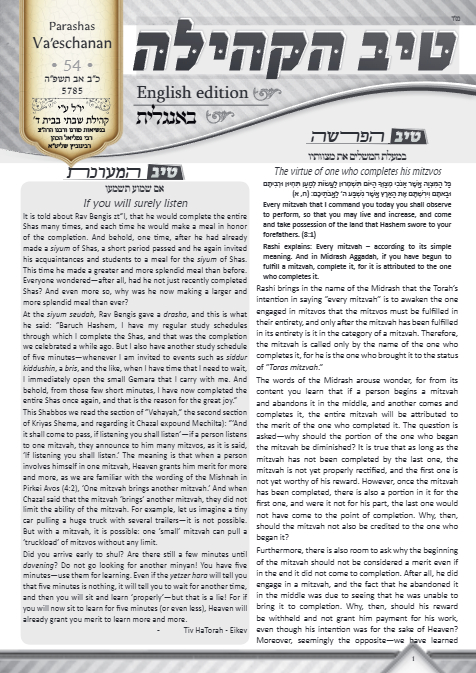

כָּל הַמִּצְוָה אֲשֶׁר אָנֹכִי מְצַוְּךָ הַיּוֹם תִּשְׁמְרוּן לַעֲשׂוֹת לְמַעַן תִּחְיוּן וּרְבִיתֶם וּבָאתֶם וִירִשְׁתֶּם אֶת הָאָרֶץ אֲשֶׁר נִשְׁבַּע ה’ לַאֲבֹתֵיכֶם: (ח, א)
Every mitzvah that I command you today you shall observe to perform, so that you may live and increase, and come and take possession of the land that Hashem swore to your forefathers. (8:1)

Rashi explains: Every mitzvah – according to its simple meaning. And in Midrash Aggadah, if you have begun to fulfill a mitzvah, complete it, for it is attributed to the one who completes it.

Rashi brings in the name of the Midrash that the Torah’s intention in saying “every mitzvah” is to awaken the one engaged in mitzvos that the mitzvos must be fulfilled in their entirety, and only after the mitzvah has been fulfilled in its entirety is it in the category of a mitzvah. Therefore, the mitzvah is called only by the name of the one who completes it, for he is the one who brought it to the status of “Toras mitzvah.”

The words of the Midrash arouse wonder, for from its content you learn that if a person begins a mitzvah and abandons it in the middle, and another comes and completes it, the entire mitzvah will be attributed to the merit of the one who completed it. The question is asked—why should the portion of the one who began the mitzvah be diminished? It is true that as long as the mitzvah has not been completed by the last one, the mitzvah is not yet properly rectified, and the first one is not yet worthy of his reward. However, once the mitzvah has been completed, there is also a portion in it for the first one, and were it not for his part, the last one would not have come to the point of completion. Why, then, should the mitzvah not also be credited to the one who began it?

Furthermore, there is also room to ask why the beginning of the mitzvah should not be considered a merit even if in the end it did not come to completion. After all, he did engage in a mitzvah, and the fact that he abandoned it in the middle was due to seeing that he was unable to bring it to completion. Why, then, should his reward be withheld and not grant him payment for his work, even though his intention was for the sake of Heaven?

Moreover, seemingly the opposite—we have learned (Berachos 6a): “If one thought to do a mitzvah and was prevented by circumstances beyond his control and did not do it, the Torah accounts it for him as if he had done it.” If so, when he abandoned it due to circumstances beyond his control, it would seem proper that he should merit his reward.

The answer to this is brought in the sefer Or HaMeir (Derush for Shabbos Shuvah), and the content of his words is that one who begins a mitzvah and does not complete it shows by his end what was in his beginning—that he did not intend for the sake of Heaven.

These words are difficult to grasp at first thought, so we will expand a little in order to clarify the depth of his intention. Behold, every person, when he takes upon himself some task, has for it a certain goal and benefit, for the sake of which he has placed the load upon his shoulder to bear it. Sometimes it is a material goal, meaning that he wishes through it to benefit himself in the material realm, and sometimes it is a spiritual goal, in which he wishes through it to bring satisfaction to HaKadosh Baruch Hu.

Now, one who contemplates will understand that there is a great difference between one whose intention is for a material goal and one whose intention is for the sake of Heaven. For one whose intention is for material benefit is not assured that he will come to completion, for if he sees that the execution of the task depends on great difficulties, he will retreat from performing it, saying to himself: “My whole intention was only to improve the quality of life, and not to burden myself excessively” [of course, all depends on the magnitude of the difficulties and the total gain].

But one whose intention is for the sake of Heaven does not at all seek after self-interest—on the contrary, he has already nullified his own desires, and his entire intention is only to fulfill the will of Hashem. Even if the work becomes extremely burdensome for him, he will desire it. Likewise, he will not come to despair when he sees that success does not shine upon him, for his will to serve his Creator does not depend at all on the results of the work, but rather on the very will of Yisbarach that he serve Him. Therefore, since the very effort to bring the commandment to completion is also the fulfillment of His will, it is also his goal, and he will not abandon it even when he does not see results. And since “the stubborn one succeeds,” he will ultimately merit to see blessing in his toil and bring the mitzvah to completion.

Now, in most cases, one who begins a mitzvah shows by the very beginning that he is capable of bringing the matter to completion, for a person knows his senses and his strengths, and he does not pursue at all something that is beyond his ability. It is true that he also knows that it is possible he will need to exert himself more than he estimated in order to bring it to completion, but in the end it will be within his ability [and he is not in the category of “he thought to do a mitzvah and was prevented,” where he is entirely unable to do it]. And if, in the end, he did not bring the matter to completion, it is a sign that from the outset he did not intend for the sake of Heaven, but rather for some personal benefit. And when it became clear to him that it was a difficult task and that the gain was not worth it to him, he regretted his deed. Therefore, he is not entitled to take his reward, and only the one who came after him and completed the task proved that his intention was for the sake of Heaven, and therefore he ignored all the difficulties that appeared in his path.

In any case, we must know that many difficulties stand before one who desires to do a mitzvah in its entirety, and even regarding every spiritual matter the yetzer hara opposes it being done in completion. And it is brought in the holy seforim that the yetzer hara agrees that they should study Torah, provided only that they do not finish an entire sefer until its end. And this is alluded to also in his name Samael, which is an acronym for Siyyum Masechta Ein La’asos (“Completing a tractate is not to be done”). And whoever overcomes the yetzer hara and brings every matter of a mitzvah to completion—he is the one worthy of great reward.

Therefore, there is great importance in making a seudas mitzvah when completing a mesechta. And not for nothing did Abaye testify about himself (Shabbos 119a) and say: “May it be to my credit, that when I see a Torah scholar who has completed his mesechta, I make a festive day for the Rabbanim.” For since the matter depends on an extra measure of overcoming the yetzer hara, one must rejoice and make a festive day when meriting such a thing.

And come and see a quote from the continuation of the words of the Midrash (Tanchuma, Eikev 6) in the statement of Rashi, from which you will understand how much Heaven is particular about one who does not complete his mitzvos. And here is its wording: “Rabbi Yannai said: Whoever begins a mitzvah and does not complete it—his wife and two sons will be buried. From whom do you learn this? From Yehudah, as it is said (Bereishis 37:26): ’ויאמר יהודה אל אחיו מה בצע וגו‘‘ - ‘And Yehudah said to his brothers: What profit...,’ they sat to break bread, and he said to them: Will we kill our brother and bless?! As it is said (Tehillim 10:3): ובוצע ברך נאץ ה‘‘ - ‘And the robber blesses himself that he blasphemes Hashem,’ therefore it is written: ‘What profit... let us sell him to the Ishmaelites,’ and they listened to him, for he was a king. And had he said to them to return him to his father, they would have listened to him, but he began the mitzvah and did not complete it. Therefore, whoever begins a mitzvah should complete all of it.” End of quote.

PDF Preview

