Vhaya Aikev Tishmeun
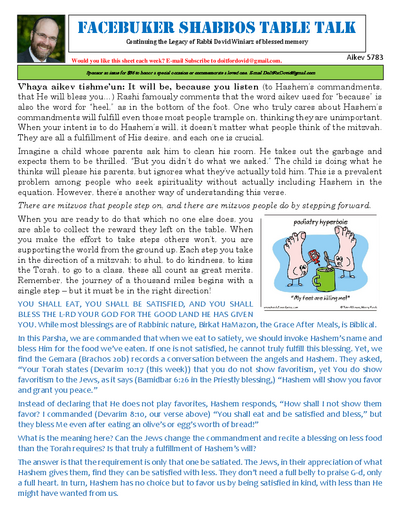
V’haya aikev tishme’un: It will be, because you listen (to Hashem’s commandments, that He will bless you...) Rashi famously comments that the word aikev used for “because” is also the word for “heel,” as in the bottom of the foot. One who truly cares about Hashem’s commandments will fulfill even those most people trample on, thinking they are unimportant. When your intent is to do Hashem’s will, it doesn’t matter what people think of the mitzvah. They are all a fulfillment of His desire, and each one is crucial.
Imagine a child whose parents ask him to clean his room. He takes out the garbage and expects them to be thrilled. “But you didn’t do what we asked.” The child is doing what he thinks will please his parents, but ignores what they’ve actually told him. This is a prevalent problem among people who seek spirituality without actually including Hashem in the equation. However, there’s another way of understanding this verse.
There are mitzvos that people step on, and there are mitzvos people do by stepping forward. When you are ready to do that which no one else does, you are able to collect the reward they left on the table. When you make the effort to take steps others won’t, you are supporting the world from the ground up. Each step you take in the direction of a mitzvah; to shul, to do kindness, to kiss the Torah, to go to a class, these all count as great merits. Remember, the journey of a thousand miles begins with a single step – but it must be in the right direction!
Birkat HaMazon: Blessing After Meals
YOU SHALL EAT, YOU SHALL BE SATISFIED, AND YOU SHALL BLESS THE L-RD YOUR GOD FOR THE GOOD LAND HE HAS GIVEN YOU. While most blessings are of Rabbinic nature, Birkat HaMazon, the Grace After Meals, is Biblical. In this Parsha, we are commanded that when we eat to satiety, we should invoke Hashem’s name and bless Him for the food we’ve eaten. If one is not satisfied, he cannot truly fulfill this blessing. Yet, we find the Gemara (Brachos 20b) records a conversation between the angels and Hashem. They asked, “Your Torah states (Devarim 10:17 (this week)) that you do not show favoritism, yet You do show favoritism to the Jews, as it says (Bamidbar 6:26 in the Priestly blessing,) “Hashem will show you favor and grant you peace.”
Instead of declaring that He does not play favorites, Hashem responds, “How shall I not show them favor? I commanded (Devarim 8:10, our verse above) “You shall eat and be satisfied and bless,” but they bless Me even after eating an olive’s or egg’s worth of bread!”
What is the meaning here? Can the Jews change the commandment and recite a blessing on less food than the Torah requires? Is that truly a fulfillment of Hashem’s will?
The answer is that the requirement is only that one be satiated. The Jews, in their appreciation of what Hashem gives them, find they can be satisfied with less. They don’t need a full belly to praise G-d, only a full heart. In turn, Hashem has no choice but to favor us by being satisfied in kind, with less than He might have wanted from us.