Rashi's Interpretation of the Prohibition of Castration and the New Grain
Ben Chamesh L'Mikra | May 13, 2024
Print This Article
View Original PDF

Rashi's Interpretation of the Prohibition of Castration and the New Grain

Ben Chamesh L'Mikra | June 27, 2025

This thing, to castrate any livestock or wild animal, even of an unclean species. This is why [our verse] says here “in your land” -to include any species found in your land. For it is impossible to say that castration is prohibited only in the land of Israel [“your land,”] because [the prohibition of] castration is an obligation [associated with] the body [of a person], and every commandment associated with the body [of a person] applies both in the Land [of Israel] and outside the Land [of Israel].

Rashi, ibid

Though the verse says “in your land,” which would seem that this prohibition is only in the land of Israel, Rashi nevertheless explains that according to the simple explanation of the Torah, this prohibition applies also outside the land of Israel.

Rashi felt compelled to explain the verse in way that runs contrary to the basic translation of the verse due to the essential rule (even according to a rudimentary understanding of the Torah) that any commandment which is associated with the body applies both in the land of Israel as well as outside of it.

From the fact that Rashi specifically brings an explanation to the verse which runs contrary to the translation of the words “in your land,” (explaining that this includes areas outside of Israel as well) it is clear that the rule that serves as the foundation to his statement must be a fundamental and basic precept according to the simple explanation of the Torah.

From this it is understood as well concerning the other half of the same rule, concerning that which is obligatory solely in regard to the land itself. It too, is also a basic rule in the understanding of the Torah, as the Talmud states,

Talmud, Kiddushin 37a

Every precept which is a personal obligation is practiced both within and without the Land; but what is an obligation of the soil has force only within the Land.

Being that the above precept is basic in understanding of the Torah, it is for this reason that Rashi considers the second explanation to be of equal validity in the simple meaning of the verse.

With this in mind, he presents both explanations and does not only explain the words “in all your dwelling places” according to the view of the first opinion (i.e., that this prohibition includes also those who live outside of Israel). Rather, he presents an alternate interpretation stating that indeed this prohibition is applicable only in the land of Israel and that these words express that the prohibition only begins once the Israelites are completely settled in their land.

Each is insufficient

Rashi’s intention with bringing both interpretations on the verse is due to a difficulty found within each. While both fit with the simple meaning of the verse, each one contains a difficulty that necessitates the alternate explanation.

The difficulty with the first explanation: Being that the mitzvah of offering the new grain pertains to the Land itself and is not a responsibility of the individual, saying that it is an obligation that applies even outside the land of Israel goes against the precept of “what is an obligation of the soil has force only within the Land.”

The difficulty with the second explanation: This opinion runs contrary to the usual understanding of the words “all your dwelling places,” and instead suggests that these words qualify when the prohibition of the new grain began.

Since each one has a separate type of difficulty according to the simple explanation of the Torah, it is clear that both explanations are of equal status. It is for this reason that Rashi brings both views and also prefaces that “the Sages of Israel differ concerning this,” thereby conveying that each explanation is as viable as the other.

The argument

What remains to be understood is that since both explanations are equally problematic and equally viable, what is the reason that some “Sages of Israel” chose one explanation and other chose the other?

The answer to this is embedded in Rashi’s words, “the Sages of Israel differ concerning this.” Instead of writing as he usually does with the term, “our Rabbis differ concerning this.”

With this expression Rashi imparts, that instead of the argument revolving around how the verse should be learned, it is rather an intuitive argument regarding how to understand and evaluate the nature of the Jewish people, “Israel.” He therefore calls them “the Sages of Israel” instead of “our Rabbis,” as depending on the way the Sages understood the nature of the Jewish people is the way that they chose to explain the prohibition.

Awakening the heart

The explanation of this as follows: When a person offers a sacrifice, the purpose of the offering is not merely the act of sacrificing the animal on top of the altar, but it is in order to arouse a certain emotional reaction within the person, depending on the nature of the sacrifice.

A sin offering is meant to awaken a feeling of regret and repentance, an offering of thanksgiving should bring a feeling of gratitude to the Almighty, etc.

This concept is expressed by Rashi in the following statement:

Rashi, Vayikra 1:17

Whether one offers much or little, [it is equally pleasing to G-d,] provided that he directs his heart to Heaven.

The emphasis and importance of the offering is not only in regard to the actual sacrifice that one offers, but primarily in the intention of the person, and the feelings directed to G-d via the sacrifice. The intent of the offering to arouse the emotions of an individual is not only in regard to private offerings, but with communal ones as well.

Accordingly, it is understood that the prohibition of eating of the new grain before the communal Omer offering was brought from its yield—a law whose intent was that the first of the grain be dedicated as an offering to the Almighty—was meant to arouse within each person the realization that the first of his produce should be bequeathed to G-d and only afterwards can the individual partake of the remaining grain.

The Omer offering however, was brought from the produce of the land of Israel and therefore posed a certain difficulty:

How can the feeling of one’s first crop belonging to the Almighty be instilled in the hearts of those Jews that resided outside the land of Israel?

In response to this conundrum are the two opinions of the Sages of Israel:

The first opinion holds that these individuals should be prohibited from eating their new grains as well. Not being able to benefit from their grain until the offering of the Omer was brought in the land of Israel would remind and arouse them of the realization that they must give their initial yield to G-d, although the actual offering was not brought from their personal produce, but from grain in Israel.

The second opinion is of the view that on the contrary, the manner in which to arouse those that live outside of Israel is not through forbidding them to partake of their new produce. Rather, from the very realization that their produce is permitted to them, and the knowledge that they cannot be part of this communal mitzvah of offering the Omer, they will be reminded of their lowly situation and this itself will serve as a catalyst for the desire to give of their fruits to G-d in a stronger way; even more so than those living inside the land of Israel.

A deeper look

According to the above, Rashi’s choice of order concerning the presentation of the two explanations can be appreciated as well.

First he brought the opinion of which the prohibition of the new grain is prohibited outside the land of Israel, and only after did he present the explanation stating that it is only prohibited within the land of Israel.

Each of the above approaches of the Sages in regards to inspiring the Jew who lived outside of Israel operates in a variant way in their choice of method to affect an individual in the best manner.

The first: Through forbidding the grain, the person’s body and animal soul is affected, but not as much their G-dly soul.

The second: Not forbidding the grain awakens in them the yearning to be at the same level as those Jews living in the land of Israel, thus arousing their G-dly soul’s inner desire to be close to G-dliness.

Accordingly, Rashi’s order is understood. He begins with explaining the easier task—to start working with and refining the animal soul, as it stands at its natural strength. Only afterwards does he explain the next stage, where the soul itself can be directly affected.

In the land of Israel too

The difference of the two explanations is not only in regards to how the prohibition applies outside of Israel, and the appreciation of the two approaches concerning those individuals. The variant opinions also concern those living in the land of Israel itself: Does the prohibition stand immediately upon the entrance into the land, or does it only begin after the possession and settlement?

According to the first explanation, the prohibition of the new grain began before the Land of Israel was completely settled, and according to the second explanation it only began after it was completely settled.

Based on the deeper insight regarding both explanations however, it is understood that the two explanations are interdependent, as the abovementioned stages in serving G-d are not only applicable to the Jews residing outside the land of Israel but also to those who live inside Israel as well.

The first opinion emphasizes affecting the body by way of a prohibition. Even within the land of Israel, the recognition that the first grains belong to the Almighty is primarily accomplished through the prohibition that affects the body (abstaining from eating the grain) and not from the actual offering of the Omer to G-d.

Therefore, according to this view, this prohibition began immediately upon entering the land of Israel, even before the Jewish people were completely settled there and thus enveloped by the holiness of the land. For, though their souls were not yet permeated with the G-dly vitality of the land, it was still possible for their bodies to begin to be affected and refined. Through the prohibition of the new grain directly affecting their body, this could be achieved.

However, according to the second opinion, which was of the approach that the main medium to affect the Jewish people is through their souls, accomplished via the bringing of the Omer, it was only possible to attain this affect after the Jewish people were completely settled in the land of Israel, and attached to its holiness in a permanent way.

(Based on Likutei Sichos 17, Emor 2, reworked by Rabbi Dovid Markel. To see other projects and to partner in our work, see: www.Neirot.com.)
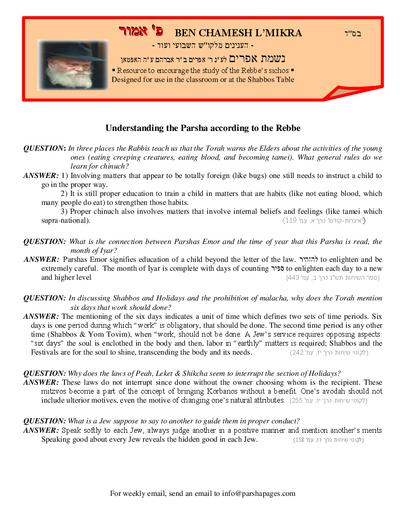
This thing, to castrate any livestock or wild animal, even of an unclean species. This is why [our verse] says here “in your land” -to include any species found in your land. For it is impossible to say that castration is prohibited only in the land of Israel [“your land,”] because [the prohibition of] castration is an obligation [associated with] the body [of a person], and every commandment associated with the body [of a person] applies both in the Land [of Israel] and outside the Land [of Israel].

Rashi, ibid

Though the verse says “in your land,” which would seem that this prohibition is only in the land of Israel, Rashi nevertheless explains that according to the simple explanation of the Torah, this prohibition applies also outside the land of Israel.

Rashi felt compelled to explain the verse in way that runs contrary to the basic translation of the verse due to the essential rule (even according to a rudimentary understanding of the Torah) that any commandment which is associated with the body applies both in the land of Israel as well as outside of it.

From the fact that Rashi specifically brings an explanation to the verse which runs contrary to the translation of the words “in your land,” (explaining that this includes areas outside of Israel as well) it is clear that the rule that serves as the foundation to his statement must be a fundamental and basic precept according to the simple explanation of the Torah.

From this it is understood as well concerning the other half of the same rule, concerning that which is obligatory solely in regard to the land itself. It too, is also a basic rule in the understanding of the Torah, as the Talmud states,

Talmud, Kiddushin 37a

Every precept which is a personal obligation is practiced both within and without the Land; but what is an obligation of the soil has force only within the Land.

Being that the above precept is basic in understanding of the Torah, it is for this reason that Rashi considers the second explanation to be of equal validity in the simple meaning of the verse.

With this in mind, he presents both explanations and does not only explain the words “in all your dwelling places” according to the view of the first opinion (i.e., that this prohibition includes also those who live outside of Israel). Rather, he presents an alternate interpretation stating that indeed this prohibition is applicable only in the land of Israel and that these words express that the prohibition only begins once the Israelites are completely settled in their land.

Each is insufficient

Rashi’s intention with bringing both interpretations on the verse is due to a difficulty found within each. While both fit with the simple meaning of the verse, each one contains a difficulty that necessitates the alternate explanation.

The difficulty with the first explanation: Being that the mitzvah of offering the new grain pertains to the Land itself and is not a responsibility of the individual, saying that it is an obligation that applies even outside the land of Israel goes against the precept of “what is an obligation of the soil has force only within the Land.”

The difficulty with the second explanation: This opinion runs contrary to the usual understanding of the words “all your dwelling places,” and instead suggests that these words qualify when the prohibition of the new grain began.

Since each one has a separate type of difficulty according to the simple explanation of the Torah, it is clear that both explanations are of equal status. It is for this reason that Rashi brings both views and also prefaces that “the Sages of Israel differ concerning this,” thereby conveying that each explanation is as viable as the other.

The argument

What remains to be understood is that since both explanations are equally problematic and equally viable, what is the reason that some “Sages of Israel” chose one explanation and other chose the other?

The answer to this is embedded in Rashi’s words, “the Sages of Israel differ concerning this.” Instead of writing as he usually does with the term, “our Rabbis differ concerning this.”

With this expression Rashi imparts, that instead of the argument revolving around how the verse should be learned, it is rather an intuitive argument regarding how to understand and evaluate the nature of the Jewish people, “Israel.” He therefore calls them “the Sages of Israel” instead of “our Rabbis,” as depending on the way the Sages understood the nature of the Jewish people is the way that they chose to explain the prohibition.

Awakening the heart

The explanation of this as follows: When a person offers a sacrifice, the purpose of the offering is not merely the act of sacrificing the animal on top of the altar, but it is in order to arouse a certain emotional reaction within the person, depending on the nature of the sacrifice.

A sin offering is meant to awaken a feeling of regret and repentance, an offering of thanksgiving should bring a feeling of gratitude to the Almighty, etc.

This concept is expressed by Rashi in the following statement:

Rashi, Vayikra 1:17

Whether one offers much or little, [it is equally pleasing to G-d,] provided that he directs his heart to Heaven.

The emphasis and importance of the offering is not only in regard to the actual sacrifice that one offers, but primarily in the intention of the person, and the feelings directed to G-d via the sacrifice. The intent of the offering to arouse the emotions of an individual is not only in regard to private offerings, but with communal ones as well.

Accordingly, it is understood that the prohibition of eating of the new grain before the communal Omer offering was brought from its yield—a law whose intent was that the first of the grain be dedicated as an offering to the Almighty—was meant to arouse within each person the realization that the first of his produce should be bequeathed to G-d and only afterwards can the individual partake of the remaining grain.

The Omer offering however, was brought from the produce of the land of Israel and therefore posed a certain difficulty:

How can the feeling of one’s first crop belonging to the Almighty be instilled in the hearts of those Jews that resided outside the land of Israel?

In response to this conundrum are the two opinions of the Sages of Israel:

The first opinion holds that these individuals should be prohibited from eating their new grains as well. Not being able to benefit from their grain until the offering of the Omer was brought in the land of Israel would remind and arouse them of the realization that they must give their initial yield to G-d, although the actual offering was not brought from their personal produce, but from grain in Israel.

The second opinion is of the view that on the contrary, the manner in which to arouse those that live outside of Israel is not through forbidding them to partake of their new produce. Rather, from the very realization that their produce is permitted to them, and the knowledge that they cannot be part of this communal mitzvah of offering the Omer, they will be reminded of their lowly situation and this itself will serve as a catalyst for the desire to give of their fruits to G-d in a stronger way; even more so than those living inside the land of Israel.

A deeper look

According to the above, Rashi’s choice of order concerning the presentation of the two explanations can be appreciated as well.

First he brought the opinion of which the prohibition of the new grain is prohibited outside the land of Israel, and only after did he present the explanation stating that it is only prohibited within the land of Israel.

Each of the above approaches of the Sages in regards to inspiring the Jew who lived outside of Israel operates in a variant way in their choice of method to affect an individual in the best manner.

The first: Through forbidding the grain, the person’s body and animal soul is affected, but not as much their G-dly soul.

The second: Not forbidding the grain awakens in them the yearning to be at the same level as those Jews living in the land of Israel, thus arousing their G-dly soul’s inner desire to be close to G-dliness.

Accordingly, Rashi’s order is understood. He begins with explaining the easier task—to start working with and refining the animal soul, as it stands at its natural strength. Only afterwards does he explain the next stage, where the soul itself can be directly affected.

In the land of Israel too

The difference of the two explanations is not only in regards to how the prohibition applies outside of Israel, and the appreciation of the two approaches concerning those individuals. The variant opinions also concern those living in the land of Israel itself: Does the prohibition stand immediately upon the entrance into the land, or does it only begin after the possession and settlement?

According to the first explanation, the prohibition of the new grain began before the Land of Israel was completely settled, and according to the second explanation it only began after it was completely settled.

Based on the deeper insight regarding both explanations however, it is understood that the two explanations are interdependent, as the abovementioned stages in serving G-d are not only applicable to the Jews residing outside the land of Israel but also to those who live inside Israel as well.

The first opinion emphasizes affecting the body by way of a prohibition. Even within the land of Israel, the recognition that the first grains belong to the Almighty is primarily accomplished through the prohibition that affects the body (abstaining from eating the grain) and not from the actual offering of the Omer to G-d.

Therefore, according to this view, this prohibition began immediately upon entering the land of Israel, even before the Jewish people were completely settled there and thus enveloped by the holiness of the land. For, though their souls were not yet permeated with the G-dly vitality of the land, it was still possible for their bodies to begin to be affected and refined. Through the prohibition of the new grain directly affecting their body, this could be achieved.

However, according to the second opinion, which was of the approach that the main medium to affect the Jewish people is through their souls, accomplished via the bringing of the Omer, it was only possible to attain this affect after the Jewish people were completely settled in the land of Israel, and attached to its holiness in a permanent way.

(Based on Likutei Sichos 17, Emor 2, reworked by Rabbi Dovid Markel. To see other projects and to partner in our work, see: www.Neirot.com.)

PDF Preview