Understanding the Parsha according to the Rebbe
Ben Chamesh L'Mikra | May 13, 2024
Print This Article
View Original PDF

Understanding the Parsha according to the Rebbe

Ben Chamesh L'Mikra | June 27, 2025

QUESTION: In three places the Rabbis teach us that the Torah warns the Elders about the activities of the young ones (eating creeping creatures, eating blood, and becoming tamei). What general rules do we learn for chinuch?

ANSWER: 1) Involving matters that appear to be totally foreign (like bugs) one still needs to instruct a child to go in the proper way.
2) It is still proper education to train a child in matters that are habits (like not eating blood, which many people do eat) to strengthen those habits.
3) Proper chinuch also involves matters that involve internal beliefs and feelings (like tamei which supra-national). ('איגרות-קודש' כרך א, עמ' 119 )

QUESTION: What is the connection between Parshas Emor and the time of year that this Parsha is read, the month of Iyar?

ANSWER: Parshas Emor signifies education of a child beyond the letter of the law. להזהיר to enlighten and be extremely careful. The month of Iyar is complete with days of counting ספיר to enlighten each day to a new and higher level (ספר השיחות תש"נ כרך ב, עמ' 443 )

QUESTION: In discussing Shabbos and Holidays and the prohibition of malacha, why does the Torah mention six days that work should done?

ANSWER: The mentioning of the six days indicates a unit of time which defines two sets of time periods. Six days is one period during which “work” is obligatory, that should be done. The second time period is any other time (Shabbos & Yom Tovim), when “work, should not be done. A Jew’s service requires opposing aspects: “six days” the soul is enclothed in the body and then, labor in “earthly” matters is required; Shabbos and the Festivals are for the soul to shine, transcending the body and its needs. (לקוטי שיחות כרך יז, עמ '242 )

QUESTION: Why does the laws of Peah, Leket & Shikcha seem to interrupt the section of Holidays?

ANSWER: These laws do not interrupt since done without the owner choosing whom is the recipient. These mitzvos become a part of the concept of bringing Korbanos without a benefit. One’s avodah should not include ulterior motives, even the motive of changing one’s natural attributes. (לקוטי שיחות כרך יז, עמ' 255 )

QUESTION: What is a Jew suppose to say to another to guide them in proper conduct?

ANSWER: Speak softly to each Jew, always judge another in a positive manner and mention another’s merits. Speaking good about every Jew reveals the hidden good in each Jew. (לקוטי שיחות כרך כז, עמ' 158 )
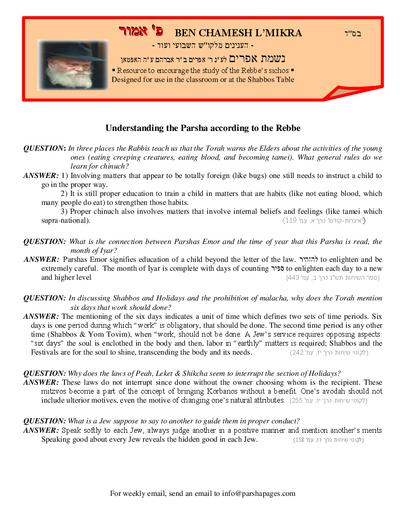
QUESTION: In three places the Rabbis teach us that the Torah warns the Elders about the activities of the young ones (eating creeping creatures, eating blood, and becoming tamei). What general rules do we learn for chinuch?

ANSWER: 1) Involving matters that appear to be totally foreign (like bugs) one still needs to instruct a child to go in the proper way.
2) It is still proper education to train a child in matters that are habits (like not eating blood, which many people do eat) to strengthen those habits.
3) Proper chinuch also involves matters that involve internal beliefs and feelings (like tamei which supra-national). ('איגרות-קודש' כרך א, עמ' 119 )

QUESTION: What is the connection between Parshas Emor and the time of year that this Parsha is read, the month of Iyar?

ANSWER: Parshas Emor signifies education of a child beyond the letter of the law. להזהיר to enlighten and be extremely careful. The month of Iyar is complete with days of counting ספיר to enlighten each day to a new and higher level (ספר השיחות תש"נ כרך ב, עמ' 443 )

QUESTION: In discussing Shabbos and Holidays and the prohibition of malacha, why does the Torah mention six days that work should done?

ANSWER: The mentioning of the six days indicates a unit of time which defines two sets of time periods. Six days is one period during which “work” is obligatory, that should be done. The second time period is any other time (Shabbos & Yom Tovim), when “work, should not be done. A Jew’s service requires opposing aspects: “six days” the soul is enclothed in the body and then, labor in “earthly” matters is required; Shabbos and the Festivals are for the soul to shine, transcending the body and its needs. (לקוטי שיחות כרך יז, עמ '242 )

QUESTION: Why does the laws of Peah, Leket & Shikcha seem to interrupt the section of Holidays?

ANSWER: These laws do not interrupt since done without the owner choosing whom is the recipient. These mitzvos become a part of the concept of bringing Korbanos without a benefit. One’s avodah should not include ulterior motives, even the motive of changing one’s natural attributes. (לקוטי שיחות כרך יז, עמ' 255 )

QUESTION: What is a Jew suppose to say to another to guide them in proper conduct?

ANSWER: Speak softly to each Jew, always judge another in a positive manner and mention another’s merits. Speaking good about every Jew reveals the hidden good in each Jew. (לקוטי שיחות כרך כז, עמ' 158 )

PDF Preview