Parshat Ki Tavo Emulating G-d
In this week’s parsha is included the directive to walk in G-d’s ways. This Sicha explains exactly how it is possible that a mere mortal can emulate the ways of G-d.
This week’s parsha expresses that man follow in the ways of G-d. The verse states:
Text 1
The Lord will establish you as His holy people as He swore to you, if you observe the commandments of the Lord, your G-d, and you shall walk in His ways.
Devarim 28:9
Rambam enumerates this as one of the 613 commandments and explains that “we are commanded to emulate G-d, blessed be He, to the best of our ability.” He continues by elucidating that “The source of this commandment is G-d's statement (exalted be He), 'And you shall walk in His ways.'”
In his book of Mishna Torah, Rambam describes this law further, stating:
Text 2
We are commanded to walk in these intermediate paths - and they are good and straight paths - as [Devarim 28:9] states: "And you shall walk in His ways." … [Our Sages] taught [the following] explanation of this mitzvah: “Just as He is called ‘Gracious,’ you shall be gracious; Just as He is called ‘Merciful,’ you shall be merciful; Just as He is called ‘Holy,’ you shall be holy;” In a similar manner, the prophets called G-d by other titles: "Slow to Anger," "Abundant in Kindness," "Righteous," "Just," "Perfect," "Almighty," "Powerful," and the like. [They did so] to inform us that these are good and just paths. A person is obligated to accustom himself to these paths and [to try to] resemble Him to the extent of his ability.
Rambam, De’ot 1:5-6
This mitzvah is a curious one however, as Rambam already explained an idea elsewhere, which seems to preclude reckoning the concept of emulating G-d as a commandment amongst the 613 mitzvot:
Text 3
It is not proper to count the general commandments that incorporate the entirety of the Torah [amongst the 613 commandments]. There are commandments and injunctions in the Torah that are not in a specific thing but rather include all of the mitzvot. As if it says, “Do all that I commanded you to do,” or “Do not do all that I prohibited.”…It does not make sense to include such a commandment as a separate command, as there is no specific action to include it as a positive commandment or specific action that is prohibited to include it as a negative commandment.
Rambam, Sefer HaMitzvot, Shoresh 4
Seemingly, it would appear that this commandment of emulating G-d’s ways is as well a general commandment, which therefore should exclude it from being mentioned amongst the 613 commandments.
For, although the verse does express specific directives to follow, of “Just as He is called ‘Gracious,’ you shall be gracious; Just as He is called ‘Merciful,’ you shall be merciful; Just as He is called ‘Holy,’ you shall be holy;” in truth, the mitzvah is much broader than that.
The essence of the mitzvah is as Rambam explains, “[to try to] resemble Him to the extent of his ability,” which, in truth, includes all the mitzvot.
The Medrash explains regarding this idea as well:
Text 4
[The verse states] (Tehillim 147:19) “He tells His words to Yaakov, His statutes and His judgments to Israel…” For the attributes of G-d are not like a mortal. A mortal instructs others to do, yet he does not do anything. G-d, however, is not like that. Rather, what He does He tells Israel to do and to guard.
Shemot Rabba 30:9
This seems to express that the commandment of emulating G-d’s ways is not a specific mitzvah but a general one. Nevertheless, Rambam still enumerates it amongst the 613 commandments.
Something Novel
From the fact that Rambam does indeed include it as one of the specific 613 commandments, notwithstanding the clause that a general commandment is not included amongst the 613 commandments, it must be because there is something specific in this commandment that is not found in other commandments. Because of this novelty, it is counted among the rest of the mitzvot.
This is similar to what Rambam explains concerning the commandment, “And you shall serve G-d, your Lord.” Though this seems to be a general precept, it is nevertheless included in the listing of the commandments:
Text 5
The 5th mitzvah is that we are commanded to serve G-d (blessed be He). This commandment is repeated many times: “And you shall serve G-d, your L-rd;” "And you shall serve Him;" "And to serve Him."
Although this commandment is of a general nature, as explained in the Fourth Principle, [and apparently should not be included in the count of the 613 mitzvot,] nevertheless it has a specific quality since it is the commandment to pray.
Rambam, Sefer HaMitzvot, Positive Commandment 5
In a similar fashion that the novelty of the commandment, “And you shall serve G-d, your L-rd,” is that it adds the directive to pray, so too with the commandment to “walk in His ways.”
There is something that is unique in this commandment which causes that it should be counted amongst the rest of the mitzvot.
Walking
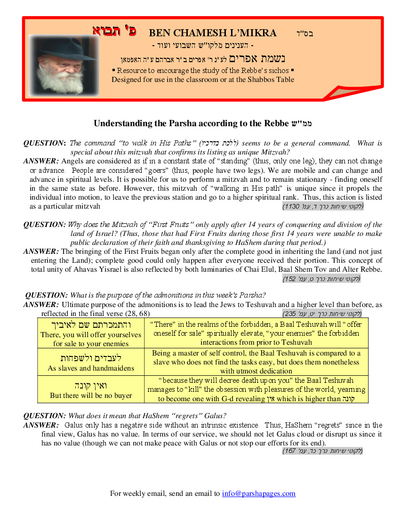
The verse states, “walk in His ways.” What is specific in this directive, which is not found in other commandments, is that the manner that a person is to emulate G-d is in a way of “walking.”
A person can do mitzvot, yet stay stationary—not making any advancement in their service of G-d. Concerning this tendency comes the commandment, “walk in His ways.” The manner in which a person fulfills the mitzvot should be in a way that the mitzvot transport him from one state to the next. Instead of being immobile, he should constantly be progressing in his service of G-d.
The means by which a person reaches the level of “walking” and progressing is when he realizes that the mitzvot are “His ways.”
When he performs the mitzvot because they are “His ways,” and his focus in fulfilling them is to “emulate G-d,” then the mitzvot will affect that his entire identity be transformed.
Although true that mitzvot do cause a person to become more refined, even when he does not fulfill them with the intent of walking in G-d’s ways, and even when he does them completely without proper intent, nevertheless, that refinement is unrecognizable in the person in a clear way. Yet, when a person performs the commandments with the explicit intent of emulating G-d, then the transformation that is caused through the fulfillment of the mitzvot is readily apparent.
Souls and Angels
This idea can better be comprehended through understanding the Chassidic explanation of the following verse:
Text 6
So said the Lord of Hosts: “If you walk in My ways, and if you keep My charge, you too shall judge My house, and you too shall guard My courtyards, and I will give walkers among these who stand.
Zecharya 3:7
Concerning this, it is explained in Chassidic thought that the quality of “walkers” is something specific to the souls of the Jewish people when they come into this world.
Text 7
It is known that angels are referred to as “standers,” as the verse (Yeshayahu 6:2) states, “Seraphim stood.” So too, souls prior to their arrival to this world are as well called “standers,” as the verse (I Melachim 17:1) states, “As the Lord, the G-d of Israel, whom I stand before, lives.” Only after the soul comes down to this world and is enclothed in a body and an animal soul, is it referred to as a “walker.”
Torah Ohr, Vayeishev 30a
It is explained in Chassidic thought, that in truth, the idea of standing does not negate advancement in one’s spiritual level. For, although angels and souls—before they become enclothed in corporeality—do indeed advance in their spiritual levels, they are nevertheless not referred to as “walkers.”
The reason for this being that all of their development is systematic and orderly—and therefore limited. No matter what heights they may attain, it is considered as if they are at a standstill, as they never uproot themselves from the level on which they were previously at. The higher level is merely building on the preceding one.
As such, no matter how high a spiritual level they attain, they are intrinsically connected to their original level. It is for this reason that they are referred to as “standers.”
Conversely, the concept of “walkers” that the soul achieves when it becomes enclothed in a corporeal body expresses ascents that are not related to the previous levels that one was at. A human being is able to completely extract himself from one level and bring himself to a height that has no association whatsoever to the situation and level on which he was previously holding.
From this it is understood, that the meaning of the commandment to “walk in His ways” is such that the person’s fulfillment of mitzvot should be in a manner that through them he should reached the infinite. When a person makes the shift between finite and infinite, it is then that he is truly called a “walker.”
Man and the infinite
This idea though, that a mortal can reach the infinite, seems problematic. A human being is intrinsically limited and therefore:
- A) How can man, through his own service of G-d—which is by definition limited—reach a manner of serving G-d that is infinite?
- B) If man can indeed reach a level of the infinite, how can he be on one hand infinite and on the other remain a limited creation? Once he reaches the infinite, he should logically cease being finite.
Truly, it is indeed impossible for a finite creature to reach the infinite through a finite service of G-d, and together with reaching infinity, remain finite.
Achieving the impossible however, is within the jurisdiction of G-d, Who is not limited by rational conundrums. G-d is able to connect the finite and the infinite together, so that man can remain a finite being while still reaching the infinite.
It is for this reason that that the verse states that one shall “walk in His ways,” as, in order to reach the true level of “walking,” one must connect to the essence of G-d, which is not limited by any limitations whatsoever. Through walking in His ways man is able to:
- A) Serve G-d in a finite way and nevertheless reach the infinite.
- B) Reach the infinite and still remain a finite creation.
This is all possible because he has connected to G-d through “walking in His ways,” and is therefore not restricted to the rules of normal logic and limitations.
The service of man
What is left to be understood is that based on the above, it seems that it is not man serving G-d, but that G-d uplifts man to a level that he would not be able to accomplish on his own.
Yet, G-d desires that we accomplish on our own and not eat “bread of shame” that has been given to us by others.
How can reaching the infinite be considered man’s accomplishment, when he can only attain this through the means of G-d raising him to this level?
One may attempt to answer the above question by pointing out that in this case, G-d is not actually doing the work for the individual. Meaning to say, that in a situation where man does all that he can and then G-d lifts him up to a higher level that he cannot attain on his own, it is clear that it is G-d who is bringing him there. In this case however, G-d is merely infusing within man’s own service the ability to reach the infinite, since man himself cannot attain it on his own.
Nonetheless, this difference is superficial. Since it is G-d Who empowered him with the ability to reach the infinite, it seemingly cannot be referred to as man’s own service, but rather G-d’s ability superimposed upon him. Ostensibly this is not fitting with the principle that G-d desires that man should serve Him on his own.
It therefore must be said, that this idea that man can reach the infinite—although he is finite—is somehow connected to man himself.
The soul of man
In order for the mitzvot that one does to be considered “the ways of G-d,” which are infused with infinite energy, a person must connect to the essence of his soul. The soul of man is a part of G-d, as expressed in the following verse:
Text 8
Now what is the portion of G-d from above and the heritage of the Almighty from on high?
Iyov 31:2
Tanya adds that the soul is “literally” a portion of G-d, and it is therefore understood, that at the core, the soul of man is limitless and infinite.
When an individual serves G-d with his soul, he is able to bring the infinite into the finite.
When Rambam formulates the practical application of emulating G-d, he writes that the way man should act is that “Just as He is called ‘Gracious,’ you shall be gracious; Just as He is called ‘Merciful,’ you shall be merciful; Just as He is called ‘Holy,’ you shall be holy.”
The word “you” is expressive of the person’s essence, which cannot be articulated through any description or term. Rambam is essentially saying then, is that man is to draw down the very essence of his soul—which is a part of G-d—into his efforts of being gracious, merciful and holy.
In one’s general service of G-d, this means that a person should do the mitzvot with simple faith and self-sacrifice, which transcends all logic and comes from the essence of one’s soul. It is then that he is able to draw down within his own graciousness, mercifulness and holiness, G-d’s attributes of graciousness, mercifulness, and holiness.
Accordingly it is understood, that the infinite “walking” of man is also an expression of man himself and the essence of his very being.
Infinitely finite
As mentioned above, the idea of transcending the bounds of logic through going “in His ways” is twofold:
- A) Man’s limited service can indeed reach the infinite.
- B) After all the ascents and attaining the infinite, man still remains finite.
Since, as stated above, all of man’s accomplishments come through his own efforts, it is understood that this second point of remaining finite after touching the infinite, comes as well through man’s own abilities.
This can be understood as follows:
The true life force of a Jewish person is from his G-dly soul. This means to say, that in every Jew there is a dichotomy at play: On one hand, he has a physical body that is limited, and on the other, he has a soul which is “literally a portion from G-d, above.” Instead of the soul breaking the body and nullifying it, the soul enlivens it. The life force of the physical body is the G-dly soul.
This life force from the G-dly soul though, is hidden. It is man’s objective through his service of G-d to bring it to light. His purpose is to reveal the soul to the point that within the limbs of his body is felt the life force of his G-dly soul.
When a person wants to do something, there is no delay between the time when the physical energizing soul expresses that desire and the point at which the body executes it.
Text 9
The organs of the human body are a garment for its soul and are completely and utterly surrendered to it, as evidenced from the fact that as soon as a person desires to stretch out his hand or foot, they obey his will immediately and forthwith, without any command or instruction to them and with no hesitation whatever, but in the very instant that he wills it.
Tanya, Ch. 23
In the same way that it is regarding one’s natural soul, so too must it be concerning one’s G-dly soul. A Jew is to remove all external things that cover over the soul. When he does so, he will feel that in truth, it is his G-dly soul that enlivens his body. At that point, his physical body will automatically express the soul.
Text 10
R. Minasya stated: “I appreciate my head, for when it reaches [the place] ‘Modim’ [in prayer,] it bows spontaneously.”
Jerusalem Talmud, Berachos 2:4
This sage’s body was so in tune with his soul, that it automatically fulfilled its wish.
When a Jew, through his service, causes the revealed connection between body and soul to the point that his finite body is expressive of the soul, he draws down, as a result, the G-dly expression, that he can reach the highest levels of “walking” in G-d’s ways and nevertheless remain finite.
Connecting to a leader
Prior to the commandment of emulating G-d, Rambam explains that one should connect to Torah scholars:
Text 11
The 6th mitzvah is that we are commanded to be close to the wise and to associate with them. We should constantly be close to them and to be with them in all possible ways of friendship, such as eating, drinking and doing business, in order to thereby succeed in emulating their actions and knowing from their words the true way of looking at things. The source of this commandment is G-d's statement (exalted be He), "And cling to Him." This commandment is repeated, "To Him you shall cling," and is explained in the words of the Sifri: "Cleave to the Sages and their students."
Rambam, Sefer Hamitzvot, Positive Commandment 6
Before a person emulates G-d, he must cling to scholars from whom he receives his G-dly nourishment. Through cleaving to them he becomes a proper receptacle to receive the light of his soul. Through cleaving to G-d by way of cleaving to scholars, he acquires the ability to walk in G-d’s ways in an infinite manner.
When a person performs mitzvot afterwards in a way that expresses the essence of his soul, he can draw down G-d Himself, so to speak, and “walk” in G-d’s ways in an infinite manner. Through this he will ultimately merit the ultimate expression of G-dliness in the time of Moshiach.
(Based on Likutei Sichos 4, reworked by Rabbi Dovid Markel. To see other projects and to partner in our work, see: www.Neirot.com.)