The Lesson of the Bikurim Baskets
Inspired by a Story | August 31, 2023
Print This Article
View Original PDF

The Lesson of the Bikurim Baskets

Inspired by a Story | December 31, 2025

A Chassid of Rav Zvi Hirsch of Liska came to visit his Rebbi. He wasn't a wealthy man, but he saved up and bought a nice large pair of shining copper candlesticks as a present for his Rebbi. His Rebbi was very touched by the gift given with such a sincere heart. He took the candlesticks and put them in his Shul next to the place of the Chazan to be used every day.

A wealthy Chassid saw the shining candlesticks and decided that he would bring the Rebbi much nicer ones. He went and bought expensive golden candlesticks. He polished them and with a big shine on his face, he brought them in to his Rebbi, Reb Zvi Hirsch. The Rebbe studied the beautiful gift. He then turned to the man and said, "I have a question to ask you."

"In Parshas Ki Savo we have the Parsha of Bikurim. A person has a field that grows fruit of the Shivas Haminim - the seven special fruits that the Torah attributes to Eretz Yisrael. As the first fruit ripen, he has to put a red string around them. Then he takes those fruit to Yerushalaim and gives them to the Kohen."

"However," continued the Rebbe, "we find a very interesting and strange Halacha. A wealthy man brings his Bikurim in an expensive basket, the Kohen empties all the fruit from the basket and returns the basket to the Kohen. When a poor man comes with a simple basket, the Kohen keeps the fruit and the basket." "Why is it that the wealthy man who won't even miss the silver or golden dish he brought, he gets it back. The poor man who every penny counts, has to lose his precious basket?"

(Chazal give an answer to this question. The wealthy man, who has lots of fruit and comes with a full basket, the Kohen empties the silver or golden dish and returns it. The poor man only has a few fruit, not even enough to fill his small basket. He fills his basket with paper and on the top puts some fruit. If the Kohen would empty his basket, the man would be so embarrassed that his basket is nearly empty. In order to save the poor man for shame, the Kohen keeps the basket. The Rebbe had another explanation with an important message.)

Parshas Ki Savo 5783

BS"D
By Rabbi Dovid Caro

"Let us imagine the following scenario. Reb Yosef the pauper walks excitedly into his home with a big smile. His wife asks him what's the news? He replies that some of the new fruits have just ripened and he has a few olives and dates to take to Yerushalaim and fulfill the great Mitzva of Bikurim. His wife is so excited too. She tells him to go to the water and pull out some reeds so she can put together a basket. She sits there making the basket, humming to herself in joy, thanking Hashem for allowing them to be able to fulfill this beautiful Mitzva. Tears of gratitude and joy are rolling down her face. Even in such difficult times Hashem still gave them the opportunity to do this Mitzva. When Reb Yosef arrives in Yerushalaim with his Bikurim, Hashem doesn't just want the fruit, He wants the basket too. That is a Mitzva done with the whole heart."

"Now," continued the Rebbe, "let us imagine another scenario. Reb Yaakov, one of the wealthiest men in his city, comes home and tells his wife that the fruit of his orchard are ripening. He then reminds her that last year, their neighbor, Reb Shimon, brought his Bikurim in a huge silver dish. 'What a chutzpah, who does he think he is? This year I will show him.' He calls up the gold store and orders a huge gold dish and asks that it should have a tall stand. He then checks to see exactly which day Reb Shimon is going to Yerushalaim. When he sees him going, he follows behind and makes sure to arrive in Yerushalaim together. There he takes out his beautiful gold dish with a big smile. Now everyone knows who is the real big guy in town. Hashem isn't interested in his dish or his fruit. Having no choice, the Kohen empties the fruit and returns the dish. Hashem doesn't need such gifts" concluded the Rebbe, and returned the golden candlesticks to his Chassid.

Hashem doesn't look at the external picture of our Mitzvos, he judges the heart, the motivations and intentions behind the Mitzva.
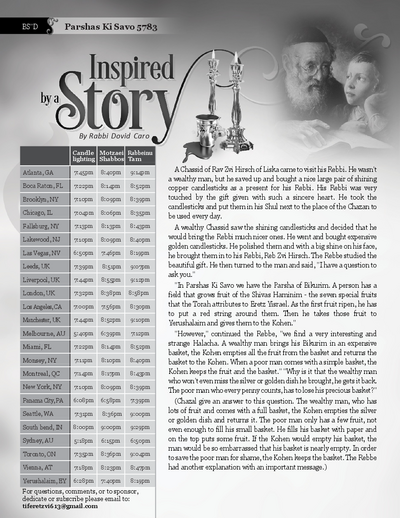
A Chassid of Rav Zvi Hirsch of Liska came to visit his Rebbi. He wasn't a wealthy man, but he saved up and bought a nice large pair of shining copper candlesticks as a present for his Rebbi. His Rebbi was very touched by the gift given with such a sincere heart. He took the candlesticks and put them in his Shul next to the place of the Chazan to be used every day.

A wealthy Chassid saw the shining candlesticks and decided that he would bring the Rebbi much nicer ones. He went and bought expensive golden candlesticks. He polished them and with a big shine on his face, he brought them in to his Rebbi, Reb Zvi Hirsch. The Rebbe studied the beautiful gift. He then turned to the man and said, "I have a question to ask you."

"In Parshas Ki Savo we have the Parsha of Bikurim. A person has a field that grows fruit of the Shivas Haminim - the seven special fruits that the Torah attributes to Eretz Yisrael. As the first fruit ripen, he has to put a red string around them. Then he takes those fruit to Yerushalaim and gives them to the Kohen."

"However," continued the Rebbe, "we find a very interesting and strange Halacha. A wealthy man brings his Bikurim in an expensive basket, the Kohen empties all the fruit from the basket and returns the basket to the Kohen. When a poor man comes with a simple basket, the Kohen keeps the fruit and the basket." "Why is it that the wealthy man who won't even miss the silver or golden dish he brought, he gets it back. The poor man who every penny counts, has to lose his precious basket?"

(Chazal give an answer to this question. The wealthy man, who has lots of fruit and comes with a full basket, the Kohen empties the silver or golden dish and returns it. The poor man only has a few fruit, not even enough to fill his small basket. He fills his basket with paper and on the top puts some fruit. If the Kohen would empty his basket, the man would be so embarrassed that his basket is nearly empty. In order to save the poor man for shame, the Kohen keeps the basket. The Rebbe had another explanation with an important message.)

Parshas Ki Savo 5783

BS"D
By Rabbi Dovid Caro

"Let us imagine the following scenario. Reb Yosef the pauper walks excitedly into his home with a big smile. His wife asks him what's the news? He replies that some of the new fruits have just ripened and he has a few olives and dates to take to Yerushalaim and fulfill the great Mitzva of Bikurim. His wife is so excited too. She tells him to go to the water and pull out some reeds so she can put together a basket. She sits there making the basket, humming to herself in joy, thanking Hashem for allowing them to be able to fulfill this beautiful Mitzva. Tears of gratitude and joy are rolling down her face. Even in such difficult times Hashem still gave them the opportunity to do this Mitzva. When Reb Yosef arrives in Yerushalaim with his Bikurim, Hashem doesn't just want the fruit, He wants the basket too. That is a Mitzva done with the whole heart."

"Now," continued the Rebbe, "let us imagine another scenario. Reb Yaakov, one of the wealthiest men in his city, comes home and tells his wife that the fruit of his orchard are ripening. He then reminds her that last year, their neighbor, Reb Shimon, brought his Bikurim in a huge silver dish. 'What a chutzpah, who does he think he is? This year I will show him.' He calls up the gold store and orders a huge gold dish and asks that it should have a tall stand. He then checks to see exactly which day Reb Shimon is going to Yerushalaim. When he sees him going, he follows behind and makes sure to arrive in Yerushalaim together. There he takes out his beautiful gold dish with a big smile. Now everyone knows who is the real big guy in town. Hashem isn't interested in his dish or his fruit. Having no choice, the Kohen empties the fruit and returns the dish. Hashem doesn't need such gifts" concluded the Rebbe, and returned the golden candlesticks to his Chassid.

Hashem doesn't look at the external picture of our Mitzvos, he judges the heart, the motivations and intentions behind the Mitzva.

PDF Preview