A Word from the Director
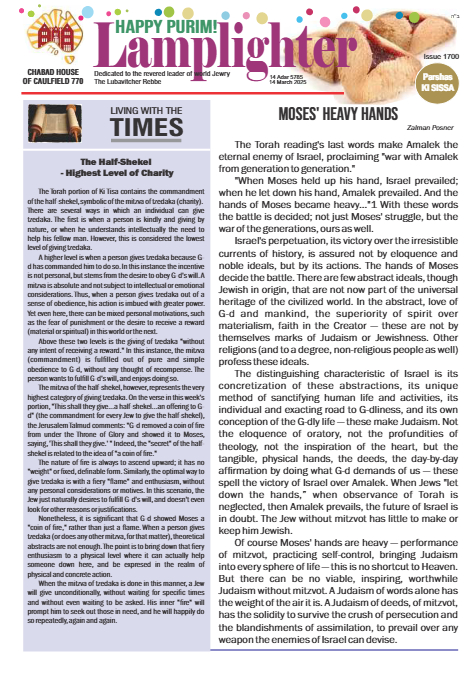
The holiday of Purim (which we celebrated on Friday) is connected to three ideas: shleimut ha'am (the completeness of the Jewish people); shleimut haTorah (the completeness of Torah); and shleimut ha'aretz (the completeness of the Land of Israel).
The "completeness of the Jewish people" means recognising that we are one nation. Haman's decree was directed against all Jews combined, "from young to old, men, women and children." By coming together in true unity, Haman's evil decree was nullified.
The "completeness of Torah" means the whole Torah - every single part of it. In the Megillah, Mordechai is referred to as "Mordechai Hayehudi," "Mordechai the Jew." The term "Yehudi" implies the rejection of idol worship. When a Jew rejects idolatry, he is declaring that the entire Torah is true. In the days of Mordechai, the Jewish people were called "Yehudim", because they clung to the totality of Torah, every single detail and aspect of it, without compromise.
The "completeness of the Land of Israel" means that all of the Holy Land belongs to the Jewish people. The events of Purim occurred during the 70 years between the First and the Second Holy Temples. Although by that time work had already begun on the construction of the new Temple, it was interrupted by order of the Persian King. Mordechai knew that learning the laws connected to the Temple would bypass and thereby nullify the decree to stop building. He gathered the Jewish children together and studied these laws, and his efforts were crowned with success. The Temple was completed, and the Land of Israel remained in Jewish hands.
Coming from the holiday of Purim, let us consider the fact that G-d Himself granted the entirety of Eretz Yisroel—the Holy Land—to every single Jew! We must, therefore, behave in a way that makes us worthy of the name "Yehudim," declaring this truth along with our whole Torah and remaining strong in our faith in G-d. Doing so will enable us to successfully achieve absolute victory over all our enemies and especially in Eretz Yisroel so that all the nations surrounding Israel will fear and respect it just as the nations did at the time of the Story of Purim as detailed in the Megillah of Esther.
Related Articles