Hindsight
Fascinating Insights | February 25, 2024
Print This Article
View Original PDF

Hindsight

Fascinating Insights | December 10, 2025

The pasuk states וראית את אחורי ופני לא יראו, Hashem told Moshe... you will see my back but my face may not be seen. The Chassam Sofer looks at these words deeper: At times in our lives, it may be difficult for us to feel Hashem since we are caught up in a frustrating situation in which we are subjective — ופני לא יראו. At these times it would be beneficial to let the situation pass. Once it passes, we can see more clearly in retrospect. This is what is meant in וראית את אחורי, as only in retrospect does it make sense.

This can be understood through an analogy: when a person is in a car he is unable to see what is happening around the corner. However, when he is on a plane, he can see everything (objective). Similarly, when we are caught up in a situation and are at ground level we are unable to see objectively. Wait for it to pass and then you can see it all clearly.

A common saying goes, “Life can only be understood backwards, but it must be lived forwards!”

Sometimes we may see the full picture the next day. But at other times it may take longer — a week, a month or even years later. And sometimes only after this world.

This is analogous to a person reading a book. No questions may be asked until the book is read from beginning to end, since otherwise, he is still in middle of the story. Similarly, in life we come in middle of the story as we are over 5,700 years into existence. We are still in middle of the book. Consequently, we cannot ask any questions.

After the tragic events at Meron in 2021 on Lag Ba’omer, R' Yaakov Shayish visited the home of Moshe ben Shalom of Bnei Brak, one of the victims and shared this insight. “The names of the parshiyos of these weeks reveal a secret to acceptance and the consolation. The sequence of these parshiyos are Acharei-Mos, Kedoshim, Emor, Behar and Becukosai. It can be interpreted to mean as following the death (Acharei-Mos) of these holy people (Kedoshim), we should say (Emor) that regarding those who lost their lives on the mountain (Behar) [Mount Meron], it was a chok (Bechoksai), something beyond our comprehension. And finally, as we say at the conclusion of Bechoksai, chazak chazak V'nischazek, let’s be strong and then we will strengthen one another.”

R' Tzvi Hirsch Meisels recounted the poignant tale of his tallis, adorned with an atarah (ornament) gifted by his father-in-law, once belonging to the author of Yitav Lev. In 1944, when the Nazis came to take him to Auschwitz, he wore the tallis with the atarah until it was forcibly taken away from him at Auschwitz. Determined, he managed to locate where the stolen belongings were stored, recovering his tallis. Aware that openly wearing it could lead to dire consequences, he cut it so he could conceal it beneath his clothing without the Nazis knowing. One day, R' Meisels was leaving the bathroom when a guard decided to inspect him and discovered the garment. When the guard asked R' Meisels about the garment’s nature, he answered that it was a “Godly garment.” Enraged, the guard subjected him to merciless beatings, and said: How can you mention God amidst the atrocities befalling his people including his own family members being killed? Threatening death unless a satisfactory explanation was given, the guard received a profound response. R' Meisels answered him with the following analogy. In a critical operation to cure a severe illness, a world-famous surgeon performed it on a distinguished person. He began to making a large incision as well as some smaller incisions as were necessary. A shoemaker watching from the side who was unaware of the medical intricacies questions the seemingly unnecessary pain. He thinks, “When I fix shoes, I would never cut the leather in a place that looks nice!” Would we expect the surgeon to stop his surgery because the shoemaker, who doesn’t understand what the surgeon is doing? R’ Meisels continued that the same applies to the actions of the Creator. The truth is that we don’t understand all of His actions and why He makes a cut at the finest part from within the Jewish people. Nevertheless, we should know that the fact that, we, who have limited minds, cannot understand His ways, doesn’t minimize His greatness. The guard was impressed with R' Meisels’ response and not only spared R' Meisels but told him that he should visit the guard’s block whenever he needed some extra food.
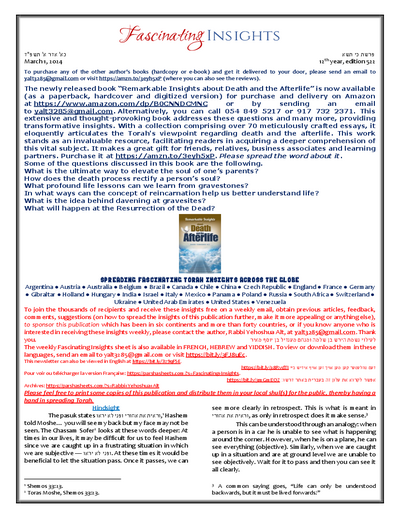

The pasuk states וראית את אחורי ופני לא יראו, Hashem told Moshe... you will see my back but my face may not be seen. The Chassam Sofer looks at these words deeper: At times in our lives, it may be difficult for us to feel Hashem since we are caught up in a frustrating situation in which we are subjective — ופני לא יראו. At these times it would be beneficial to let the situation pass. Once it passes, we can see more clearly in retrospect. This is what is meant in וראית את אחורי, as only in retrospect does it make sense.

This can be understood through an analogy: when a person is in a car he is unable to see what is happening around the corner. However, when he is on a plane, he can see everything (objective). Similarly, when we are caught up in a situation and are at ground level we are unable to see objectively. Wait for it to pass and then you can see it all clearly.

A common saying goes, “Life can only be understood backwards, but it must be lived forwards!”

Sometimes we may see the full picture the next day. But at other times it may take longer — a week, a month or even years later. And sometimes only after this world.

This is analogous to a person reading a book. No questions may be asked until the book is read from beginning to end, since otherwise, he is still in middle of the story. Similarly, in life we come in middle of the story as we are over 5,700 years into existence. We are still in middle of the book. Consequently, we cannot ask any questions.

After the tragic events at Meron in 2021 on Lag Ba’omer, R' Yaakov Shayish visited the home of Moshe ben Shalom of Bnei Brak, one of the victims and shared this insight. “The names of the parshiyos of these weeks reveal a secret to acceptance and the consolation. The sequence of these parshiyos are Acharei-Mos, Kedoshim, Emor, Behar and Becukosai. It can be interpreted to mean as following the death (Acharei-Mos) of these holy people (Kedoshim), we should say (Emor) that regarding those who lost their lives on the mountain (Behar) [Mount Meron], it was a chok (Bechoksai), something beyond our comprehension. And finally, as we say at the conclusion of Bechoksai, chazak chazak V'nischazek, let’s be strong and then we will strengthen one another.”

R' Tzvi Hirsch Meisels recounted the poignant tale of his tallis, adorned with an atarah (ornament) gifted by his father-in-law, once belonging to the author of Yitav Lev. In 1944, when the Nazis came to take him to Auschwitz, he wore the tallis with the atarah until it was forcibly taken away from him at Auschwitz. Determined, he managed to locate where the stolen belongings were stored, recovering his tallis. Aware that openly wearing it could lead to dire consequences, he cut it so he could conceal it beneath his clothing without the Nazis knowing. One day, R' Meisels was leaving the bathroom when a guard decided to inspect him and discovered the garment. When the guard asked R' Meisels about the garment’s nature, he answered that it was a “Godly garment.” Enraged, the guard subjected him to merciless beatings, and said: How can you mention God amidst the atrocities befalling his people including his own family members being killed? Threatening death unless a satisfactory explanation was given, the guard received a profound response. R' Meisels answered him with the following analogy. In a critical operation to cure a severe illness, a world-famous surgeon performed it on a distinguished person. He began to making a large incision as well as some smaller incisions as were necessary. A shoemaker watching from the side who was unaware of the medical intricacies questions the seemingly unnecessary pain. He thinks, “When I fix shoes, I would never cut the leather in a place that looks nice!” Would we expect the surgeon to stop his surgery because the shoemaker, who doesn’t understand what the surgeon is doing? R’ Meisels continued that the same applies to the actions of the Creator. The truth is that we don’t understand all of His actions and why He makes a cut at the finest part from within the Jewish people. Nevertheless, we should know that the fact that, we, who have limited minds, cannot understand His ways, doesn’t minimize His greatness. The guard was impressed with R' Meisels’ response and not only spared R' Meisels but told him that he should visit the guard’s block whenever he needed some extra food.

PDF Preview