Strengthen Yourself and Have Courage in Every Situation
Hashgacha Pratis | March 05, 2026
Print This Article
View Original PDF

Strengthen Yourself and Have Courage in Every Situation

Hashgacha Pratis | March 06, 2026

Introducing tocheles. This is one of the words Rabbenu Bachyai brings at the end of Shaar Habitachon, and it expresses bitachon in Hashem. To be meyachel is to long for Hashem, to await salvation, to hope for the best. To be in this posture means to long and wait for the light to come, for joy to appear, for shefa to arrive — to trust in Hashem, Who is Good and Who does good.

The only time the passuk “Be strong and fortify your heart, all those who long for Hashem” (Tehillim 31:25) appears in sefer Chovos Halevavos is in Shaar Cheshbon Hanefesh, (ch. 3), in an essay about bitachon. In this perek of Tehillim Dovid Hamelech speaks about all his troubles. “I am pained”; “My life has ended in pain”; “I have been an embarrassment”; “They plotted to take my soul....” He was chased, forced to flee and to deal with very difficult situations, and in the midst of these great difficulties he composed this song of Tehillim.

Dovid Hamelech directed his words to apply to all situations, for all Jews throughout their lives. His advice is like the faithful words of a man who tells his friend, “Learn from my experience. I also went through such difficulties. Do what I did!”

His advice does not come from someone who is sitting at the heights of success and throwing pithy statements into the air; this advice represents his way of life. He went through dark times and yet never succumbed to the darkness. He was certain that the darkness was only a temporary situation. He was pursued, yet he still believed that he would return to his royal throne. He knew that difficulties are sent from the All-Merciful Hashem, Who sent them to him for his good, and he was sure that Hashem would extract him from his troubles. Hashem is always present, and He whispers into the ear of every Jew, wherever he might be: “Be strong and fortify your hearts, all those who long for Hashem!”

To whom do we say, “Be strong”? Have you ever seen a young, spry man who runs up six flights of steps, puts up all the boards of his sukkah with his own hands while perched on a ladder, and does not become at all exhausted? You would not tell him, “Be strong.” Only when you see a person who can barely walk on his own would you say, “Be strong! Encourage yourself!” This is Dovid Hamelech’s intent in this passuk. He was speaking to someone who is weak, to one for whom the day did not light the way, to one who is wandering and confused, one who does not know where to turn, which yeshivah will accept his son after three yeshivos gave him a negative response. He was talking to one who is wondering what will be with a shidduch after the latest proposals came to nothing, to one who is longing for good news about his future generations...

How many Yidden are in the darkness and need chizuk! Dovid Hamelech says these holy words to them. He instructs us: Do not give up, do not think this situation will go on forever, chalilah. As Iyov, the greatest baal yissurim in Tanach, said (Iyov 28:3), “He set a limit to the darkness.” Good days will yet come; you will yet see a tremendous yeshuah; you will yet dance a dance of thanksgiving, and it is worth your while to plan it already now. Strengthen and fortify your hearts! Be strong with courage and strength. Don’t pay attention to the temporary difficulty, but rather, join all the good Yidden who are meyachalim, longing for Hashem and hoping for good. Hashem wants us to eagerly await the good that He will shower upon us in the future.

What can help as we wait is the thought that all the ways of Hashem are truth. The Chafetz Chaim compares this to someone’s personal stamp. If you look at it, you see letters that are backward, and only when you stamp the seal to the paper do you see letters that appear properly. That is how we can understand that Hakadosh Baruch Hu’s “seal” is truth. In the beginning we don’t see how everything will work out. Everything seems so messy and confusing. But in the end it all becomes clear, and we’ll see that all of this is truth and emunah.

The peirush Matnas Kehunah on the Midrash teaches regarding the Torah’s opening words, “In the beginning Elokim created”: The final letters of those words spell the word emes, but they appear in the opposite order. The Zohar Hakadosh notes this, but it adds that the letters do appear in the correct order in the second, third and fourth words of the passuk – bara Elokim es. This is to show us that at first the emes already exists but it is hidden – the letters are out of order. Only later, after we develop greater emunah, are we zocheh to see how everything is emes, exactly as it should be.

May Hashem enable us to always be meyachel for Him and to see His yeshuah and the geulah speedily; amen.
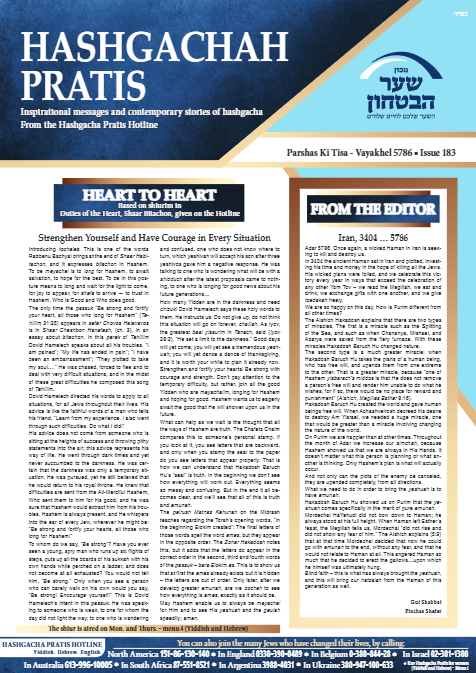
Introducing tocheles. This is one of the words Rabbenu Bachyai brings at the end of Shaar Habitachon, and it expresses bitachon in Hashem. To be meyachel is to long for Hashem, to await salvation, to hope for the best. To be in this posture means to long and wait for the light to come, for joy to appear, for shefa to arrive — to trust in Hashem, Who is Good and Who does good.

The only time the passuk “Be strong and fortify your heart, all those who long for Hashem” (Tehillim 31:25) appears in sefer Chovos Halevavos is in Shaar Cheshbon Hanefesh, (ch. 3), in an essay about bitachon. In this perek of Tehillim Dovid Hamelech speaks about all his troubles. “I am pained”; “My life has ended in pain”; “I have been an embarrassment”; “They plotted to take my soul....” He was chased, forced to flee and to deal with very difficult situations, and in the midst of these great difficulties he composed this song of Tehillim.

Dovid Hamelech directed his words to apply to all situations, for all Jews throughout their lives. His advice is like the faithful words of a man who tells his friend, “Learn from my experience. I also went through such difficulties. Do what I did!”

His advice does not come from someone who is sitting at the heights of success and throwing pithy statements into the air; this advice represents his way of life. He went through dark times and yet never succumbed to the darkness. He was certain that the darkness was only a temporary situation. He was pursued, yet he still believed that he would return to his royal throne. He knew that difficulties are sent from the All-Merciful Hashem, Who sent them to him for his good, and he was sure that Hashem would extract him from his troubles. Hashem is always present, and He whispers into the ear of every Jew, wherever he might be: “Be strong and fortify your hearts, all those who long for Hashem!”

To whom do we say, “Be strong”? Have you ever seen a young, spry man who runs up six flights of steps, puts up all the boards of his sukkah with his own hands while perched on a ladder, and does not become at all exhausted? You would not tell him, “Be strong.” Only when you see a person who can barely walk on his own would you say, “Be strong! Encourage yourself!” This is Dovid Hamelech’s intent in this passuk. He was speaking to someone who is weak, to one for whom the day did not light the way, to one who is wandering and confused, one who does not know where to turn, which yeshivah will accept his son after three yeshivos gave him a negative response. He was talking to one who is wondering what will be with a shidduch after the latest proposals came to nothing, to one who is longing for good news about his future generations...

How many Yidden are in the darkness and need chizuk! Dovid Hamelech says these holy words to them. He instructs us: Do not give up, do not think this situation will go on forever, chalilah. As Iyov, the greatest baal yissurim in Tanach, said (Iyov 28:3), “He set a limit to the darkness.” Good days will yet come; you will yet see a tremendous yeshuah; you will yet dance a dance of thanksgiving, and it is worth your while to plan it already now. Strengthen and fortify your hearts! Be strong with courage and strength. Don’t pay attention to the temporary difficulty, but rather, join all the good Yidden who are meyachalim, longing for Hashem and hoping for good. Hashem wants us to eagerly await the good that He will shower upon us in the future.

What can help as we wait is the thought that all the ways of Hashem are truth. The Chafetz Chaim compares this to someone’s personal stamp. If you look at it, you see letters that are backward, and only when you stamp the seal to the paper do you see letters that appear properly. That is how we can understand that Hakadosh Baruch Hu’s “seal” is truth. In the beginning we don’t see how everything will work out. Everything seems so messy and confusing. But in the end it all becomes clear, and we’ll see that all of this is truth and emunah.

The peirush Matnas Kehunah on the Midrash teaches regarding the Torah’s opening words, “In the beginning Elokim created”: The final letters of those words spell the word emes, but they appear in the opposite order. The Zohar Hakadosh notes this, but it adds that the letters do appear in the correct order in the second, third and fourth words of the passuk – bara Elokim es. This is to show us that at first the emes already exists but it is hidden – the letters are out of order. Only later, after we develop greater emunah, are we zocheh to see how everything is emes, exactly as it should be.

May Hashem enable us to always be meyachel for Him and to see His yeshuah and the geulah speedily; amen.

PDF Preview