He Who Created a Day Created the Sustenance for It
Hashgacha Pratis | September 13, 2024
Print This Article
View Original PDF

He Who Created a Day Created the Sustenance for It

Hashgacha Pratis | June 27, 2025

People like to say with longing, “It used to be good”; “We used to be happy.” We relate to the past as though the people who lived then did not make mistakes and did not suffer. They just sat near the burning fireplace in winter and sang songs. In truth, many people who lived long ago did this as well, but there were many other aspects to their lives. For example, each day they saved food for the next day.

The financial situation used to be very tight. Food was so scarce that having bitachon that Hashem would provide for us tomorrow was considered a very high madreigah of bitachon.

When a person bought bread, he would save it for the next three days. And then they would eat the old bread they’d purchased three days earlier. Who ate fresh bread? The fresh bread was saved for the next day, for who knew if there would be bread then? If food was still edible, we ate it, and we ate sparingly, so that there would be something left of it.

Thanks to Hashem, nowadays one can anticipate that Yidden – not only very great tzaddikim — will trust in Hashem to send them food for tomorrow. May Hashem’s Name be blessed – there is plenty of food. There are hundreds of flavors and types of food available to everyone, and every person can find what suits his palate. Trucks unload tons of food products every day, and the question is not whether there will be food, but rather how the food will get to us.

What is it that concerns us? Money. People worry about whether their money will all be spent and at some point they won’t be able to buy food. Here is where we need to strengthen ourselves in bitachon, until we reach the seventh level of bitachon, as Rabbenu Bachyai wrote at the end of the fifth chapter:

He who trusts in Hashem will not hoard. The word he uses comes from the root word otzar, meaning treasure. A person safeguards in his treasure house that which he has in order to use it in the future. A person who learns bitachon, however, will enjoy what he has at home today. He bought a new outfit for a wedding, and he continues using it for Shabbos and Yamim Tovim. What will he wear for the next wedding? His good Father will take care of it. He sent him his needs today so that he would enjoy them, and He will also send him his needs in the future so that he will enjoy them then as well.

If you were ever near a waterfall, you know that the sight is simply amazing: The waters flow and flow, and the shefa continues constantly, without stopping! This is how the Divine shefa works, and more. The Creator of the world is mashpia all the time, and if so, what do we have to worry about? If you have money to buy a certain product, and you come to the store and see that it’s on sale – “Buy three of these for a lower price each.” If you have enough money at the moment, then maybe your should buy three; but if you have only enough money to buy one, don’t feel bad. Enjoy the one that you needed right now, and be sure that the good King Who does good will provide for you in the future as well! Parnassah is not something that can be measured in terms of dollars and cents. The main thing is that you have what you require now.

The passuk In Parshas Hamann states: “The nation will go out to collect each day’s portion on that day.” Rabi Elazar Hamoda’i asks: Why is there a need to emphasize that they took “each day’s portion on that day”? The Torah tells us clearly that the mann rained down each day and that Bnei Yisrael collected it and brought it into their homes!

His answer should be highlighted and posted on a sign for all to see: “He Who created a day, created the sustenance for it!”

Is there anyone in the world who goes to sleep at night agitated because he doesn’t know whether the sun will rise the next morning? There is no such thing. Billions of people who live in this world are sure that the sun will rise at the time that is listed on the calendar. Why are they so sure of this? Who says there won’t be some fluke in the sun’s pathway?

The answer is that it states clearly in Parshas Noach, “[The cycles of] day and night will not cease.” Regarding day and night, we have no personal experience on which to base our trust that this cycle will not halt, but regarding parnassah – we have experience. The difference is not in Hakadosh Baruch Hu’s ability to provide for all our needs; rather, the difference is in our own emunah. We need to aspire to develop a strong emunah and clear bitachon in Hashem, that He will provide for all our needs, and we need to be as sure of this as we are sure that the sun will rise.

This is a joyous life, a life of peace and serenity, without any worries about the future. May we merit to be written and sealed in the book of parnassah and mercy, life, peace, and all that is good; amen.
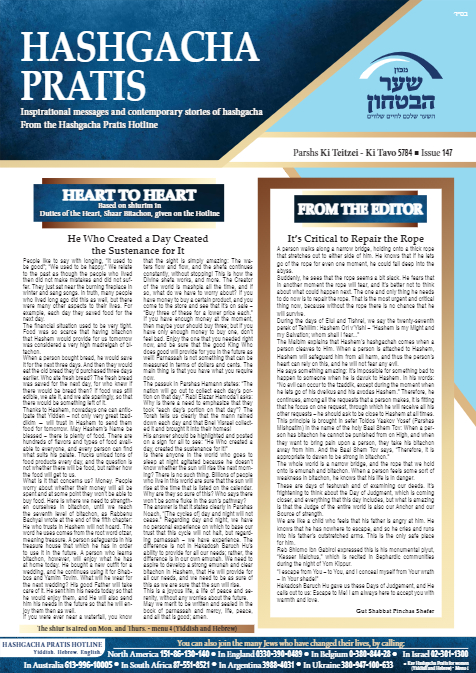
People like to say with longing, “It used to be good”; “We used to be happy.” We relate to the past as though the people who lived then did not make mistakes and did not suffer. They just sat near the burning fireplace in winter and sang songs. In truth, many people who lived long ago did this as well, but there were many other aspects to their lives. For example, each day they saved food for the next day.

The financial situation used to be very tight. Food was so scarce that having bitachon that Hashem would provide for us tomorrow was considered a very high madreigah of bitachon.

When a person bought bread, he would save it for the next three days. And then they would eat the old bread they’d purchased three days earlier. Who ate fresh bread? The fresh bread was saved for the next day, for who knew if there would be bread then? If food was still edible, we ate it, and we ate sparingly, so that there would be something left of it.

Thanks to Hashem, nowadays one can anticipate that Yidden – not only very great tzaddikim — will trust in Hashem to send them food for tomorrow. May Hashem’s Name be blessed – there is plenty of food. There are hundreds of flavors and types of food available to everyone, and every person can find what suits his palate. Trucks unload tons of food products every day, and the question is not whether there will be food, but rather how the food will get to us.

What is it that concerns us? Money. People worry about whether their money will all be spent and at some point they won’t be able to buy food. Here is where we need to strengthen ourselves in bitachon, until we reach the seventh level of bitachon, as Rabbenu Bachyai wrote at the end of the fifth chapter:

He who trusts in Hashem will not hoard. The word he uses comes from the root word otzar, meaning treasure. A person safeguards in his treasure house that which he has in order to use it in the future. A person who learns bitachon, however, will enjoy what he has at home today. He bought a new outfit for a wedding, and he continues using it for Shabbos and Yamim Tovim. What will he wear for the next wedding? His good Father will take care of it. He sent him his needs today so that he would enjoy them, and He will also send him his needs in the future so that he will enjoy them then as well.

If you were ever near a waterfall, you know that the sight is simply amazing: The waters flow and flow, and the shefa continues constantly, without stopping! This is how the Divine shefa works, and more. The Creator of the world is mashpia all the time, and if so, what do we have to worry about? If you have money to buy a certain product, and you come to the store and see that it’s on sale – “Buy three of these for a lower price each.” If you have enough money at the moment, then maybe your should buy three; but if you have only enough money to buy one, don’t feel bad. Enjoy the one that you needed right now, and be sure that the good King Who does good will provide for you in the future as well! Parnassah is not something that can be measured in terms of dollars and cents. The main thing is that you have what you require now.

The passuk In Parshas Hamann states: “The nation will go out to collect each day’s portion on that day.” Rabi Elazar Hamoda’i asks: Why is there a need to emphasize that they took “each day’s portion on that day”? The Torah tells us clearly that the mann rained down each day and that Bnei Yisrael collected it and brought it into their homes!

His answer should be highlighted and posted on a sign for all to see: “He Who created a day, created the sustenance for it!”

Is there anyone in the world who goes to sleep at night agitated because he doesn’t know whether the sun will rise the next morning? There is no such thing. Billions of people who live in this world are sure that the sun will rise at the time that is listed on the calendar. Why are they so sure of this? Who says there won’t be some fluke in the sun’s pathway?

The answer is that it states clearly in Parshas Noach, “[The cycles of] day and night will not cease.” Regarding day and night, we have no personal experience on which to base our trust that this cycle will not halt, but regarding parnassah – we have experience. The difference is not in Hakadosh Baruch Hu’s ability to provide for all our needs; rather, the difference is in our own emunah. We need to aspire to develop a strong emunah and clear bitachon in Hashem, that He will provide for all our needs, and we need to be as sure of this as we are sure that the sun will rise.

This is a joyous life, a life of peace and serenity, without any worries about the future. May we merit to be written and sealed in the book of parnassah and mercy, life, peace, and all that is good; amen.

PDF Preview