Understanding the Parsha according to the Rebbe
Ben Chamesh L'Mikra | August 20, 2023
Print This Article
View Original PDF

Understanding the Parsha according to the Rebbe

Ben Chamesh L'Mikra | December 31, 2025

QUESTION: What is the Chassidic understanding of the first verse in this Parsha regarding the purpose of the soul’s descent into this world?

ANSWER: The purpose of the soul is not to destroy the body, but to subdue and rectify it to service of G-d. Thus, according to Chassidus, one would “translate” as follows:

  • “Go out to war” Soul has to battle, not to destroy but to refine
  • “Your enemies” one’s body and animal soul
  • “G-d will deliver them into your hands” assist you to prevail (when one makes the effort to battle)
  • “Capture one’s captives” the sparks inherent in physical matter will be transformed by the soul’s efforts

(384, עמ'בלקוטי שיחות כרך)

QUESTION: Within the allusion that the HaShem and the Jewish people are married, how can one speak of separation from HaShem?

ANSWER: A Get (divorce document) is principally a matter of separation (כריתות), but also contains the concept of unity (ספר), revealing the essence of the prior connection that exists. Thus, the appearance of separation between HaShem and the Jewish people provides an opportunity for a greater connection that can result from the subsequent Teshuvah of the Jews. (143 'עמ ,טלקוטי שיחות כרך)

QUESTION: How do we reconcile the mitzvah to wipe out the memory of Amalek, yet we must also remember what Amalek did to us in the desert?

ANSWER: The two directives do not contradict each other. We do have a mitzvah to wipe out all items in the world which carry forth the name of Amalek (people, animals, etc.). However, one must remember the deeds of Amalek so we can use that knowledge to grow in our service to HaShem. In terms of our avodah, the concept of Amalek is “coldness”. Thus, we need to remove all the places that this “coldness” can take hold. Using Kabolas Ol, we use this experience to grow. (86 , עמ'ד י לקוטי שיחות כרך)

QUESTION: Why is there a difference between issur of Shatnez (which is permitted in the Mikdash and in Tzitzis) and the other prohibited mixtures (which are never permitted)?

ANSWER: Forbidden to mix together different groups of animals or growth of the ground since such a mixture attempts to cross the boundaries established by G-d. Whereas, the mixture of wool and linen (Shatnez) does not change the essence of each item, which remains as is. (122, עמ' טכלקוטי שיחות כרך)

QUESTION: What are the three explanations of how one makes Shatnez and how to understand each concept?

  • Rashi: Need all 3 activities of combing, spinning and weaving. One category of joining 2 entities to become a new single entity (totally mixed). Similar to the vineyard.
  • Rabeinu Tam: Issur only if woven together as one (regardless if combed or spun). Each item not mixed in its essence. External combination – similar to plowing.
  • Rambam: Any one of 3 actions: Combed or spun or woven. Even if not combined into one entity. Intermediate comparison: similar to mixing species; requires joining but not to the extent of becoming one entity.
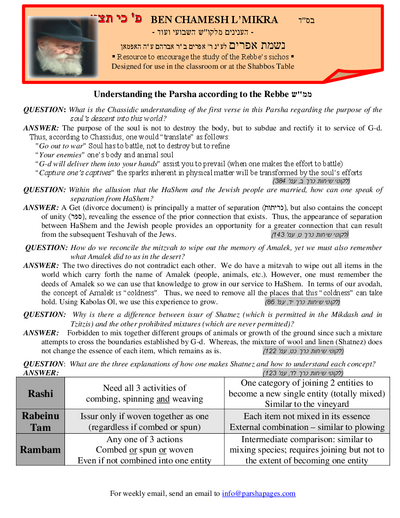
QUESTION: What is the Chassidic understanding of the first verse in this Parsha regarding the purpose of the soul’s descent into this world?

ANSWER: The purpose of the soul is not to destroy the body, but to subdue and rectify it to service of G-d. Thus, according to Chassidus, one would “translate” as follows:

  • “Go out to war” Soul has to battle, not to destroy but to refine
  • “Your enemies” one’s body and animal soul
  • “G-d will deliver them into your hands” assist you to prevail (when one makes the effort to battle)
  • “Capture one’s captives” the sparks inherent in physical matter will be transformed by the soul’s efforts

(384, עמ'בלקוטי שיחות כרך)

QUESTION: Within the allusion that the HaShem and the Jewish people are married, how can one speak of separation from HaShem?

ANSWER: A Get (divorce document) is principally a matter of separation (כריתות), but also contains the concept of unity (ספר), revealing the essence of the prior connection that exists. Thus, the appearance of separation between HaShem and the Jewish people provides an opportunity for a greater connection that can result from the subsequent Teshuvah of the Jews. (143 'עמ ,טלקוטי שיחות כרך)

QUESTION: How do we reconcile the mitzvah to wipe out the memory of Amalek, yet we must also remember what Amalek did to us in the desert?

ANSWER: The two directives do not contradict each other. We do have a mitzvah to wipe out all items in the world which carry forth the name of Amalek (people, animals, etc.). However, one must remember the deeds of Amalek so we can use that knowledge to grow in our service to HaShem. In terms of our avodah, the concept of Amalek is “coldness”. Thus, we need to remove all the places that this “coldness” can take hold. Using Kabolas Ol, we use this experience to grow. (86 , עמ'ד י לקוטי שיחות כרך)

QUESTION: Why is there a difference between issur of Shatnez (which is permitted in the Mikdash and in Tzitzis) and the other prohibited mixtures (which are never permitted)?

ANSWER: Forbidden to mix together different groups of animals or growth of the ground since such a mixture attempts to cross the boundaries established by G-d. Whereas, the mixture of wool and linen (Shatnez) does not change the essence of each item, which remains as is. (122, עמ' טכלקוטי שיחות כרך)

QUESTION: What are the three explanations of how one makes Shatnez and how to understand each concept?

  • Rashi: Need all 3 activities of combing, spinning and weaving. One category of joining 2 entities to become a new single entity (totally mixed). Similar to the vineyard.
  • Rabeinu Tam: Issur only if woven together as one (regardless if combed or spun). Each item not mixed in its essence. External combination – similar to plowing.
  • Rambam: Any one of 3 actions: Combed or spun or woven. Even if not combined into one entity. Intermediate comparison: similar to mixing species; requires joining but not to the extent of becoming one entity.
PDF Preview