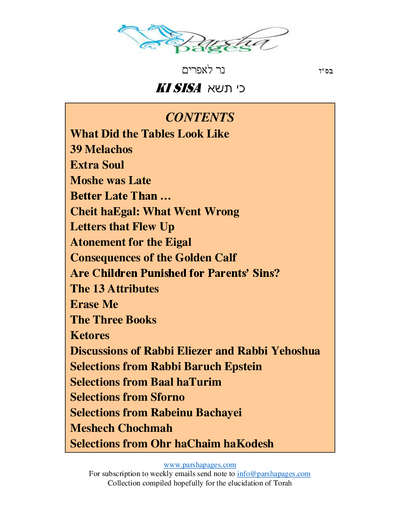
Cheit haEgal What Went Wrong
Parsha Pages | February 25, 2024
Print This Article
View Original PDF

Cheit haEgal What Went Wrong

Parsha Pages | December 10, 2025

I. Was the Cheit Ha'Egel Actual Idol Worship?

  1. Reading the pesukim on a superficial level would lead one to the conclusion that the Jewish people want a new elohim to guide them through the desert. Aharon made for them an egel and they declared it to be אלהיך ישראל אשר העלוך מארץ מצרים . (Shmos 32:1-5)
  2. The Gemara (Sanhedrin 63a) quotes a beraisa that presents two basic approaches to what happened:
    1. The first opinion is that העלוך implies that they believed in two entities. They never denied HaShem, but they were משתף שם שמים ודבר אחר.
    2. R. Shimon bar Yochai states that avodah zarah b'shituf would hardly be a justification for their action. Rather, the reason why it was written in the plural is because they desired to worship multiple idols- אלהות הרבה איוו להם
  3. This discussion carries over to a halachic discussion about avoda zarah. The Gemara (Avodah Zara 53b) is discussing a case of an item that a Jew was intending to worship, and a non-Jew came and worshipped it instead. Is the item prohibited? The Gemara compares it to the original asheiros of Eretz Yisrael. Assuming that the Jewish people owned Eretz Yisrael from the time of Avraham Avinu, how did the Kna’anim invalidate the asheira trees? When the Jews worshipped the egel, they indicated that they are interested in avodah zarah and therefore, even if the non-Jews in Eretz Yisrael didn't own the asheira trees, they worshipped them as representatives of the Jewish people who expressed interest in avodah zarah at the time of the egel. The Gemara asks: how do we know that they were interested in worshipping asheira trees? Maybe they were only interested in worshipping the egel! The Gemara answers that אלה אלהיך ישראל implies that they embraced all forms of avodah zarah- אלהות הרבה איוו להם .

II. Approaches of the Meforshim

  1. Rashi (1040-1105) offers a number of insights:
    1. There was a mix-up in terms of the number of days the people thought Moshe would be on Har Sinai
    2. Rashi follows the approach that אלהות הרבה איוו להם .
    3. Rashi notes that Aharon tried to stall the people by asking the women for their jewelry.
    4. Rashi notes that the magicians of the erev rav turned the gold into a calf.
    5. When the pasuk says לך רד כי שחת עמך, Rashi writes that it is specifically referencing the erev rav.
  2. R. Avraham ibn Ezra (1089-1167) writes that it cannot be that Aharon would have allowed the people to worship avodah zarah. Rather, the people thought that Moshe Rabbeinu had died, and they wanted something to replace him. They never meant to worship avodah zarah, just to replace Moshe Rabbeinu. The erev rav used this as an opportunity to worship avodah zarah, but the rest of the people did not. Aharon was not punished because he did anything wrong but because his actions led to avodah zarah.
  3. R. Yehuda HaLevi (1075-1141) follows a similar approach to Ibn Ezra. He writes that we cannot comprehend the idea of an item serving as a replacement for Moshe. However, we can relate to a building as a medium to relating to HaShem. The egel was the equivalent that building. Klal Yisrael without Moshe needed a medium to relate to HaShem, so they asked Aharon to build them a tzura that can serve as that medium. (HaKuzari 1:97)
  4. R. Yitzchak Abarbanel (1437-1508), after noting the ibn Ezra and R. Yehuda HaLevi likely discussed this approach together, adds that in place of Moshe, the people thought they could fill the void with a talisman that would predict the future and guide them through the desert with אותות ומופת ים .
  5. Ramban (1194-1270) follows a similar approach and suggests that Aharon's claim was that they never asked for avodah zarah. They only asked for an item that can serve as their leader. Aharon tried to stall them and channel them towards avodas HaShem. When Chazal state איוו אלהות הרבה, it wasn't for actual avoda zarah. They were trying to figure out what can be used to replace Moshe.
  6. R. Levi ben Gershon (Ralbag 1288-1344) charts Aharon's process in stalling the people so that by the time the egel would be formed, Moshe would have returned. That's why he asked for jewelry from the women, why he formed the gold instead of molding it, and why he had them offer korbanos.
  7. R. Ephraim Lunchitz (Kli Yakar 1550-1619) follows the approach that the whole cheit ha'egel episode was the doing of the erev rav. He notes that העם in the first verse refers specifically the erev rav. Additionally, אלו אלהיך ישראל is the erev rav talking to the Bnei Yisrael.
  8. R. Yaakov Mecklenburg (HaKsav VaKaballah 1785-1865) puts together the approaches of Ibn Ezra, R. Yehuda HaLevi, Ramban and Kli Yakar. He suggests that the erev rav did not yet convert and they had the status of non-Jews. Non-Jews are permitted to worship avodah zarah b'shituf and therefore, Aharon had no problem making for them a tzura that was intended to be a replacement for Moshe. He further suggests that the even if it was actual avoda zarah, there was no issue at that point in history because it was at a time when the Torah was given and the seven mitzvos of Bnei Noach were in flux.
  9. R. Shamshon R. Hirsch (1808-1888) follows in the footsteps of Ramban in explaining that the goal of the egel was not to replace HaShem but to replace Moshe. Their failure was not in a violation of the prohibition in the Aseres HaDibros but in their violation of לא תעשון אתי אלהי כסף ואלהי זהב, which is a prohibition against using props as a medium for connecting to HaShem. They were so convinced that this object could replace Moshe that they declared that it was this object that took them out of Egypt. When Chazal said that they were משתף שם שמים עם דבר אחר, they were identifying the use of an intermediary to connect with HaShem.
  10. Netziv (1816-1893) writes that there were people among the nation who couldn't imagine living a life that was not part of the natural order. They didn't want to leave Egypt and only did so knowing that Moshe would lead them through this unusual experience. When they thought Moshe died, they assumed that this unusual hashgacha would cease and that there would be no way to survive in the desert. This crisis led to the cheit ha'egel, which included those actually worshipped avoda zarah.
    1. They then asked Aharon to make a tzura. This was before they received the prohibition against לא תעשון אתי אלהי כסף, and therefore, even Aharon didn't know that such a prohibition existed. They thought that creating a tzura and using it as an intermediary to make requests from HaShem is no different than asking a malach for rachamim.
    2. While the creation of the egel may have been out of ignorance, it got out of hand when people started to worship the egel as actual avoda zarah. At that point, Aharon should have stopped it, but he made the following calculation: the egel was preventing most people from actually worshipping avoda zarah but at the same time was causing others to worship avoda zarah. Aharon therefore, made the conscious decision to take one for the team and as a result, he was rewarded for saving the people who didn't worship and was punished for those who did.
I. Was the Cheit Ha'Egel Actual Idol Worship?

  1. Reading the pesukim on a superficial level would lead one to the conclusion that the Jewish people want a new elohim to guide them through the desert. Aharon made for them an egel and they declared it to be אלהיך ישראל אשר העלוך מארץ מצרים . (Shmos 32:1-5)
  2. The Gemara (Sanhedrin 63a) quotes a beraisa that presents two basic approaches to what happened:
    1. The first opinion is that העלוך implies that they believed in two entities. They never denied HaShem, but they were משתף שם שמים ודבר אחר.
    2. R. Shimon bar Yochai states that avodah zarah b'shituf would hardly be a justification for their action. Rather, the reason why it was written in the plural is because they desired to worship multiple idols- אלהות הרבה איוו להם
  3. This discussion carries over to a halachic discussion about avoda zarah. The Gemara (Avodah Zara 53b) is discussing a case of an item that a Jew was intending to worship, and a non-Jew came and worshipped it instead. Is the item prohibited? The Gemara compares it to the original asheiros of Eretz Yisrael. Assuming that the Jewish people owned Eretz Yisrael from the time of Avraham Avinu, how did the Kna’anim invalidate the asheira trees? When the Jews worshipped the egel, they indicated that they are interested in avodah zarah and therefore, even if the non-Jews in Eretz Yisrael didn't own the asheira trees, they worshipped them as representatives of the Jewish people who expressed interest in avodah zarah at the time of the egel. The Gemara asks: how do we know that they were interested in worshipping asheira trees? Maybe they were only interested in worshipping the egel! The Gemara answers that אלה אלהיך ישראל implies that they embraced all forms of avodah zarah- אלהות הרבה איוו להם .

II. Approaches of the Meforshim

  1. Rashi (1040-1105) offers a number of insights:
    1. There was a mix-up in terms of the number of days the people thought Moshe would be on Har Sinai
    2. Rashi follows the approach that אלהות הרבה איוו להם .
    3. Rashi notes that Aharon tried to stall the people by asking the women for their jewelry.
    4. Rashi notes that the magicians of the erev rav turned the gold into a calf.
    5. When the pasuk says לך רד כי שחת עמך, Rashi writes that it is specifically referencing the erev rav.
  2. R. Avraham ibn Ezra (1089-1167) writes that it cannot be that Aharon would have allowed the people to worship avodah zarah. Rather, the people thought that Moshe Rabbeinu had died, and they wanted something to replace him. They never meant to worship avodah zarah, just to replace Moshe Rabbeinu. The erev rav used this as an opportunity to worship avodah zarah, but the rest of the people did not. Aharon was not punished because he did anything wrong but because his actions led to avodah zarah.
  3. R. Yehuda HaLevi (1075-1141) follows a similar approach to Ibn Ezra. He writes that we cannot comprehend the idea of an item serving as a replacement for Moshe. However, we can relate to a building as a medium to relating to HaShem. The egel was the equivalent that building. Klal Yisrael without Moshe needed a medium to relate to HaShem, so they asked Aharon to build them a tzura that can serve as that medium. (HaKuzari 1:97)
  4. R. Yitzchak Abarbanel (1437-1508), after noting the ibn Ezra and R. Yehuda HaLevi likely discussed this approach together, adds that in place of Moshe, the people thought they could fill the void with a talisman that would predict the future and guide them through the desert with אותות ומופת ים .
  5. Ramban (1194-1270) follows a similar approach and suggests that Aharon's claim was that they never asked for avodah zarah. They only asked for an item that can serve as their leader. Aharon tried to stall them and channel them towards avodas HaShem. When Chazal state איוו אלהות הרבה, it wasn't for actual avoda zarah. They were trying to figure out what can be used to replace Moshe.
  6. R. Levi ben Gershon (Ralbag 1288-1344) charts Aharon's process in stalling the people so that by the time the egel would be formed, Moshe would have returned. That's why he asked for jewelry from the women, why he formed the gold instead of molding it, and why he had them offer korbanos.
  7. R. Ephraim Lunchitz (Kli Yakar 1550-1619) follows the approach that the whole cheit ha'egel episode was the doing of the erev rav. He notes that העם in the first verse refers specifically the erev rav. Additionally, אלו אלהיך ישראל is the erev rav talking to the Bnei Yisrael.
  8. R. Yaakov Mecklenburg (HaKsav VaKaballah 1785-1865) puts together the approaches of Ibn Ezra, R. Yehuda HaLevi, Ramban and Kli Yakar. He suggests that the erev rav did not yet convert and they had the status of non-Jews. Non-Jews are permitted to worship avodah zarah b'shituf and therefore, Aharon had no problem making for them a tzura that was intended to be a replacement for Moshe. He further suggests that the even if it was actual avoda zarah, there was no issue at that point in history because it was at a time when the Torah was given and the seven mitzvos of Bnei Noach were in flux.
  9. R. Shamshon R. Hirsch (1808-1888) follows in the footsteps of Ramban in explaining that the goal of the egel was not to replace HaShem but to replace Moshe. Their failure was not in a violation of the prohibition in the Aseres HaDibros but in their violation of לא תעשון אתי אלהי כסף ואלהי זהב, which is a prohibition against using props as a medium for connecting to HaShem. They were so convinced that this object could replace Moshe that they declared that it was this object that took them out of Egypt. When Chazal said that they were משתף שם שמים עם דבר אחר, they were identifying the use of an intermediary to connect with HaShem.
  10. Netziv (1816-1893) writes that there were people among the nation who couldn't imagine living a life that was not part of the natural order. They didn't want to leave Egypt and only did so knowing that Moshe would lead them through this unusual experience. When they thought Moshe died, they assumed that this unusual hashgacha would cease and that there would be no way to survive in the desert. This crisis led to the cheit ha'egel, which included those actually worshipped avoda zarah.
    1. They then asked Aharon to make a tzura. This was before they received the prohibition against לא תעשון אתי אלהי כסף, and therefore, even Aharon didn't know that such a prohibition existed. They thought that creating a tzura and using it as an intermediary to make requests from HaShem is no different than asking a malach for rachamim.
    2. While the creation of the egel may have been out of ignorance, it got out of hand when people started to worship the egel as actual avoda zarah. At that point, Aharon should have stopped it, but he made the following calculation: the egel was preventing most people from actually worshipping avoda zarah but at the same time was causing others to worship avoda zarah. Aharon therefore, made the conscious decision to take one for the team and as a result, he was rewarded for saving the people who didn't worship and was punished for those who did.
PDF Preview