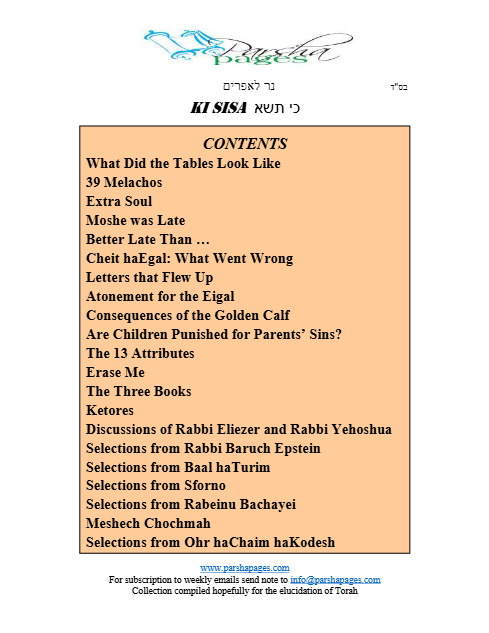
Consequences of the Golden Calf
Parsha Pages | March 12, 2025
Print This Article
View Original PDF

Consequences of the Golden Calf

Parsha Pages | June 27, 2025

Moshe Removes His Tent From the Encampment

שמות פרק לג ז וּמשֶה יִּקַח אֶת-הָאֹהֶל וְׁנָטָה-לוֹ מִּחוּץ לַמַחֲנֶה הַרְׁ חֵּק מִּן -הַמַחֲנֶה וְׁקָרָא לוֹ אֹהֶל מוֹעֵּד וְׁהָיָה כָל -מְׁבַקֵּש ה' יֵּצֵּא אֶל-אֹהֶל מוֹעֵּד אֲשֶר מִּחוּץ לַמַחֲנֶה :

The sin of the Calf resulted in the removal of the tent of Moshe from the encampment of the Jews to a distance of techum Shabbos, 2000 amos. (Rashi)

Principal: מנודה לרב מנודה לתלמיד One who is banished from the teacher is banished from the student. The Jews were banished from HaShem’s presence since He said He would not be among them. Thus, Moshe, the student, also removed his tent from among them, since they were banished. (Rashi)

Moshe’s tent did not return until the Mishkan was put up, indicating HaShem’s return to the Jews and the end of the banishment. And Moshe called his tent “Ohel Moed”.

At first it was simply called “tent.” Now it would be called “Meeting Tent” or “Festival Tent”, since Moshe’s tent had additional holiness, since now he met with HaShem there.

Some say being called the Ohel Moed was a bad sign. Prior to the sin of the Calf, it was simply called the tent. It did not have a set time that it would exist forever. But now that the Jews sinned, it was called the Ohel Moed, which can translated to mean the “temporary tent”, that was no longer destined to last forever.

Moshe moved his tent two thousand amos, the limit of techum, the maximum area one may travel outside residential area on Shabbos. Even though he could no longer be in the middle of the Jews, Moshe’s responsibility remained to provide leadership, decision making, and judgment for his people, thus, he had to stay in proximity to the Jews.

The Gemara (Eruvin 55b and Sanhedrin 5b) states the law that a disciple must be at least three parsaos away from his teacher in order for the students to teach halachos, as derived from this verse. Rashi explains that this was the furthest a person would need to travel from one end of the encampment to visit Moshe for judgment. The Aruch Leneir explains that this did not occur when Moshe’s tent was in the middle of the Jewish encampment (when the furthest a person would travel would only be 1 ½ parsaos). Rather, it refers to the period that Moshe’s tent was outside the encampment when the furthest travel across the encampment was 12 mil.

1) Which tent did Moshe move? Where did he move it to?

  1. Rashi and Targum Yonasan: He moved his own tent to a distance of two thousand Amos (one Mil) outside the camp. Targum Yonasan adds that Moshe took the crowns and concealed them in his tent (See Na'ar Yonasan).
  2. Da'as Zekenim, Hadar Zekenim: 'Ohel' is the crowns removed from Bnei Yisrael. Moshe received them (Shabbos 88a). From this, his face radiated. Some say that Ohel is an expression of light, like "b'Hilo" (Iyov 29:3).

2) Why did Moshe move his tent outside Machaneh Yisrael?

  1. Rashi and Rashbam: Because he held 'Menudeh le'Rav, Menudeh le'Talmid' (If Yisrael are excommunicated from Hashem, then they are also excommunicated from Moshe. Because Hashem did not want to speak with Moshe in the Camp of Yisrael
  2. Hadar Zekenim, citing R. Yosef Karo: The 40 days that he prayed for Yisrael, he was there. He did not ascend until Rosh Chodesh Elul, to get the second Luchos.
  3. Sanheedrin, 110a: The people all warned their wives (Sotah) against Moshe, so Moshe moved his tent outside the camp to shake off the suspicion. Based on the Pasuk in Tehilim, 106:16 Vauekan'u le Moshe ba'Machaneh. See Torah Temimah, note 3.

3) Why did he call it 'Ohel Mo'ed'?

  1. Rashi and Targum Onkelos: Because it was the meeting-place for whoever wanted to study Torah.
  2. Seforno: Because that is where Hashem met with Moshe - and not in Machaneh Yisrael.
  3. Targum Yonasan: Whoever sinned and did Teshuvah wholeheartedly, would make his way there, confess his sin and pray to HaShem, and his sin would be forgiven.

4) Seeing as the people wanted Moshe, why does the Torah write "Mevakesh Hashem"?

  1. Rashi: To teach us that seeking the presence of a Talmid-Chacham is akin to seeking the presence of Hashem.
  2. Targum Onkelos: Because it is referring to people who came to seek teaching from Hashem (whose Shali'ach Moshe was).
  3. Targum Yonasan: Because it is referring to the people who did Teshuvah on their sins, and who came to confess their sins and to Daven to Hashem.
  4. Oznayim la'Torah: This hints at the Midrash that, from the time that Moshe broke the Luchos, One will only be able to learn Torah with difficulty, with suffering and moving from one place to another. See Oznayim la'Torah.

One Parsah = 4 mil
One Mil = 2000 amos
3 Parsaos = 12 mil =24000 amos
Estimated 6.8 to 9 miles
Moshe Removes His Tent From the Encampment

שמות פרק לג ז וּמשֶה יִּקַח אֶת-הָאֹהֶל וְׁנָטָה-לוֹ מִּחוּץ לַמַחֲנֶה הַרְׁ חֵּק מִּן -הַמַחֲנֶה וְׁקָרָא לוֹ אֹהֶל מוֹעֵּד וְׁהָיָה כָל -מְׁבַקֵּש ה' יֵּצֵּא אֶל-אֹהֶל מוֹעֵּד אֲשֶר מִּחוּץ לַמַחֲנֶה :

The sin of the Calf resulted in the removal of the tent of Moshe from the encampment of the Jews to a distance of techum Shabbos, 2000 amos. (Rashi)

Principal: מנודה לרב מנודה לתלמיד One who is banished from the teacher is banished from the student. The Jews were banished from HaShem’s presence since He said He would not be among them. Thus, Moshe, the student, also removed his tent from among them, since they were banished. (Rashi)

Moshe’s tent did not return until the Mishkan was put up, indicating HaShem’s return to the Jews and the end of the banishment. And Moshe called his tent “Ohel Moed”.

At first it was simply called “tent.” Now it would be called “Meeting Tent” or “Festival Tent”, since Moshe’s tent had additional holiness, since now he met with HaShem there.

Some say being called the Ohel Moed was a bad sign. Prior to the sin of the Calf, it was simply called the tent. It did not have a set time that it would exist forever. But now that the Jews sinned, it was called the Ohel Moed, which can translated to mean the “temporary tent”, that was no longer destined to last forever.

Moshe moved his tent two thousand amos, the limit of techum, the maximum area one may travel outside residential area on Shabbos. Even though he could no longer be in the middle of the Jews, Moshe’s responsibility remained to provide leadership, decision making, and judgment for his people, thus, he had to stay in proximity to the Jews.

The Gemara (Eruvin 55b and Sanhedrin 5b) states the law that a disciple must be at least three parsaos away from his teacher in order for the students to teach halachos, as derived from this verse. Rashi explains that this was the furthest a person would need to travel from one end of the encampment to visit Moshe for judgment. The Aruch Leneir explains that this did not occur when Moshe’s tent was in the middle of the Jewish encampment (when the furthest a person would travel would only be 1 ½ parsaos). Rather, it refers to the period that Moshe’s tent was outside the encampment when the furthest travel across the encampment was 12 mil.

1) Which tent did Moshe move? Where did he move it to?

  1. Rashi and Targum Yonasan: He moved his own tent to a distance of two thousand Amos (one Mil) outside the camp. Targum Yonasan adds that Moshe took the crowns and concealed them in his tent (See Na'ar Yonasan).
  2. Da'as Zekenim, Hadar Zekenim: 'Ohel' is the crowns removed from Bnei Yisrael. Moshe received them (Shabbos 88a). From this, his face radiated. Some say that Ohel is an expression of light, like "b'Hilo" (Iyov 29:3).

2) Why did Moshe move his tent outside Machaneh Yisrael?

  1. Rashi and Rashbam: Because he held 'Menudeh le'Rav, Menudeh le'Talmid' (If Yisrael are excommunicated from Hashem, then they are also excommunicated from Moshe. Because Hashem did not want to speak with Moshe in the Camp of Yisrael
  2. Hadar Zekenim, citing R. Yosef Karo: The 40 days that he prayed for Yisrael, he was there. He did not ascend until Rosh Chodesh Elul, to get the second Luchos.
  3. Sanheedrin, 110a: The people all warned their wives (Sotah) against Moshe, so Moshe moved his tent outside the camp to shake off the suspicion. Based on the Pasuk in Tehilim, 106:16 Vauekan'u le Moshe ba'Machaneh. See Torah Temimah, note 3.

3) Why did he call it 'Ohel Mo'ed'?

  1. Rashi and Targum Onkelos: Because it was the meeting-place for whoever wanted to study Torah.
  2. Seforno: Because that is where Hashem met with Moshe - and not in Machaneh Yisrael.
  3. Targum Yonasan: Whoever sinned and did Teshuvah wholeheartedly, would make his way there, confess his sin and pray to HaShem, and his sin would be forgiven.

4) Seeing as the people wanted Moshe, why does the Torah write "Mevakesh Hashem"?

  1. Rashi: To teach us that seeking the presence of a Talmid-Chacham is akin to seeking the presence of Hashem.
  2. Targum Onkelos: Because it is referring to people who came to seek teaching from Hashem (whose Shali'ach Moshe was).
  3. Targum Yonasan: Because it is referring to the people who did Teshuvah on their sins, and who came to confess their sins and to Daven to Hashem.
  4. Oznayim la'Torah: This hints at the Midrash that, from the time that Moshe broke the Luchos, One will only be able to learn Torah with difficulty, with suffering and moving from one place to another. See Oznayim la'Torah.

One Parsah = 4 mil
One Mil = 2000 amos
3 Parsaos = 12 mil =24000 amos
Estimated 6.8 to 9 miles

PDF Preview