Haftorah of the Sidra Korach
This week’s Haftorah is taken from the First Book of Shmuel, from Chapter 11 verse 14 till Chapter 12 verse 22
1. Arguably the most precious and defining quality with which HaShem has endowed His greatest creation, Man, is his spirit of freedom. Joined to his intelligence and ever-questing nature, Man’s spirit of freedom is what makes him HaShem’s greatest creation, the one for whom the whole of creation was called into existence. HaShem wants Man to be free because only in freedom can Man realize his full Divinely-gifted potential.
2. But freedom doesn’t mean life without duty or destiny. On the contrary, without duties and without a sense of purpose, Man’s life becomes meaningless and no more than the existence of an animal except that because of his intelligence and cleverness, that animalistic life is more grossly debased and more corrupted and ruined than any ordinary animal life could be. By way of an analogy, in pretty much the same way as a powerful engine would shake and shatter itself to destruction if it was not strongly bolted down and harnessed via rods and camshafts to productively drive machinery, so too the human spirit, if not harnessed in duty and guided by purpose, would dissipate itself in futile animalistic existence and eventual collapse. For this reason, HaShem has given us His Torah for the Torah is His instructions manual for us which controls and guides the free spirit in Man and helps to bring out the full potential of that great power that is the human spirit. (One needs to look no further than the tragedy of today’s drug-crazed and immoral society to see to what depths a life without constraints and purpose can sink.) At the same time that the Torah controls the fearsome power that is the human being, it also not only allows but positively encourages the human spirit to develop and thrive and fulfil its destiny. Only in Torah can we have true freedom for in a Torah life the human spirit is both free and disciplined and instead of harming itself, the human spirit is preserved, enriched and enhanced.
3. The Torah and Mitzvos are designed by HaShem to at one and the same time control and influence the Jewish People, preserving the freedom of the human spirit and encouraging it that it should develop its potential with vigour. This makes us into a people that is constantly straining at the leash spiritually and intellectually and a difficult people to keep under control. In addition to that, our first loyalty has always been and always will be to HaShem alone and never to any mortal sovereign or ruler. Thus it is that the Jewish People has never been an easy people to govern.
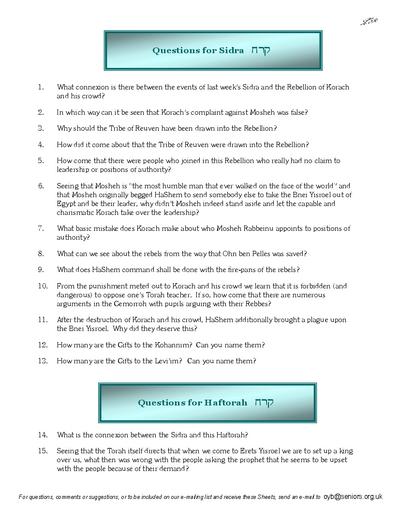
4. The Sidra and the Haftorah share the same theme — leadership. The first part of the Sidra tells of the challenge of Korach and his crowd who rose up against the leadership of Mosheh our Teacher, with dire results and an all-important lesson. And the Haftorah tells of the events of a later time and what amounted to the rejection by the Jewish People of the leadership of the prophet Shmuel because they wanted a king, as they put it, “like all the nations that are round about us.”
5. Being ruled by a king is not a bad thing. HaShem Himself commands that “when you are come into the Land which I am giving to you,” we are to set a king over us. But the Torah’s ideal is that our king should be not so much a warrior-king like the peoples around us (which was the kind of king that the people demanded from Shmuel) but more as a moral guide and an example of rectitude for the people, to direct them in their duties as the People of HaShem.
6. The kind of leadership that is the ideal for any particular folk or national group is bound to be different for each, as each folk and national group has a different character. Some national groups function best under firm leadership and some function best under a more gentle ruler. Some thrive best under a dictatorship, others succeed under a theocracy and yet others come out best under a democracy. There is really no system that fits all kinds of ethnic groups equally well. As far as the Jewish People is concerned, the best system, the one that is going to serve the majority of the people and will allow and encourage the freedom of man to thrive and yet control that freedom that it should not spin out of control, is a benign dictatorship. It is this kind of leadership that the Torah advocates for the Jewish People, a monarchy with the built-in safeguard of a king under the All-Seeing Authority of HaShem, the Supreme King of all Kings, a monarch at the same time invested with authority by HaShem and indeed representative of His Authority (for which reason the law is that "מלך שמחל על כבודו אין כבודו מחול" — “a king who forgoes his respect, his respect is not forgone”) yet beholden to His People and never their overlord.
7. To Shmuel it was clear that the people’s intentions for a king were at variance to the king ideal of the Torah and he felt this demand was actually more a rejection of his leadership than a request for a king. In any case, Shmuel knew that for the Jewish People, the time was not yet ripe for a king. They were still at the stage of development as a nation that would benefit from a leader-prophet. In addition, he suspected that their demand for a king, even if perhaps they did not realize this themselves, was an attempt by the people to control their leader as was the case with the foreign peoples round about them. Another thing that worried Shmuel was that every radical change of leadership is a potential for national instability and can be an invitation to the external enemies of the Jewish People to take advantage of the uncertainty of the transition. He queried why the leadership could not pass over to his sons. After all, they had seen their father in action and learned at his feet the skills necessary to govern. But the people knew that great though they were, the sons of Shmuel were not as great as their father, and they were insistent. They wanted a king.
8. Even though the Torah advocates the setting up of a king (as mentioned above) with all that, Shmuel was concerned that there was hardly a human being really worthy of having such absolute authority invested in him. In an attempt to discourage the people from persisting in their demand, Shmuel described for them the power that is invested in the king and how it is liable to be abused. He was worried, in those famous words, that “power corrupts and absolute power corrupts absolutely.” Sadly, the great majority of kings in our history did prove him right, not necessarily in the matter of the corruption of power (never was there a Jewish king who was anything like the megalomaniacs of the non-Jewish world) but more in the misuse of their position and bad example of waywardness and disloyalty to HaShem and His Torah.
9. Thus it was that HaShem chose the first human king for His people, the righteous Shaul. When he presented Shaul to the assembled people, they rejoiced. But there were a few sceptics who questioned the choice of this humble, self-effacing man as king and it was only after his success in mustering the people and leading them in battle against their belligerent enemies that the people unanimously agreed that Shaul was to be their king.
10. Our Haftorah describes the further meeting of the people with Shmuel to establish Shaul as king, this time with the agreement of everyone. He reminds them how he has served them selflessly all his life (they readily attested that this was so) and in fact under the burdens of leadership he had grown prematurely old. (Shmuel was only 52 when he died.) As he prepares to step down and completely hand over the Nation’s leadership to the new King, Shmuel asks the gathered people to speak up and bring to his attention any grievance, any wrongdoing or any unfair advantage that he might have taken of anybody, so that he can rectify it. Not even a single person could recall any such fault at any time in the life of the venerable and respected prophet who has served the people throughout his life with such concern and such care. As his parting message as their leader, Shmuel reprimands the people about their occasional less than full commitment to the Torah and he forcefully warns them all that they, with their king, would find peace and security, individually and nationally, only if they remained loyal to HaShem and His Torah.