Sidra of the Week Korach
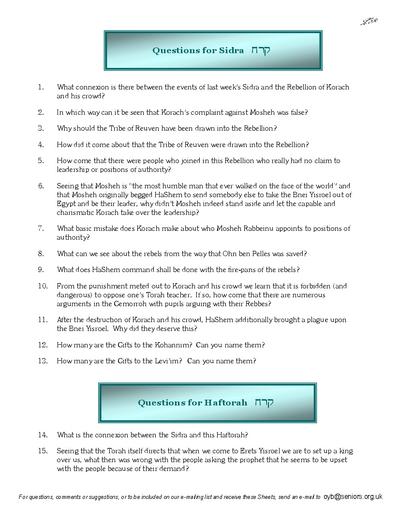
1. This week’s Sidra is given up, in the main, to the Rebellion of Korach and his crowd against Mosheh our Teacher. One of the reasons that HaShem has included the report of this Rebellion in His Torah is to warn those in later generations who might perhaps claim that no-one ever challenged Mosheh’s authority because the people of that time were intimidated by Mosheh, or because they felt indebted to him for leading them out from their slavery in Egypt. It was for that reason, they might later have said, that all the people of that time accepted whatever Mosheh told them. HaShem therefore publicizes in His Torah that there was indeed a revolt against Mosheh — and the rebels were not small people, either. The rebellion was put down and the rebels were punished in such a spectacular way so that they shall serve as a warning for all time.
2. Korach ben Yitzhor ben Ke’hos ben Levi, a cousin of Mosheh, prompted by pride and jealousy (and too much wealth) rebels against the Authority of Mosheh our Teacher. He incites a large number of prominent people, mainly from his neighbouring tribe, Reuven (whom he persuaded to also now claim the right to lead the People as they were the Tribe descended from the firstborn son of Yaakov) to join him in his rebellion, claiming that, “All the Nation is holy and there’s no need for Mosheh to be their leader.” (And anyhow, if there is to be a Prince of the families of Ke’hos, it should be him and not Elitzoffon ben Uzziel, a younger cousin, who had been appointed by Mosheh.)
Mosheh Our Teacher and Korach — The Family Connexion
3. The Rebellion of Korach occurred shortly after the episode of the Spies. In fact, had Korach tried to raise his Rebellion against Mosheh our Teacher at any other time, not only would the Jewish people have dismissed his claims out of hand but indeed in all probability they would have killed him for even attempting to deny the Divine Authority that Mosheh represented. The only reason that the Rebellion of Korach attracted some supporters and sympathizers was because Korach cynically utilized the hopelessness and blank despondency of the Jewish people at that particular time. For as a result of the sin of the Spies the people had been told that they themselves would not be allowed to come to the Promised Land. Because of its faithlessness, HaShem had decreed that that generation was doomed to die in the Wilderness: it would be their children who would take possession of the Land. [ See last week’s SIDRA OF THE WEEK : שלח לך.] It was because of this decree that Korach was able to drum-up support amongst the dejected and desolated people. For any revolution depends for its support upon public dissatisfaction: when people are satisfied with things, they will not support a revolution, however righteous its cause might claim to be.
4. Initially, Korach did not openly challenge the laws that were taught to us by Mosheh. Ostensibly, Korach was concerned only with the appointment of people to positions of authority. He claimed to be concerned mainly with the authority invested in Mosheh our Teacher, which he said was too great; he was worried about the power of the office of Kohen Ga’dol invested in Aharon (Mosheh’s brother) which he said was due to nepotism; and (and this was the main point of contention for Korach and the final straw which spurred him to revolt) he was disappointed with the appointment of Elitzoffon ben Uzziel to be the Prince of the Ke’hosites, whereas he, Korach, was not given any high position despite his great wealth and his not inconsiderable prominence. Nevertheless, by challenging these appointments, Korach insinuated that they were made by Mosheh himself. He denied that these appointments were by the command of HaShem, and, by extension, he in effect implied that all that Mosheh had commanded us in the Name of HaShem was Mosheh’s own invention. Korach was saying that the whole Torah — besides the “Ten Commandments” which were proclaimed publicly and so spectacularly at Mount Sinai — came from Mosheh and not from HaShem. He insinuated that the words, “HaShem spoke to Mosheh ...” were not true.
5. It was because of this outrageous and dangerous accusation, striking as it did at the very foundations of the Torah, that Mosheh our Teacher, the true servant of HaShem and the most dedicated leader that our Nation has ever merited, was forced to ask HaShem to show in the most dramatic way that everything that Mosheh had done and everything that he had taught us was not from Mosheh, as Korach implied, but was indeed from HaShem Himself. However much he shrank from asserting his authority, Mosheh our Teacher the most humble man who ever walked upon the face of the earth, saw that it was his sad duty to ask HaShem that He demonstrate once and for all that תורה מן השמים, that the Torah comes from HaShem. For if Korach should go unpunished for his false accusation that Mosheh’s words are his own, even in this one matter of the appointments to high position, then it would be only one step further to say that any of the Torah — or indeed even all of the Torah, which likewise was taught to us by Mosheh — all emanated not from HaShem but from Mosheh himself. Korach’s accusation about these appointments was tantamount to his denying the Divine Authority of all that Mosheh taught. In future generations others will rise up and follow Korach’s villainous example and they too will claim that they may abrogate the law of the Torah given through Mosheh, “for it is not the Law of G-d but it is the Law of Moses.”
6. It was only for the sake of the future of the Jewish People, whose very existence depends upon total loyalty to the Torah of HaShem in its entirety and on nothing else, that Mosheh was forced to ask HaShem to show clearly that anyone who denies the teachings of the Chachommim in every generation (and Mosheh in his time) thereby denies the Torah of HaShem.
7. The Rebellion of Korach and his crowd against Mosheh was nothing less than a rebellion against HaShem, and Korach’s punishment serves as a warning to all those who would question the authority of the Torah and our great Teachers, our Chachommim, the successors of Mosheh our Teacher, for כל החולק על רבו כחולק על השכינה — “Whoever would dare to argue against the authority of his Torah teacher is considered as if he argues against HaShem.”
8. Despite Mosheh’s attempts to explain that the appointments to positions of leadership are not made by Mosheh but are commanded by HaShem Himself, Korach persists in stirring-up his Rebellion and he is warned of the consequences that are bound to follow. Mosheh begs HaShem to spare those of the Jewish People who are only the simpleminded followers of Korach and his crowd, but to make an example of the ringleaders so that it shall be seen for all time that in all that he does and says, Mosheh our Teacher is acting only by the direct command of HaShem.
9. The next morning, at the terrible confrontation of Korach and his crowd with Mosheh and Aharon, the earth splits open, just as Mosheh had foretold, and swallows-up the crowd of rebels and all their possessions, and a fire from Heaven consumes the 250 ringleaders (with the exception of Ohn ben Pelles, whose wife saved him from further involvement after the initial protestation). The sons of Korach, too, were miraculously saved from the fate of their father when they repented in the last moment and showed respect to Mosheh our Teacher and thus disassociated themselves from the Rebellion led by their father. The only things remaining are the sacred fire-pans of incense by which the rebels had been tested. HaShem later commands that these fire-pans are to be hammered flat and fixed to the great Copper Altar, as a reminder of the dangers of ever rebelling against the Word of HaShem given through His chosen prophets. (Centuries later, the Gemorroh tells us, those who had been swallowed-up by the earth could be heard proclaiming for all time: "משה אמת ותורתו אמת" — “Mosheh is true, and his Torah is true!”)
10. HaShem sends a terrible plague sweeping through the Camp of the Jewish People, killing those who persisted in their murmurings and who had some sympathy with the Rebellion of Korach, until Aharon, the Kohen Ga’dol, acting upon Mosheh’s orders, rushes to them with the same incense which was so fatal to the rebels, and the plague stops immediately.
11. At the command of HaShem, the staffs of the Princes of the Tribes and the staff of Aharon’s tribe, Levi, are placed together in the Mishkan. Only this staff of Aharon, alone among all the others, blossoms forth with buds and fruit, thus demonstrating that the Tribe of Levi is to be the special “Legion of the King.”
12. The special duties of the Tribe of Levi and their responsibilities to the Jewish People are taught in this week’s Sidra, as are the special gifts to the Tribe of Levi and to the Kohannim — the מתנות כהונה — that HaShem commands the Jewish People to give to them. These include Terumoh, certain meat of the Korbonnos, the First Fruits, the animal firstborn, etc., for the Kohannim, and Maaser for the Levi’im.
For the explanation of the Haftorah of Sidra קרח please go to HAFTORAHS.
Related Articles




