Korach's Jealousy and the Dispute over Leadership
Parsha B'Iyun | June 27, 2025
Print This Article
View Original PDF

Korach's Jealousy and the Dispute over Leadership

Parsha B'Iyun | December 10, 2025

Another topic Chazal discuss is Korach’s jealousy of Elitzaphan ben Uziel’s leadership. When Korach went to war, he didn’t actually want Elitzaphan’s top role. He wanted to be the Kohen Gadol. But to hide this true intention, he latched onto the idea of wanting to set the criteria for how roles were given out. He didn’t dispute that Moshe Rabbeinu deserved to be king, says the Siftei Chachamim. Everyone agreed that only Moshe was in the heights of Heavens for forty days and nights and nobody else brought down the luchot. Not even Korach disputed Moshe’s role as leader. But what does he dispute? Moshe’s ability to then appoint the next leader – i.e., the Kohen Gadol, his brother. Korach said, “It is justified that you lead the nation, but what gives you the right to empower others? There needs to be criteria as to how that’s done.” The Ohr HaChaim Hakadosh expands: Korach said, “If we go by who’s greater, I’m greater than Elitzaphan ben Uziel. I’m greater than him, so the role is mine. If we go by spiritual greatness, I’m greater than Aharon the Kohen. So, the role is mine. Please decide. If we go by age, I’m older than Elitzaphan ben Uziel, so it’s mine. If we go by importance, I’m more important than Aharon – I’m the son of oil.” In a sefer called Mishulchan Rabbi Eliyahu Baruch Finkel, he says it was all a disguise. Korach latched onto Elitzaphan ben Uziel, but his dispute was really about the Kehuna. In order for them not to realize he targeted the Kehuna, Korach said, “I don’t care; I’m already a bearer of the Aron and not seeking a role for myself. I just want proper criteria set. That’s all I demand.”

How did Korach pull it off? He dragged 253 people with him, all heads of Sanhedrin and notable men. He took Datan, Aviram, and On ben Pelet along too. Chazal say he took eleven small Sanhedrins in total, as each small Sanhedrin is twenty-three, resulting in 253 people.

The Gemara (Bava Batra 74a) tells of Rava bar bar Chana crossing the Sinai Desert. He had a Yishmaeli guide who said, “Rabbi, want to see historical sites of Bnei Yisrael? There are a few in the desert.” He said, “Why not? Same price?” The guide said, “No, there’s an extra charge, naturally.” He asked, “What’s special to see in the desert?” The guide responded, “There’s Har Sinai, where they received the Torah; there’s the place of Korach’s swallowing; and the place where those in the wilderness all died. Want to see them?” Rav bar bar Chana answered, “Sure, why not, take me.” We won’t go into everything detailed in the Gemara, but instead skip to the place of Korach’s swallowing. 1500 years after the incident with Korach and his posse being swallowed, smoke was still rising from the spot. The Yishmaeli took a spear, put wet cotton on it, inserted it into the hole, pulled it out – and it was completely charred! Wet cotton, inserted into the hole, came out charred. Why cotton? Why water? Why a spear? All great questions to study over a long Shabbat afternoon!

The Gemara says, every month, the Yishmaeli said, they turn them like meat in a pot. Like you grill steak, flipping it over periodically. And they cry out: מֹשֶׁה וְתוֹרָתוֹ אֱמֶת וְהֵן בַּדָּאִין – Moshe is true, and his Torah is true, and they are liars. The guide said, “Put your ear to the ground and you’ll hear them crying!” When do they turn them? Is it mid-month? At the end of the month? On a random day in the month? The Rashbam says it’s every Rosh Chodesh. Why Rosh Chodesh? The Maharsha explains that Korach had an idea on how to rally everyone. He proposed a new law: Every month, a different Kohen Gadol. Everyone gets a turn, from each tribe, in the month most appropriate for them, and there’s no pressure on anyone that way. That was his proposal. That’s how he pulled everyone in: “Guys, I’m not worried about myself; I’m all set. I just want to set criteria.” Hakadosh Baruch Hu says, “Criteria? No problem. Every month, I’ll set your criteria. I set a criterion. I chose Aharon the Kohen; he’s my criteria. Got it? I chose him. You want criteria? Every month, I’ll give you a new criterion!” Thus, the Maharsha says, every Rosh Chodesh, they turn them in the ground.
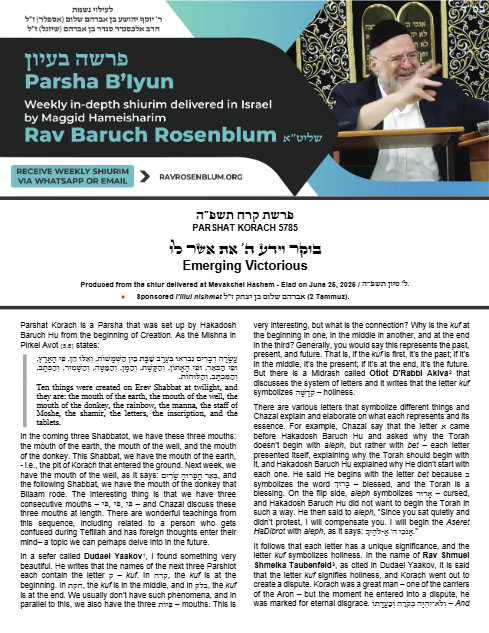

Another topic Chazal discuss is Korach’s jealousy of Elitzaphan ben Uziel’s leadership. When Korach went to war, he didn’t actually want Elitzaphan’s top role. He wanted to be the Kohen Gadol. But to hide this true intention, he latched onto the idea of wanting to set the criteria for how roles were given out. He didn’t dispute that Moshe Rabbeinu deserved to be king, says the Siftei Chachamim. Everyone agreed that only Moshe was in the heights of Heavens for forty days and nights and nobody else brought down the luchot. Not even Korach disputed Moshe’s role as leader. But what does he dispute? Moshe’s ability to then appoint the next leader – i.e., the Kohen Gadol, his brother. Korach said, “It is justified that you lead the nation, but what gives you the right to empower others? There needs to be criteria as to how that’s done.” The Ohr HaChaim Hakadosh expands: Korach said, “If we go by who’s greater, I’m greater than Elitzaphan ben Uziel. I’m greater than him, so the role is mine. If we go by spiritual greatness, I’m greater than Aharon the Kohen. So, the role is mine. Please decide. If we go by age, I’m older than Elitzaphan ben Uziel, so it’s mine. If we go by importance, I’m more important than Aharon – I’m the son of oil.” In a sefer called Mishulchan Rabbi Eliyahu Baruch Finkel, he says it was all a disguise. Korach latched onto Elitzaphan ben Uziel, but his dispute was really about the Kehuna. In order for them not to realize he targeted the Kehuna, Korach said, “I don’t care; I’m already a bearer of the Aron and not seeking a role for myself. I just want proper criteria set. That’s all I demand.”

How did Korach pull it off? He dragged 253 people with him, all heads of Sanhedrin and notable men. He took Datan, Aviram, and On ben Pelet along too. Chazal say he took eleven small Sanhedrins in total, as each small Sanhedrin is twenty-three, resulting in 253 people.

The Gemara (Bava Batra 74a) tells of Rava bar bar Chana crossing the Sinai Desert. He had a Yishmaeli guide who said, “Rabbi, want to see historical sites of Bnei Yisrael? There are a few in the desert.” He said, “Why not? Same price?” The guide said, “No, there’s an extra charge, naturally.” He asked, “What’s special to see in the desert?” The guide responded, “There’s Har Sinai, where they received the Torah; there’s the place of Korach’s swallowing; and the place where those in the wilderness all died. Want to see them?” Rav bar bar Chana answered, “Sure, why not, take me.” We won’t go into everything detailed in the Gemara, but instead skip to the place of Korach’s swallowing. 1500 years after the incident with Korach and his posse being swallowed, smoke was still rising from the spot. The Yishmaeli took a spear, put wet cotton on it, inserted it into the hole, pulled it out – and it was completely charred! Wet cotton, inserted into the hole, came out charred. Why cotton? Why water? Why a spear? All great questions to study over a long Shabbat afternoon!

The Gemara says, every month, the Yishmaeli said, they turn them like meat in a pot. Like you grill steak, flipping it over periodically. And they cry out: מֹשֶׁה וְתוֹרָתוֹ אֱמֶת וְהֵן בַּדָּאִין – Moshe is true, and his Torah is true, and they are liars. The guide said, “Put your ear to the ground and you’ll hear them crying!” When do they turn them? Is it mid-month? At the end of the month? On a random day in the month? The Rashbam says it’s every Rosh Chodesh. Why Rosh Chodesh? The Maharsha explains that Korach had an idea on how to rally everyone. He proposed a new law: Every month, a different Kohen Gadol. Everyone gets a turn, from each tribe, in the month most appropriate for them, and there’s no pressure on anyone that way. That was his proposal. That’s how he pulled everyone in: “Guys, I’m not worried about myself; I’m all set. I just want to set criteria.” Hakadosh Baruch Hu says, “Criteria? No problem. Every month, I’ll set your criteria. I set a criterion. I chose Aharon the Kohen; he’s my criteria. Got it? I chose him. You want criteria? Every month, I’ll give you a new criterion!” Thus, the Maharsha says, every Rosh Chodesh, they turn them in the ground.

PDF Preview